Rejoignez-nous pour un voyage dans le monde des livres!
Ajouter ce livre à l'électronique
Grey
Ecrivez un nouveau commentaire Default profile 50px
Grey
Abonnez-vous pour lire le livre complet ou lisez les premières pages gratuitement!
All characters reduced
The Diary of John Evelyn - Reflections of a Renaissance Man: Insights from a 17th Century English Diarist - cover

The Diary of John Evelyn - Reflections of a Renaissance Man: Insights from a 17th Century English Diarist

John Evelyn

Maison d'édition: Good Press

  • 0
  • 0
  • 0

Synopsis

In "The Diary of John Evelyn," the renowned 17th-century English writer delivers an intimate and unvarnished account of his life, capturing the intricacies of social, political, and cultural shifts during the Restoration period. Written in a reflective and eloquent literary style, the diary juxtaposes personal anecdotes with broader historical events, offering a rare glimpse into the sentiments of a gentleman-scholar navigating the tumultuous landscape of his time. Evelyn's meticulous documentation of his observations'Äîranging from nature to art, politics, and scientific inquiry'Äîpositions the work as a vital primary source for understanding the era's intellectual and cultural milieu. John Evelyn (1620-1706), a prominent figure in the Royal Society and a proto-environmentalist, was deeply influenced by the scientific advancements and prevailing artistic trends of his day. His background as a nobleman allowed him unique access to influential circles where he engaged in discussions on horticulture, architecture, and philosophy. This cross-pollination of interests is evident throughout his diary, which reveals not only the public endeavors of an accomplished man but also his private reflections and moral deliberations. For those interested in the interplay of personal experience and historical narrative, "The Diary of John Evelyn" serves as an indispensable text. It is highly recommended for readers seeking a comprehensive understanding of early modern Britain through the eyes of a perceptive and engaged mind. Evelyn's reflections provide a rich tapestry of thought, making this work not only informative but profoundly relatable.
Disponible depuis: 21/12/2023.
Longueur d'impression: 733 pages.

D'autres livres qui pourraient vous intéresser

  • Great Gatsby The: The Original 1925 Edition - cover

    Great Gatsby The: The Original...

    F. Scott Fitzgerald

    • 0
    • 0
    • 0
    The Great Gatsby is a 1925 novel by American writer F. Scott Fitzgerald. Set in the Jazz Age on Long Island, near New York City, the novel depicts first-person narrator Nick Carraway's interactions with mysterious millionaire Jay Gatsby and Gatsby's obsession to reunite with his former lover, Daisy Buchanan. 
    The novel was inspired by a youthful romance Fitzgerald had with socialite Ginevra King, and the riotous parties he attended on Long Island's North Shore in 1922. Following a move to the French Riviera, Fitzgerald completed a rough draft of the novel in 1924. He submitted it to editor Maxwell Perkins, who persuaded Fitzgerald to revise the work over the following winter. After making revisions, Fitzgerald was satisfied with the text, but remained ambivalent about the book's title and considered several alternatives. Painter Francis Cugat's cover art greatly impressed Fitzgerald, and he incorporated aspects of it into the novel. 
    After its publication by Scribner's in April 1925, The Great Gatsby received generally favorable reviews, though some literary critics believed it did not equal Fitzgerald's previous efforts. Compared to his earlier novels, Gatsby was a commercial disappointment, selling fewer than 20,000 copies by October, and Fitzgerald's hopes of a monetary windfall from the novel were unrealized. When the author died in 1940, he believed himself to be a failure and his work forgotten.
    Voir livre
  • 384 Months: The Sacrificial Lamb - cover

    384 Months: The Sacrificial Lamb

    Anthony Gonzalez

    • 0
    • 0
    • 0
    How could a man who had the world as his playground while the manager of a platinum-selling rap group suddenly lose it all? Anthony “Geezy” Gonzalez writes in his own words about how his life’s circumstances and choices led him from being called “The Man” on the streets to a federal prisoner. Feel his joy, pride, and even his shame as he takes you from his beginnings on Southgate Ave. in Virginia Beach, around the world with The Clipse, and into a courtroom where he hears his sentence: 384 Months.
    Voir livre
  • Fierce and Delicate - Essays on Dance and Illness - cover

    Fierce and Delicate - Essays on...

    Renee K. Nicholson

    • 0
    • 0
    • 0
    Renée Nicholson’s professional training in ballet had both moments of magnificence and moments of torment, from fittings of elaborate platter tutus to strange language barriers and unrealistic expectations of the body. In Fierce and Delicate, she looks back on the often confused and driven self she had been shaped into—always away from home, with friends who were also rivals, influenced by teachers in ways sometimes productive and at other times bordering on sadistic—and finds beauty in the small roles she performed. When, inevitably, Nicholson moved on from dancing, severed from her first love by illness, she discovered that she retained the lyricism and narrative of ballet itself as she negotiated life with rheumatoid arthritis. 
    An intentionally fractured memoir-in-essays, Fierce and Delicate navigates the traditional geographies of South Florida, northern Michigan, New York City, Milwaukee, West Virginia, and also geographies of the body—long, supple limbs; knee replacements; remembered bodies and actual. It is a book about the world of professional dance and also about living with chronic disease, about being shattered yet realizing the power to assemble oneself again, in a new way.
    Voir livre
  • The Things I Came Here With - A Memoir - cover

    The Things I Came Here With - A...

    Chris MacDonald

    • 0
    • 0
    • 0
    “Does it hurt?” When you’re a tattoo artist, that’s the most universal question. For Chris MacDonald, the answer is simple: hurts less than a broken heart. Those words are painted above the entrance to his shop, Under My Thumb Tattoos, as a reminder.
    		 
    Chris and his brothers were as wild as the wind, in their house among the fields of Alliston, Ontario, when their parents divorced. Shell-shocked, they were uprooted and brought to Toronto by their dad. Their mother’s mental illness worsened in the aftermath, and she disappeared. As a teenager, Chris left home and found himself immersed in the city’s underbelly, a world where drugs, skateboarding, and punk rock reigned. Between the youth shelters, suicidal thoughts, and haunted apartments, a light shined: and it was art.
    		 
    He eventually found himself following the path of his brother, Rob, and pursuing life as a tattooist. Then, at the height of a destructive summer, everything changed: he met Megan, the girl who would become his rock of ages.
    		 
    This remarkable memoir examines what tattooing means to MacDonald and traces the connection his artistic motives have to both his family and childhood. The Things I Came Here With is about how crucial our past is to understanding our future, but it’s also a love letter to his daughter about the importance of expression, life’s uncertainty, and beauty.
    Voir livre
  • The Lion of Round Top - The Life and Military Service of Brigadier General Strong Vincent in the American Civil War - cover

    The Lion of Round Top - The Life...

    Hans G. Myers

    • 0
    • 0
    • 0
    “This military biography clearly and informatively rescues from an undeserved obscurity one of the Union’s key commanders at the battle of Gettysburg.” —Midwest Book Review Citizen-soldier Strong Vincent was many things: Harvard graduate, lawyer, political speaker, descendent of pilgrims and religious refugees, husband, father, brother. But his greatest contribution to history is as the savior of the Federal left flank on the second day at Gettysburg, when he and his men held Little Round Top against overwhelming Confederate numbers. Forgotten by history in favor of his subordinate, Joshua Lawrence Chamberlain, Vincent has faded into relative obscurity in the decades since his death. This book restores Vincent to his rightful place among the heroes of the battle of Gettysburg: presenting his life story using new, never-before-published sources and archival material to bring the story of one of the most forgotten officers of the American Civil War back to the attention of readers and historians.“This is a well-researched and well-written book, and the author makes a strong case for Colonel Vincent’s essential role in the union victory at Gettysburg.” —The Journal of America’s Military Past “Erie, Pennsylvania historian Hans G. Myers brings to life an overlooked Gettysburg hero . . . a good, well-researched biography certainly worth the read.” —Maine at War“Readers of battle history, in particular the voluminous literature on Gettysburg, will find interest in both the short life of Strong Vincent and the hereto unheralded role his decisions played in saving the Federal left flank at Little Round Top.” —Journal of MilitaryHistory
    Voir livre
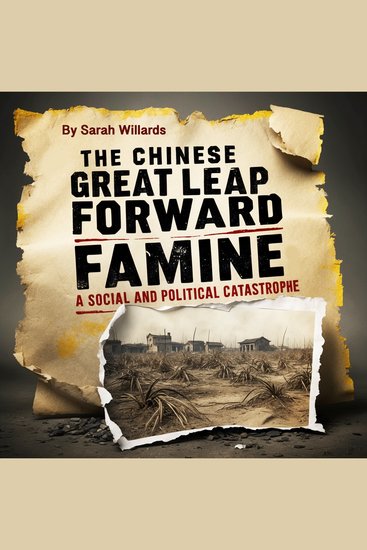
  • The Chinese Great Leap Forward Famine - A Social and Political Catastrophe - cover

    The Chinese Great Leap Forward...

    Sarah Willards

    • 0
    • 0
    • 0
    The origins of the Great Leap Forward are deeply rooted in the political ambition and ideological vision of Mao Zedong, the founding leader of the People’s Republic of China. Following the success of the Communist revolution in 1949, Mao sought not only to rebuild a war-torn nation but to rapidly transform it into a socialist utopia capable of rivaling the industrial powers of the West. By the mid-1950s, China had already launched its First Five-Year Plan, modeled after the Soviet approach to centralized economic planning. Encouraged by early gains in heavy industry, Mao envisioned a second phase of development that would leap over traditional stages of economic growth. 
    At the heart of this vision was a push for mass mobilization. Mao believed that the sheer size of China's population could be harnessed as a revolutionary force capable of achieving miraculous feats. The Great Leap Forward, initiated in 1958, was designed to propel China into a modern communist society by emphasizing agricultural collectivization and rural industrialization simultaneously. Rather than relying on expert knowledge or slow-paced industrial planning, Mao favored decentralized enthusiasm and ideological commitment, trusting that the collective will of the people would overcome any technical limitations. 
    One of the most radical elements of this plan was the establishment of people’s communes, which replaced the traditional family unit and private farming with large-scale collective labor. Households were merged into communes comprising thousands of individuals, who would eat, sleep, and work under strict communal arrangements. The idea was to increase efficiency and free up labor for industrial production, especially in rural areas where backyard furnaces were set up to produce steel. This was accompanied by an aggressive campaign to eliminate what were seen as capitalist tendencies, including private plots and individual incentives.
    Voir livre