Join us on a literary world trip!
Add this book to bookshelf
Grey
Write a new comment Default profile 50px
Grey
Subscribe to read the full book or read the first pages for free!
All characters reduced
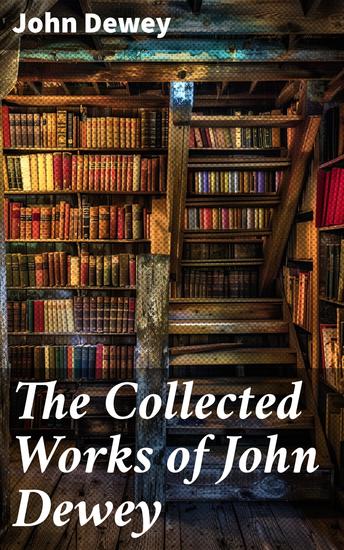
The Collected Works of John Dewey - American School System Theory of Educational Philosophy Psychological Works Political Writings: 40 Titles in One Volume - cover

The Collected Works of John Dewey - American School System Theory of Educational Philosophy Psychological Works Political Writings: 40 Titles in One Volume

John Dewey

Publisher: Good Press

  • 0
  • 0
  • 0

Summary

The Collected Works of John Dewey is a monumental compilation that encapsulates the vast intellectual breadth and philosophical insights of one of the 20th century's most influential thinkers. Spanning various themes such as education, democracy, and the interplay between experience and knowledge, these works evoke a pragmatic literary style that emphasizes the importance of human experience in shaping thought and action. Dewey's writings resonate within the modernist literary context, often reflecting the complexities of an evolving societal landscape through a lens that seeks to bring philosophical abstractions into practical application. John Dewey (1859-1952), an instrumental figure in the development of pragmatism and progressive education, was not only a philosopher but also a public intellectual guided by a commitment to social reform. His experiences as an educator and as a participant in the social issues of his times deeply informed his writings, making his views on education and democracy relevant not just philosophically, but also in practical terms for a society eager for change. For those seeking a comprehensive understanding of modern educational philosophy and democratic ideals, The Collected Works of John Dewey serves as an essential resource. It invites readers to engage with Dewey's transformative ideas and to consider their implications for contemporary society, making this collection an invaluable contribution to both scholars and general readers alike.
Available since: 12/04/2023.
Print length: 3637 pages.

Other books that might interest you

  • Open-Eyed Adoption - Real Help for those Parenting Adoptees - cover

    Open-Eyed Adoption - Real Help...

    Robin Hitt

    • 0
    • 0
    • 0
    Open-Eyed Adoption presentsa compassionate look at uncovering the mysteries of the adoptive parent/adoptee relationshipOpen-Eyed Adoption is written for the purpose of supplying a resource for those who have adopted children as well as those who are considering the possibility of doing so. Often adoptive parents are ill-prepared and uninformed as to the unique challenges that raising adopted children presents. For instance, the earlier a parent knows that an adoptee has trauma from the beginning, the better equipped they can be to adapting their parenting style vs what may have been the style of their own parents. Being unaware of this, they can be confused and discouraged as to what they are seeing and why their adopted child responds the way they do. They may even be bewildered, due to the amount of love they give, to see a different response than they expect. This book gives resource and tools to the parent for better understanding of what may be happening in the heart of their child. The information contained in Open-Eyed Adoption can also be used when parents are communicating with their adult adopted children. It encourages parents to look at parenting from different angles when it comes to the adoptee. Furthermore, Open- Eyed Adoption dispels the myth that they are all alone, takes a look at the importance of self-kindness and shows the way to get the support they need.
    Show book
  • Pocahontas - The Real History of the Native American Peacemaker - cover

    Pocahontas - The Real History of...

    Kelly Mass

    • 0
    • 0
    • 0
    Pocahontas was a Native American woman from the Powhatan-speaking tribe, most famous for her connection to the colonial settlement at Jamestown, Virginia. She was the daughter of Powhatan, the powerful chief of Tsenacommacah, a confederation of about 30 Algonquian-speaking tribes in the Tidewater region of Virginia. Powhatan held dominion over a vast territory, which made Pocahontas a figure of significant influence within her own people’s complex political and social systems. 
    In 1613, during a conflict between the Powhatan Confederacy and the English settlers, Pocahontas was captured by the English. She was held hostage for ransom in an effort to leverage peace negotiations with her father. During her captivity, Pocahontas experienced a profound transformation, converting to Christianity and being baptized with the name Rebecca. Her conversion was seen as an opportunity by the English to showcase their success in "civilizing" the native population.
    Show book
  • Return to Growth Volume One - How to Fix the Economy - cover

    Return to Growth Volume One -...

    Jon Moynihan

    • 0
    • 0
    • 0
    The UK has, in recent years, been suffering from what is nothing short of an economic crisis. Growth has now completely stalled in those western democracies, the UK included, where high government spending and high taxes have steadily burgeoned, decade after decade. Free-market economies now threaten to leave us behind in terms of wealth, opportunity and standards of living. At the end of Rishi Sunak's 2024 government, expenditure was at 45 per cent of GDP and taxes were 36 per cent and rising – yet still nowhere near sufficient to cover public expenditure. The government's net annual borrowing is now a completely unsustainable 4.4 per cent of GDP, with our overall national debt growing rapidly and alarmingly.
    In this arresting and powerful manifesto for economic change, Jon Moynihan analyses the UK's decades-long stagnant economy and looks at what can be done to resuscitate it. Combining rigorous research with unparalleled business experience, he explores the key dynamics affecting economic growth, ranging from government borrowing, expenditure, tax and regulation to the way national resources are deployed on non-productive and futile, growth-stifling endeavours.
    Ultimately, Moynihan shows that unless we act now to reverse the decline, by radically restructuring our economy to stimulate economic growth, the UK risks stagnation, financial collapse and a long-term disintegration in our standard of living. Ignore his warning at your peril.
    Show book
  • Railroad Robber Barons The: The Lives of the Magnates Who Dominated America’s Rail Industry in the 19th Century - cover

    Railroad Robber Barons The: The...

    Editors Charles River

    • 0
    • 0
    • 0
    The Gilded Age and the dawn of the 20th century are often remembered as an era full of monopolies, trusts, and economic giants in heavy industries like oil and steel. Men like Andrew Carnegie built empires like Carnegie Steel, and financiers like J.P. Morgan merged and consolidated them. The era also made names like Astor, Cooke, and Vanderbilt instantly recognizable across the globe. Over time, the unfathomable wealth generated by the businesses made the individuals on top incredibly rich, and that in turn led to immense criticism and an infamous epithet used to rail against them: robber barons.  
    	Dozens of men were called “robber barons”, and the industrial might wielded by some of these men in the late 19th century directly led to a public backlash and made President Teddy Roosevelt the “trust buster”, and there has since been countless regulations to attempt to avoid the types of monopolies found over 100 years ago. However, many 20th century historians and writers pushed back against the allegations hurled at the “robber barons” and even took issue with the name. Libertarian writer John Stossel argued, “They weren't robbers, because they didn't steal from anyone, and they weren't barons - they were born poor...” Ironically, one of America’s most famous robber barons, Andrew Carnegie, epitomized the American Dream, migrating with his poor family to America in the mid-19th century and rising to the top of the business world in his adopted country. And like Carnegie, railroad tycoon Cornelius Vanderbilt set a precedent of sorts with his philanthropy, most notably his gift to Vanderbilt University, which bears his name. Similarly, the West Coast's most famous railroad mogul became Leland Stanford, who also bequeathed a prestigious university after making it to the top of the industry.
    Show book
  • Thrive Through Vagus Power Secrets - "Elevate your journey! Experience dynamic audio lessons designed to unleash the power of Vagus Secrets" - cover

    Thrive Through Vagus Power...

    Orson Falloway

    • 0
    • 0
    • 0
    Thrive Through Vagus Power Secrets: A Simplified Approach with Comprehensive Insights** 
    Are you eager to advance in your career and enhance your understanding of emotional well-being?  
    Searching for an all-inclusive guide that equips you with everything needed to empower your mind and transform your emotional health?  
    Your search ends here! 
    This audiobook serves as your ultimate companion for deepening your knowledge, applying your skills, and actively engaging in practical exercises. With this resource, you're set on the path to success. 
    Now updated for the latest structure and insights. 
    Key features of this enhanced guide include: 
    - In-depth exploration of emotional well-being techniques  
    - Comprehensive explanations for transforming your emotional health 
    - Effective strategies for personal growth and practical application  
    Our guide stands out due to its extensive coverage, which is vital for achieving your goals. Concepts are examined thoroughly rather than just touched upon. 
    Please note that this guide operates independently and is not affiliated with any official entity regarding emotional health. 
    Crafted with clarity and ease of understanding, our guide ensures seamless transitions between topics. Bid farewell to complicated jargon and embrace straightforward, precise, and technically accurate content. 
    So, why hesitate? Click the BUY NOW button, secure your guide, and embark on your journey toward mastering your emotional well-being!
    Show book
  • Benin Empire - Art Warfare and the Kingdom of Bronze - cover

    Benin Empire - Art Warfare and...

    Rolf Hedger

    • 0
    • 0
    • 0
    The Benin Empire, one of the most powerful and influential kingdoms in West Africa, flourished for over 1,000 years. Its capital, Benin City, located in present-day southern Nigeria, was an epicenter of art, culture, and political power. The empire’s historical significance extends beyond its impressive architectural feats, remarkable artistry, and military prowess, as it was also a hub of trade and diplomacy. 
    The origins of the Benin Empire can be traced back to the early 11th century, with a history deeply intertwined with the Kingdom of Ife, from which the Benin people are believed to have descended. The development of the kingdom was largely shaped by its early rulers, the Obas, whose leadership and vision helped lay the foundation for the Benin Empire. The Benin monarchy, a vital institution in the kingdom, solidified the rule of the Obas and their divine connection to the people. 
    At its peak, the Benin Empire extended its influence over a vast region in West Africa, establishing a complex political and social structure. The monarchy not only commanded political and military power but also served as a central force in religious and cultural life. The empire was renowned for its rich heritage in art, including the world-famous Benin Bronzes, which showcased the advanced craftsmanship and symbolic significance of Benin artisans. These bronzes, intricate sculptures, and plaques, which depicted scenes of royalty, warriors, and historical events, remain symbols of the empire’s grandeur.
    Show book