Join us on a literary world trip!
Add this book to bookshelf
Grey
Write a new comment Default profile 50px
Grey
Subscribe to read the full book or read the first pages for free!
All characters reduced
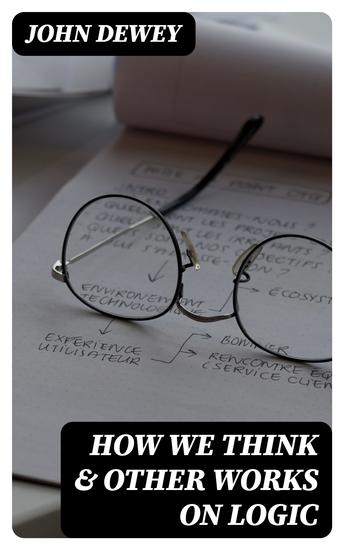
How We Think & Other Works On Logic - Leibniz's New Essays; Essays in Experimental Logic; Creative Intelligence; Human Nature & Conduct - cover

How We Think & Other Works On Logic - Leibniz's New Essays; Essays in Experimental Logic; Creative Intelligence; Human Nature & Conduct

John Dewey

Publisher: DigiCat

  • 0
  • 0
  • 0

Summary

In "How We Think & Other Works On Logic," John Dewey presents a profound examination of the processes of thought and reflection, emphasizing their practical implications for education and democratic society. Written in a clear, accessible style, this work aligns itself within the progressive educational movement of the early 20th century. Dewey critiques traditional rote learning, advocating instead for a reflective thought process that fosters critical thinking and problem-solving skills, essential for personal and societal growth. The collection serves not only as a philosophical treatise but also as a guide for educators seeking to engage students in meaningful dialogues about knowledge and inquiry. John Dewey (1859-1952) was a prominent American philosopher, psychologist, and educational reformer whose work has significantly impacted various fields, including education, psychology, and political theory. His experiences as an educator in a rapidly changing world fueled his belief in the need for experiential learning and the application of scientific methods to nurture democratic citizenship. Dewey's commitment to pragmatism and a participatory democracy shaped his ideology, leading to this influential exploration of how we think. This book is essential for educators, philosophers, and anyone interested in the intersection of thought and action in our lives. Dewey's insights challenge readers to reflect on their cognitive processes, fostering a deeper understanding of the significance of thinking in our democratic society. A must-read for those seeking to enhance their reflective practices and contribute meaningfully to their communities.
Available since: 05/17/2022.
Print length: 240 pages.

Other books that might interest you

  • Summer 2009 - A Journey of Self-Discovery Amidst the Afghanistan War - cover

    Summer 2009 - A Journey of...

    Andrew Coville

    • 0
    • 0
    • 0
    The Afghanistan war endured for two decades, involving an all-volunteer military force deployed repeatedly between 2001-2021. Over the course of these 20 years, thousands of young Americans lived through their own unique versions of the war, each marked by personal war stories and life-altering events. The war concluded on August 30th, 2021, leaving both the United States and the people of Afghanistan with a somber and perplexing aftermath. An entire generation now grapples with questions surrounding the reasons behind their sacrifices, as well as the thousands of lives lost or forever changed during the conflict. 
    This narrative presents a firsthand account of a Marine who played a small role in the Afghan War. It begins with his enlistment in the Marine Corps immediately after high school, driven by dreams of earning the prestigious title of United States Marine and serving his country in combat. The story culminates with his reentry into the civilian world, marked by the challenging task of making sense of the profound experiences he underwent. 
    The account unfolds through a journey kept by the Marine during a significant offensive in the Helmand Province in the summer of 2009. These firsthand entries, composed by a 21-year-old, are revisited 15 years later, offering a continually evolving perspective and outlook on life. This is not merely a war story, or a detailed military operation account; rather, it is a vulnerable and revealing exploration into the inner thoughts of a young man navigating the complexities of war. It delves into what he learned from those experiences as the years unfolded.
    Show book
  • Inner Space - Malibu 1971 - Dialogue 2 - cover

    Inner Space - Malibu 1971 -...

    Jiddu Krishnamurti

    • 0
    • 0
    • 0
    Inner space" - 26 March 1971. Duration: 61 minutes. 
    Is it possible to be free of the centre so that the centre doesn't create space around itself and build a wall? Can the centre be still or fade away? Can consciousness empty itself of its content? Is love within the field of consciousness?If you don't form an image now, the past images have no place. Are there environments which can be conducive to liberation? The company of the good doesn't teach me what is good and what is false or true. I have to see it.
    Show book
  • Fort Pillow and the Crater: The History of the Most Notorious Battles Where the Confederates Massacred Black Soldiers - cover

    Fort Pillow and the Crater: The...

    Editors Charles River

    • 0
    • 0
    • 0
    As far as skirmishes go, Fort Pillow was a completely unremarkable fight. Before attacking, Forrest demanded the unconditional surrender of the Union garrison, a normal custom of his, and he warned the Union commanding officer that he would not be responsible for his soldiers’ actions if the warning went unheeded. What made Fort Pillow markedly different was that a sizable amount of the Union garrison defending the Fort was comprised of black soldiers, which particularly enraged Confederate soldiers whenever they encountered those they viewed as former slaves in the field. It is still unclear exactly how the fighting unfolded, but what is clear is that an unusually high percentage of Union soldiers were killed, and the Confederates were accused of massacring black soldiers after they had surrendered. Primary sources tell conflicting accounts of what happened at Battle of Fort Pillow, leaving scholars to piece together the battle and determine whether Confederate soldiers purposely shot Union soldiers after they had surrendered. 
    The mine that precipitated the Battle of the Crater during the Siege of Petersburg produced one of the most amazing scenes of the entire Civil War. The force of the explosion created a crater that was nearly 200 feet long, 100 feet wide, and 30 feet deep. Remnants of the crater can still be seen today. But through a mix of bad luck, fog of war, and incompetent leadership, the Union assault that followed the explosion was badly bungled. Instead of capturing Petersburg, the Battle of the Crater was a Union debacle that left more than 4,000 Union soldiers killed, wounded, or captured. The Confederates lost about 1,500, with nearly 300 of them being casualties of the initial explosion. The Battle of the Crater didn’t help the Confederates much in front of Petersburg, but it remains the most memorable and controversial battle of the entire siege.
    Show book
  • The Shortest History of Music - From Bone Flutes to Synthesizers Hildegard of Bingen to Beyoncé―5000 Years of Instrument and Song - cover

    The Shortest History of Music -...

    Andrew Ford

    • 0
    • 0
    • 0
    No art form is as widely discussed—or as readily available—as music. With the click of just a few buttons, modern humans can decide what they think of the brand-new Beyoncé just as quickly as they can form opinions on Brahms or the Beatles or Bob Dylan. But things weren't always this way. In this brisk, breakneck history, award-winning musician and broadcaster Andrew Ford dives into the constant evolutions and reinventions that have led to the popularity and accessibility of modern music. Ford explores: 


    ● Why playing history's earliest example of notated music—clay tablets from 1400 BCE Syria—doesn't produce a consistent sound 


    ● How colonization and the slave trade led to one region in West Africa having an unparalleled influence on world music 


    ● How clerical and royal support allowed early composers to invent the symphony 


    ● What leads humans to make music in the first place—and why music plays such a massive role in our culture. 


    The Shortest History of Music takes us on a lively tour through several thousands of years of music history, tracing our relationship with this essential art and allowing us to freshly appreciate and understand music today.
    Show book
  • HBCU Made - A Celebration of the Black College Experience - cover

    HBCU Made - A Celebration of the...

    Ayesha Rascoe

    • 0
    • 0
    • 0
    In this joyous essay collection edited by NPR's Ayesha Rascoe, celebrities and other alumni provide testimonials about their experience attending historically Black college universities–which shaped their lives and made them who they are today. With a diverse set of contributors, including Oprah Winfrey, Stacey Abrams, and Branford Marsalis, HBCU Made celebrates the experience of going to a historically Black college or university. In moving essays, a wide range of alums share their accounts of how they chose their HBCU, their first days on campus, the dynamic atmosphere, and how they were shaped by their rigorous training.  A collection that brims with insight and school spirit, HBCU Made is a perfect gift for each generation of prospective students and graduates to come.   
    Show book
  • Rust Belt Union Blues - Why Working-Class Voters Are Turning Away from the Democratic Party - cover

    Rust Belt Union Blues - Why...

    Theda Skocpol, Lainey Newman

    • 0
    • 0
    • 0
    In the heyday of American labor, the influence of local unions extended far beyond the workplace. Unions were embedded in tight-knit communities, touching nearly every aspect of the lives of members and their families and neighbors. They conveyed fundamental worldviews, making blue-collar unionists into loyal Democrats who saw the party as on the side of the working man. Today, unions play a much less significant role in American life. 


    Lainey Newman and Theda Skocpol provide timely insight into the relationship between the decline of unions and the shift of working-class voters away from Democrats. Using western Pennsylvania as a case study, Newman and Skocpol argue that union members' loyalty to Democratic candidates was as much a product of the group identity that unions fostered as it was a response to the Democratic Party's economic policies. As the social world around organized labor dissipated, conservative institutions like gun clubs, megachurches, and other Republican-leaning groups took its place. 


    Rust Belt Union Blues sheds new light on why so many union members have dramatically changed their party politics. It makes a compelling case that Democrats are unlikely to rebuild credibility in places like western Pennsylvania unless they find new ways to weave themselves into the daily lives of workers and their families.
    Show book