Rejoignez-nous pour un voyage dans le monde des livres!
Ajouter ce livre à l'électronique
Grey
Ecrivez un nouveau commentaire Default profile 50px
Grey
Abonnez-vous pour lire le livre complet ou lisez les premières pages gratuitement!
All characters reduced
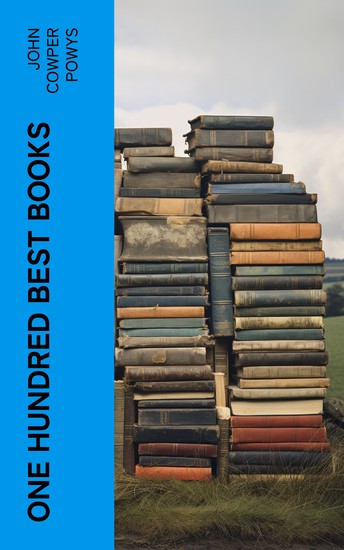
One Hundred Best Books - With Commentary and an Essay on Books and Reading - cover

One Hundred Best Books - With Commentary and an Essay on Books and Reading

John Cowper Powys

Maison d'édition: e-artnow

  • 0
  • 0
  • 0

Synopsis

"One Hundred Best Books" by John Cowper Powys. Published by e-artnow. e-artnow publishes a wide range of titles that encompasses every genre. From well-known classics & literary fiction and non-fiction to forgotten−or yet undiscovered gems−of world literature, we issue the books that need to be read. Each e-artnow edition has been meticulously edited and formatted to boost readability for all e-readers and devices. Our goal is to produce eBooks that are user-friendly and accessible to everyone in a high-quality digital format.
Disponible depuis: 24/11/2023.
Longueur d'impression: 149 pages.

D'autres livres qui pourraient vous intéresser

  • Big Love - cover

    Big Love

    Brooke Blurton

    • 0
    • 0
    • 0
    A raw, moving and uplifting memoir about courage, resilience and the transformative power of love, from one of Australia's most captivating personalities 
    'Powerful, heartbreaking and beautiful ... a story of incredible triumph fuelled by love and compassion' Osher Gunsberg 
    'Brooke Blurton is an icon for people of all generations and backgrounds. I love seeing her star shine.' Clementine Ford 
      
    My story is about the one thing that I never went without. Love. Big love, that filled me up and made me feel like there was a future for me. The kind of love that's unconditional, and that lasts across time and space ... 
    From the moment Brooke Blurton appeared on Australian television, she dazzled audiences with her authenticity, self-knowledge, generosity and honesty. As a proud young Noongar-Yamatji woman, Brooke's connection to her culture and country is deep, and as an openly queer woman, she knows that love is simply love. Most of all Brooke knows the importance of family, and the uplifting power of unconditional connection. 
    But behind the public persona Brooke presents to the world is a story of epic proportions and awe-inspiring resilience - she had to grow up fast from a very young age, surviving an extremely challenging childhood and youth, and overcoming the shocking legacy of intergenerational trauma, abuse and homelessness. She's also had to defy labels and perceptions about who she is, and her worth, all her life. 
    But through it all, Brooke didn't just survive, she found her voice and thrived, and in this raw, heartbreaking, often funny and ultimately life-affirming memoir, Brooke lays her journey bare about how she refused to allow the past to define her and reclaimed her own identity - and realised the power of love, for herself, for her family, and her community.  
    HarperCollins Australia 2022
    Voir livre

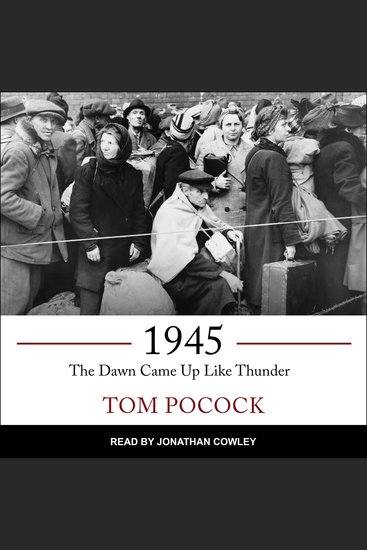
  • 1945 - The Dawn Came Up Like Thunder - cover

    1945 - The Dawn Came Up Like...

    Tom Pocock

    • 0
    • 0
    • 0
    In 1945 Tom Pocock travelled widely and saw the final collapse of the German armies; the horror of concentration camps and destroyed cities; retribution reaching war criminals; and the unpredictable strangers from the east, the Red Army. In Berlin, he climbed through the ruins of Hitler's Chancellery. In Vienna, he roistered with the Russians only to be arrested by them on a trip to Budapest. By the end of the year, he had paid his first visit to the El Dorado of that now distant world, New York, the glittering, happy, prosperous, democratic center of hopes and affections of the Western World. 


    Here indeed is the very form and pressure of the time: the awful stench of death and wholesale destruction; the casual murders and cruelties where over large tracts of territory law and order had collapsed; worst of all, the concentration camps still peopled by the ghosts of human beings, starved, tortured, terrified, and degraded. 


    Tom Pocock's friends had served and died in the war from which he himself had been invalided, but when Hitler was defeated, he shared their feelings of exultation and relief. He was in London for VE Day and his account of it is not easily forgotten.
    Voir livre
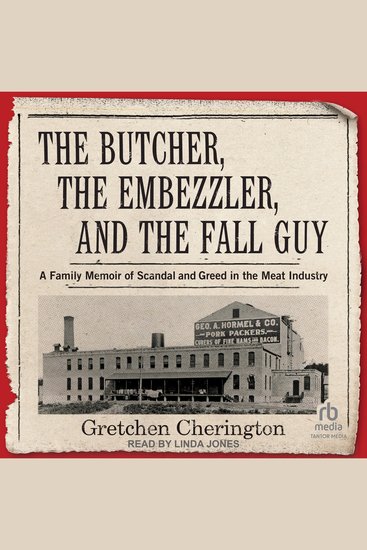
  • The Butcher Embezzler and the Fall Guy - A Family Memoir of Scandal and Greed in the Meat Industry - cover

    The Butcher Embezzler and the...

    Gretchen Cherington

    • 0
    • 0
    • 0
    Three powerful men converge on the banks of the Red Cedar River in the early 1900s in southern Minnesota—George Albert Hormel, founder of what will become the $10 billion food conglomerate Hormel Foods; Alpha LaRue Eberhart, the author's paternal grandfather and Hormel's executive vice president and corporate secretary; and Ransome Josiah Thomson, Hormel's comptroller. Over ten years, Thomson will embezzle $1.2 million from the company's coffers, nearly bringing the company to its knees. 


    The Butcher, The Embezzler, and The Fall Guy opens in 1922 as George Hormel calls Eberhart into his office and demands his resignation. Hailed as the true leader of the company he'd helped Hormel build—is Eberhart complicit in the embezzlement? Far worse than losing his job and the great wealth he'd rightfully accumulated is that his beloved young wife, Lena, is dying while their three children grieve alongside. Of course, his story doesn't end there. 


    In scale both intimate and grand, Cherington deftly weaves the histories of Hormel, Eberhart, and Thomson within the sweeping landscape of our country's early industries, along with keen observations about business leaders gleaned from her thirty-five-year career advising top company executives.
    Voir livre
  • Correspondence (Unabridged) - cover

    Correspondence (Unabridged)

    Ingeborg Bachmann, Paul Celan

    • 0
    • 0
    • 0
    "Paul Celan (1920-70) is one of the best-known German poets of the Holocaust; many of his poems, admired for their spare, precise diction, deal directly with its stark themes. Austrian writer Ingeborg Bachmann (1926-73) is recognized as one of post-World War II German literature's most important novelists, poets and playwrights. It seems only appropriate that these two contemporaries and masters of language were at one time lovers, and they shared a lengthy, artful and passionate correspondence.
    Collected here for the first time in English are their letters written between 1948 and 1961. Their correspondence forms a moving testimony of the discourse of love in the age after Auschwitz, with all the symptomatic disturbances and crises caused by their conflicting backgrounds and their hard-to-reconcile designs for living-as a woman, as a man, as writers. In addition to the almost 200 letters, the volume includes an important exchange between Bachmann and Gisèle Celan-Lestrange, who married Celan in 1951, as well as the letters between Paul Celan and Swiss writer Max Frisch, who was Bachmann's lover for four years."
    Voir livre
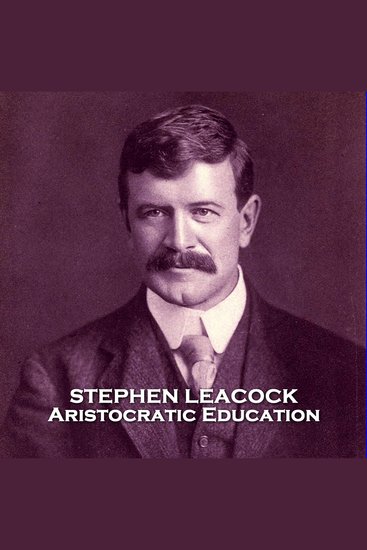
  • Aristocratic Education - From their pens to your ears genius in every story - cover

    Aristocratic Education - From...

    Stephen Leacock

    • 0
    • 0
    • 0
    Stephen P H Butler Leacock FRSC was born on the 30th December 1869 in Swanmore, near Southampton, England, the third of eleven children. 
    The family emigrated to Canada in 1876 to live on a 100-acre farm in Sutton, Ontario.  There Leacock was home-schooled and later enrolled into the elite private school Upper Canada College in Toronto.  Academically he was very strong and enrolled at the University of Toronto to study languages and literature.  He left there after his alcoholic father abandoned the family and finances were too stretched to continue his attendance.  He now enrolled in a three-month course at Strathroy Collegiate Institute to become a qualified high school teacher and with it a regular income. 
    Leacock published humorous articles in many Canadian and US magazines but his real passion was economics and political theory.  In 1899 he enrolled for postgraduate studies at the University of Chicago and earned his PhD in 1903. 
    His marriage to Beatrix Hamilton produced a single child 15 years later.  Over time father and son developed a love-hate relationship, partially caused by his son’s diminutive stature of only four feet.  
    He accepted a post at McGill University and kept it until he retired in 1936.  His work ‘Elements of Political Science’, was adopted as a standard textbook for two decades and was also his most profitable.  He now also began public speaking and lecturing.  
    In 1910, he privately printed some articles as ‘Literary Lapses’.  It was then released by a recognised publisher, and he became a commercially successful writer.  His collections of light-hearted whimsy, parody, nonsense, and satire were now frequently published along with biographies and several award-winning volumes on Canada. 
    Politically Leacock was a difficult creature.  He opposed women’s right to vote, was a champion of Empire but advocated social welfare legislation and wealth redistribution, but he often caused friction with his racist views. 
    Leacock has been forgotten as an economist, but it’s often said that in 1911 more people had heard of him than had heard of Canada.  For the decade after 1915 Leacock was the most popular humorist in the English-speaking world. 
    Stephen Leacock died on 28th March 1944 of throat cancer in Toronto, Canada.  He was 74.
    Voir livre
  • Austerlitz or Death - cover

    Austerlitz or Death

    Auguste Vallois

    • 0
    • 0
    • 0
    "Austerlitz or Death" is an epic historical novel by Auguste Vallois, a captain of the Imperial Guard who recounts his memories from the battlefields of Europe to the solitude of inner exile. 
    From his revolutionary youth in Lyon to the Egyptian campaign, the victories in Italy, the glory at Austerlitz, the frozen hell of Russia, and the final tragedy at Waterloo, Auguste tells the story of the Napoleonic Empire in first person and with painful clarity—not from the pages of history books, but from the blood, mud, and soul of those who built it… and watched it fall. 
    Through these pages, the reader will march alongside a man who lost everything but his honor. You will witness how a soldier is forged, how faith fades, how a sword is held even on broken knees. Each chapter is filled with emotion, introspection, fire, and silence. Every victory bears the taste of sacrifice, and every defeat, the dignity of those who never surrendered. 
    Vallois's prose is both elegant and raw, intimate and epic, heir to the great traditions of war and memory literature such as All Quiet on the Western Front or The Disasters of War. This is not the official history of Napoleon, nor the tale of grand strategists. It is the story of the anonymous men who believed in something greater than themselves… and paid the price. 
    A novel that masterfully blends epic military drama, psychological depth, and historical tragedy. Ideal for readers of war literature, historical fiction, soldier memoirs, or explorations of the human condition in times of crisis. 
    "I served the Emperor. And I do not regret it." 
    — Auguste Vallois
    Voir livre