Begleiten Sie uns auf eine literarische Weltreise!
Buch zum Bücherregal hinzufügen
Grey
Einen neuen Kommentar schreiben Default profile 50px
Grey
Jetzt das ganze Buch im Abo oder die ersten Seiten gratis lesen!
All characters reduced
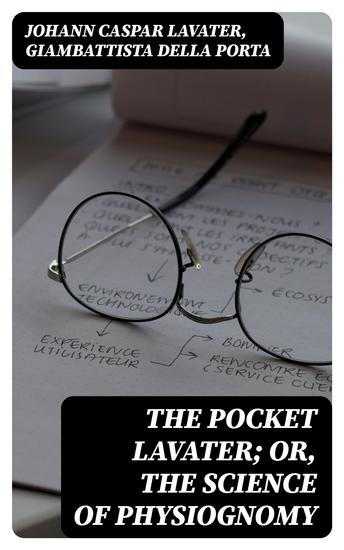
The Pocket Lavater; or The Science of Physiognomy - Enriched edition To which is added an inquiry into the analogy existing between brute and human physiognomy - cover

The Pocket Lavater; or The Science of Physiognomy - Enriched edition To which is added an inquiry into the analogy existing between brute and human physiognomy

Johann Caspar Lavater, Giambattista della Porta

Verlag: DigiCat

  • 0
  • 0
  • 0

Beschreibung

Dive into the intriguing world of physiognomy with 'The Pocket Lavater; or, The Science of Physiognomy,' a compendium presenting a fascinating exploration of the art of reading human features. This anthology brings together diverse writings that interweave scientific inquiry with speculative musings, reflecting the late 18th and early 19th centuries' fervent interest in the correlation between appearance and character. The collection is a rich tapestry of essays and treatises, each piece contributing to a broader understanding of how one's external traits can reveal hidden depths of mind and spirit. Standout compositions elucidate complex ideas with both clarity and nuance, providing a significant snapshot of a pivotal moment in literary and scientific history. The compilation draws from the works of Johann Caspar Lavater and Giambattista della Porta, two enigmatic figures whose ideas shaped the discourse on physiognomy during their time. Lavater's insightful observations and Porta's pioneering studies conjoin to provide a comprehensive narrative on this pseudo-scientific field. Engaging with their collective scholarship reveals much about the cultural and intellectual movements that emerged during the Enlightenment and early modern periods. This anthology thus not only highlights their individual contributions but also showcases the collaborative progression of thought during an era rich with intellectual cross-pollination. Readers are invited to immerse themselves in this thoughtfully curated volume, offering a unique encounter with the historical discourse on physiognomy. As the essays traverse multiple perspectives and styles, they challenge and expand the reader's understanding of human physicality and personality. This anthology is a treasure trove for anyone interested in the intersections of history, science, and literature, promising a rewarding and enlightening journey into the exploration of human identity and perception. Engage with this collection to appreciate its educational merit and the rich dialogue sparked between its diverse voices.

In this enriched edition, we have carefully created added value for your reading experience:
- A succinct Introduction situates the work's timeless appeal and themes.
- The Synopsis outlines the central plot, highlighting key developments without spoiling critical twists.
- A detailed Historical Context immerses you in the era's events and influences that shaped the writing.
- A thorough Analysis dissects symbols, motifs, and character arcs to unearth underlying meanings.
- Reflection questions prompt you to engage personally with the work's messages, connecting them to modern life.
- Hand‐picked Memorable Quotes shine a spotlight on moments of literary brilliance.
- Interactive footnotes clarify unusual references, historical allusions, and archaic phrases for an effortless, more informed read.
Verfügbar seit: 04.09.2022.
Drucklänge: 49 Seiten.
Weitere Bücher, die Sie mögen werden

  • Trained by the Skater Bro (Gay Transformation Erotica) - cover

    Trained by the Skater Bro (Gay...

    Archer Vale

    • 0
    • 0
    • 0
    “Dude…have you ever watched two guys kiss?” 
    I’m not sure how it happened. 
    Zack promised to teach me how to skate, but instead we ended up in his bed, fully nude while watching hardcore videos on his laptop. He thought it’d be funny to show me gay stuff, but it did something to my brain. 
    These days, my free time is spent alone in my dark bedroom. I surf the web for fringe content like “Hardcore Gay Findom” and “Gay MAGA Redpill”, but it’s not enough. 
    I keep going back to his apartment. He makes me wear a collar. He films me and sells the videos online. 
    My mind is broken. 
    I’m addicted to showing my body… 
    --- 
    CONTAINS EXPLICIT GAY SEXUAL CONTENT. 
    For exclusive stories, visit www.ArcherVale.com.
    Zum Buch
  • The Making of Modern New Zealand - From Colonization to Sovereignty - cover

    The Making of Modern New Zealand...

    Lillian Brooks

    • 0
    • 0
    • 0
    Before the arrival of Europeans, New Zealand, or Aotearoa, was inhabited solely by the Māori people, who had arrived from Polynesia over a thousand years earlier. Their ancestors navigated vast distances across the Pacific Ocean, using their advanced knowledge of stars, winds, and ocean currents. They eventually settled in Aotearoa, forming distinct tribal communities known as iwi, each with its own territory, social structures, and traditions. 
    The Māori society was organized around iwi (tribes), hapū (sub-tribes), and whānau (families). Each iwi had a paramount chief, or rangatira, who was responsible for making decisions that affected the entire tribe. The rangatira was supported by a council of elders, or kaumatua, who provided guidance based on wisdom and experience. The hapū, made up of extended families, was the primary unit of Māori society, with a strong emphasis on kinship and collective responsibility. 
    Māori were deeply connected to the land, or whenua, and believed that their ancestors, the atua, or gods, imbued the earth, sea, and sky with sacred energy. This connection formed the foundation of Māori spiritual beliefs, which revolved around whakapapa (genealogy), mana (spiritual power or authority), and tapu (sacredness). Their spiritual worldview tied their identity to the land and natural resources, and they saw themselves as stewards, responsible for the care and preservation of the environment.
    Zum Buch
  • A Rare Recording of Julius Howell Civil War Confederate Soldier - cover

    A Rare Recording of Julius...

    Julius Howell

    • 0
    • 0
    • 0
    Julius Franklin Howell was born in Suffolk, Virginia, in 1846. He enlisted in the Confederate States Army in 1862 and served in the 24th Virginia Cavalry until 1864 when his regiment was moved to the north of Richmond as Robert E. Lee and Ulysses S. Grant fought near Petersburg. Howell took part in the cavalry charge against Union artillery and infantry at a clearing near the Darbytown Road, during which he was shot in the leg. After his recovery, Howell returned to fight and was captured at the Battle of Sailor's Creek in Amelia County, Virginia, on April 6, 1865, and held in a Union prison at Point Lookout, MD. when he heard about the assassination of President Abraham Lincoln. After the war, he became an educator, preserving the memories of the Confederate soldier and serving as Commander-in-Chief of the United Confederate Veterans for decades. In 1947, he gave the following recording about his wartime experiences. He died a year later at the age of 102.
    Zum Buch
  • Krsna Your Eternal Friend - The Path To Enlightenment - cover

    Krsna Your Eternal Friend - The...

    Prana Govinda Das

    • 0
    • 0
    • 0
    Noted internationally known Self-help advocate and teacher of devotional yoga Prana Govinda Das was born in Liverpool, England in 1968 admittedly a pretty good year for all things bright and beautiful. He says, "From as early as I can remember I had an unquenchable thirst for knowledge, and a desire to understand the true nature of man and this world we live in. I was also always seeking out people who could answer all the questions I had about life, the universe and everything." After studying film production in the early nineties Prana was able to fulfill his lifelong desire to travel to India. admittedly his first trip changed his life completely and forever. "At that point," He recalls, "my thirst for material knowledge turned to a desire to understand the spiritual side of life. For the next six years, I frequently returned to, where I studied many different paths of Hinduism, Buddhism, and other forms of yoga and meditation. However, even after learning and experiencing so much I was still left incomplete." in 2001 during the young man's sixth trip to India, he traveled to Vrindavan, a holy town associated with Lord Krishna south of Delhi. It was there he met his spiritual guide, and mentor Srila Bhaktivedanta Narayana Goswami. Some twenty years on, Prana has been resident in his teacher's temples all over the world, particularly India, Australia, America, and Europe. Welcome then to the inspirational, engrossing, all-inclusive teachings of Prana Govinda Das. 
     
    With special guest acclaimed yogi Sripad Jagannatha Das, Prana's "guru bai."
    Zum Buch
  • Freemasonic Symbolism - cover

    Freemasonic Symbolism

    Manly Palmer Hall

    • 0
    • 0
    • 0
    According to Freemasonic symbolism, Enoch, fearing that all knowledge of the sacred Mysteries would be lost at the time of the Deluge, erected the two columns mentioned in the quotation. Upon the metal column in appropriate allegorical symbols he engraved the secret reaching and upon the marble column placed an inscription stating that a short distance away a priceless treasure would be discovered in a subterranean vault. After having thus faithfully completed his labors, Enoch was translated from the brow Of Mount Moriah. In time the location of the secret vaults was lost, but after the lapse of ages there came another builder--an initiate after the order of Enoch--and he, while laying the foundations for another temple to the Great Architect of the Universe, discovered the long-lost vaults and the secrets contained within.
    Zum Buch
  • A Rare Recording of EE Cummings Reading His Own Poetry - cover

    A Rare Recording of EE Cummings...

    EE Cummings

    • 0
    • 0
    • 0
    Edward Estlin Cummings (October 14, 1894 - September 3, 1962), commonly known as e e cummings, was an American poet, painter, essayist, author, and playwright. During World War I, he worked as an ambulance driver and was imprisoned in an internment camp, which provided the basis for his 1922 novel The Enormous Room. The following year he published his first collection of poetry. Cummings wrote approximately 2,900 poems and is often regarded as one of the most important American poets of the 20th century. He is associated with modernist free-form poetry, and much of his work uses idiosyncratic syntax and lower-case spellings for poetic expression. In the following recordings, Cummings reads his poems "somewhere i have never travelled,gladly beyond" (1931), "next to of course god america i" (1926), "anyone lived in a pretty how town" (1940), "Buffalo Bill's (1920), "in Just–" (1920), i carry your heart with me(i carry it in)" (1952). The final audio clip is from a 1955 Cummings speech, "A Poet's Advice to Students."
    Zum Buch