Join us on a literary world trip!
Add this book to bookshelf
Grey
Write a new comment Default profile 50px
Grey
Subscribe to read the full book or read the first pages for free!
All characters reduced
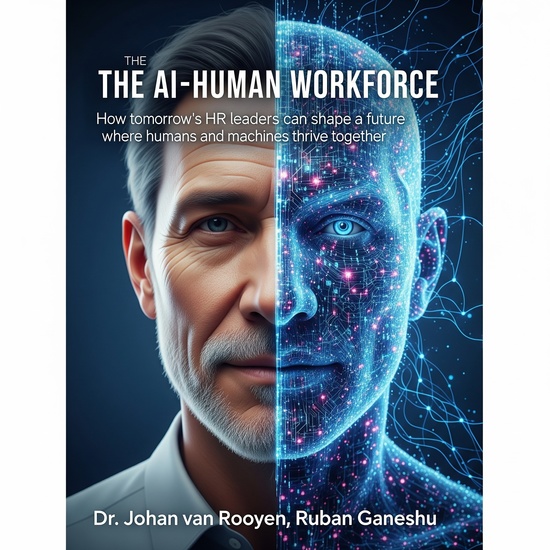
The AI-Human Workforce - cover

The AI-Human Workforce

Johan van Rooyen, Ruban Ganeshu

Publisher: Publishdrive

  • 0
  • 0
  • 0

Summary

The workplace is changing faster than ever before. Artificial Intelligence, robotics, and machine learning are no longer futuristic buzzwords, they’re rewriting the rules of talent management, leadership, and organizational success today. As we enter a new era of work, HR professionals face a choice: adapt, lead, or be left behind.
 
In The AI-Human Workforce, Dr. Johan van Rooyen and Ruban Ganeshu take readers beyond the hype, exploring how technology will transform every aspect of human resources over the next decade. Through cutting-edge research, real-world case studies, and bold future scenarios, this book reveals how organizations can balance efficiency and humanity in a machine-augmented workplace.
 
From AI-powered recruitment and predictive talent analytics to managing hybrid teams of humans and intelligent agents, this book provides the tools and insights HR professionals need to design organizations where both people and technology thrive. It tackles complex ethical dilemmas, explores the rise of “Chief Purpose Officers,” and shows how companies can retain top talent by delivering more than a paycheck; offering meaning, impact, and well-being in an automated world.
 
This is not just a book about the future of HR, it’s a blueprint for building the future of work itself.
Available since: 08/11/2025.
Print length: 268 pages.

Other books that might interest you

  • Time-Space - We Are All in It Together - cover

    Time-Space - We Are All in It...

    Penelope J. Corfield

    • 0
    • 0
    • 0
    Are you curious about the nature of time-space and the dynamics of human lives within it? Dive into this book and explore these fascinating concepts.
     
    Time, the fundamental dynamo, leads the union with space, its perennial partner. Together, they frame a vast and restless cosmos where all individual has their unique time and place. Yet, humans do not survive alone; they share this beautiful but tiny planetary homestead with many 
    other species.
     
    While humans walk upon Planet Earth, they simultaneously scan the stars, probing the unfolding saga of their home planet and the entire cosmos:‘Twinkle, twinkle, little star How I wonder what you are…’
     
    This book combines insights from history, physics, geography, and literature – not forgetting songs. The opening section reveals how humans live, remember, forget, and think through time. The next section highlights key features of time and explains why denying time is nonsensical.
     
    The final section surveys the collective human journey through time-space. Humans are a complex species, capable of both deceit and trust, hatred and love, conflict and cooperation. Yet, slowly, they are creating international networks and a global civics. This exciting trend is 
    crucial, especially in responding effectively to today’s urgent climate crisis on Planet Earth.
    Show book
  • The Art of War - cover

    The Art of War

    Sun Tzu

    • 0
    • 0
    • 0
    "The Art of War" by Sun Tzu is a timeless masterpiece on military strategy and tactics. Packed with wisdom, it offers profound insights into warfare, leadership, and conflict resolution. A must-read for anyone seeking to understand the dynamics of power and to achieve success in any competitive arena.
    Show book
  • The Dark Side of Introverts - Understanding the Complexities of Quiet Personalities - cover

    The Dark Side of Introverts -...

    John Harpoon

    • 0
    • 0
    • 0
    Introverts have long been misunderstood in a world that favors extroversion. Often seen as shy, antisocial, or even cold, they are frequently pressured to conform to society’s expectation of constant interaction and social engagement. However, introversion is far more complex than simply being quiet. It is a deeply ingrained personality trait that affects how individuals process thoughts, emotions, and experiences. While introverts possess many strengths, they also face unique challenges that are often overlooked. This book aims to explore the lesser-known struggles of introverts, shedding light on the psychological complexities that shape their lives. 
      
    One of the biggest misconceptions about introverts is that they dislike people. In reality, introverts are highly selective about their social interactions, often preferring deep, meaningful connections over surface-level conversations. Their energy is drained by excessive socialization, making them more inclined toward solitude and introspection. However, this need for alone time can sometimes lead to feelings of loneliness and isolation, especially in a world that values constant networking and outgoing personalities. The very traits that make introverts thoughtful and introspective can also cause them to struggle with overthinking, self-doubt, and emotional exhaustion. 
      
    Despite their quiet nature, introverts experience a vast range of emotions, many of which remain unspoken. They tend to internalize their struggles, making it difficult for others to recognize when they are overwhelmed or in distress. This internalization can lead to anxiety, depression, and self-imposed isolation. Additionally, introverts often feel the pressure to adapt to extroverted norms, forcing themselves into uncomfortable social situations or pretending to be more outgoing than they truly are.
    Show book
  • Geist und Materie Gott und die Welt – ein verborgener Gesamtzusammenhang Spirit and Matter God and the World – a Hidden Overall Context - Ein kleiner Essay A short Essay - cover

    Geist und Materie Gott und die...

    Luc Ciompi

    • 0
    • 0
    • 0
    … "Wenn ich also das Ergebnis meiner Untersuchung in knappster Form zusammenfassen müsste, so ergäbe sich etwa Folgendes: Energie ist eine Urkraft unbekannter Herkunft mit einem ungeheuren Differenzierungspotenzial. 'Tote' wie lebende Materie ist zunehmend raffiniert organisierte Energie. Das organisierende Prinzip ist der Weltgeist, ein grenzenloses abstraktes Potenzial von Kombinationsmöglichkeiten, welche im Lauf der Evolution vom Big Bang bis heute immer differenzierter realisiert und materialisiert worden sind. Aspekte des Weltgeists werden von lebendigen Organismen sukzessive entdeckt und genutzt. Sowohl der Weltgeist wie auch die Energie können wahlweise als göttlichen oder natürlichen Ursprungs aufgefasst werden."
    
    … "So if I had to summarize the result of my investigation in the briefest form, it would be something like the following: energy is a primal force of unknown origin with a tremendous potential for differentiation. 'Dead' and living matter is increasingly sophisticatedly organized energy. The organizing principle is the world spirit, a limitless abstract potential of possible combinations, which has been realized and materialized in an increasingly differentiated way in the course of evolution from the Big Bang to the present day. Aspects of the world spirit are successively discovered and utilized by living organisms. Both the world spirit and the energy can be understood to be either of divine or natural origin."
    Der Autor:
    Luc Ciompi, Prof. em.; Studium der Medizin, Facharzt für Psychiatrie und Psychotherapie; psychoanalytische und systemisch-familientherapeutische Ausbildung; 1977–1994 Ordentlicher Professor an der medizinischen Fakultät der Universität Bern, Mit-Vorsteher des Departements der Universität Bern und ärztlicher Direktor der Sozialpsychiatrischen Universitätsklinik Bern; 1984–1998 Begründer und erster ärztlicher Leiter der therapeutischen Wohngemeinschaft "Soteria Bern"; seit 1995 freier wissenschaftlicher Buchautor und Publizist; psychotherapeutische Beratungs- und Supervisionstätigkeit, Computerforschung zum Konzept der Affektlogik.
    Show book
  • Saratoga and Yorktown: The History of the American Revolution’s Most Important Campaigns - cover

    Saratoga and Yorktown: The...

    Editors Charles River

    • 0
    • 0
    • 0
    At the end of 1776, the American war effort was on the verge of collapse, and despite Washington’s success at Trenton, the British were confident that they could quell the rebellion in 1777. That winter, the British planned a complicated campaign in which British armies from Canada and New York would strike out across New England and link up, with the goal of cutting off the Northern colonies. Indeed, 1777 did prove to be the pivotal year of the war, but not in the way the British intended. 
    In December 1776, Benjamin Franklin was sent by Congress to France to attempt to secure a critically needed alliance. Franklin was an ideal choice for Enlightened France, which revered Franklin for his scientific accomplishments and his known reputation as a brilliant man. Franklin had also been a diplomat before the Revolution, spending several years in London on behalf of the colonies. However, the French refused to provide more than arms and money throughout 1777, until they learned in December 1777 about Saratoga and Burgoyne’s surrender. With that news, French King Louis XVI entered into a formal military alliance with the United States, and in February 1778, France joined the war. 
    Yorktown was a former tobacco trading post now in decline, not much bigger than a large village. But Yorktown was tucked away on the northern edge of the York peninsula in rural Virginia, and in 1781 it became the site of a brief siege between two small armies, fought with all the decorum and formality of 18th century European warfare. As he made his dispositions at Yorktown in September 1781, he had every reason to expect another British success. The ensuing siege panned out rather differently. On October 19, 1781, for just the second time during the war (the other at Saratoga), an entire British field army surrendered to the rebel patriots.
    Show book
  • Selflessness - The Altruistic Heart - cover

    Selflessness - The Altruistic Heart

    Esther Jameson

    • 0
    • 0
    • 0
    Selflessness is a concept that transcends simple acts of kindness and touches on the very core of what it means to live in a community. It is the quality of being more concerned with the needs and well-being of others than with one’s own desires or ambitions. At its heart, selflessness is about recognizing the interconnectedness of humanity and acting in ways that foster compassion, understanding, and support among individuals. This chapter explores the many dimensions of selflessness, from its philosophical roots to its everyday manifestations in the lives of those who choose to put others first. 
    Historically, selflessness has been celebrated in various cultures and traditions. Many religious and spiritual teachings emphasize the importance of altruistic behavior, often framing it as a path to personal growth and enlightenment. In these traditions, selflessness is not merely a moral duty but a transformative journey that leads to a deeper connection with the universe and with fellow human beings. The idea that one can find fulfillment through acts of service rather than the pursuit of personal gain is a recurring theme in texts and teachings from around the world. 
    In a more modern context, selflessness is understood as both an individual virtue and a social necessity. In today’s fast-paced, competitive society, the act of prioritizing others can sometimes be seen as counterintuitive. However, when individuals choose to put aside their own interests for the benefit of others, they contribute to a more compassionate and resilient community. Whether it is through small gestures of kindness or significant sacrifices made in times of crisis, the impact of selflessness is profound. It can inspire trust, build stronger relationships, and create a ripple effect that encourages further acts of altruism.
    Show book