Rejoignez-nous pour un voyage dans le monde des livres!
Ajouter ce livre à l'électronique
Grey
Ecrivez un nouveau commentaire Default profile 50px
Grey
Abonnez-vous pour lire le livre complet ou lisez les premières pages gratuitement!
All characters reduced
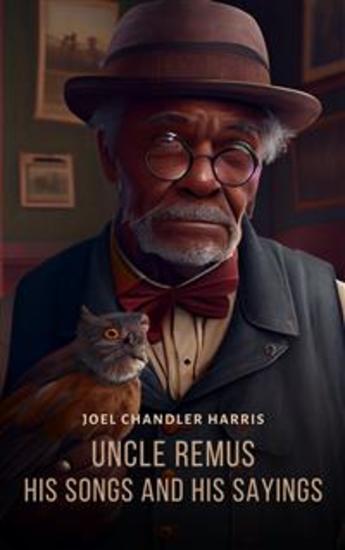
Uncle Remus His Songs and His Sayings - cover

Uncle Remus His Songs and His Sayings

Joel Chandler Harris

Maison d'édition: Interactive Media

  • 0
  • 0
  • 0

Synopsis

Uncle Remus, His Songs and His Sayings by Joel Chandler Harris is an iconic American tome that is renowned for its exploration of African-American folklore. The collection of oral narratives and folksongs, compiled by Harris in the late 19th century, is a seminal work that offers invaluable insight into the rich, cultural heritage of African-Americans living in the southern states during this period.
Disponible depuis: 20/01/2023.
Longueur d'impression: 172 pages.

D'autres livres qui pourraient vous intéresser

  • The Lost World - cover

    The Lost World

    Arthur Conan Doyle

    • 0
    • 0
    • 0
    "The Lost World" is a novel written by Sir Arthur Conan Doyle, the British author best known for creating the iconic detective Sherlock Holmes. Published in 1912, this adventure novel stands apart from Doyle's more famous detective fiction and is known for its exploration of the unknown and its contribution to the "lost world" literary genre. 
     
    The story is centered around the character of Professor Challenger, an eccentric and larger-than-life scientist who, like Sherlock Holmes, became one of Conan Doyle's memorable literary creations. Professor Challenger claims to have discovered evidence of prehistoric life in the Amazon rainforest and invites a group of individuals, including the narrator Edward Malone, to join him on an expedition to verify his findings. 
     
    The group embarks on a perilous journey into the uncharted and remote plateau in South America, where they encounter a world seemingly frozen in time. Dinosaurs and other prehistoric creatures roam the plateau, and the explorers must navigate not only the dangers of the natural world but also the challenges of their own personalities and relationships. 
     
    "The Lost World" is a pioneering work in the "lost world" subgenre of adventure fiction, which involves the discovery of isolated and prehistoric environments that time forgot. It predates other famous works in this genre, such as Edgar Rice Burroughs' "The Land That Time Forgot" and Sir Arthur Conan Doyle's contemporary H.G. Wells' "The Time Machine." 
     
    The novel combines elements of science fiction, adventure, and exploration with themes of human curiosity, bravery, and the clash between the modern world and the primeval past. It also touches on the ethical implications of encountering and documenting creatures thought to be extinct.
    Voir livre
  • Louise de la Valliere Volume 1 - cover

    Louise de la Valliere Volume 1

    Alexandre Dumas

    • 0
    • 0
    • 0
    In Louise de la Vallière Volume 1, Alexandre Dumas delves into the tumultuous world of French court intrigue during Louis XIV’s reign. The story follows Louise, a humble lady-in-waiting, whose beauty captures the king's heart, thrusting her into a web of politics and jealousy. Meanwhile, the legendary Musketeers—Athos, Porthos, Aramis, and d'Artagnan—navigate shifting alliances and personal challenges. As love blossoms amidst betrayal and ambition, Dumas masterfully blends historical detail with romance and adventure, setting the stage for a dramatic exploration of power, loyalty, and the human spirit.
    Voir livre
  • In Bayswater - One family is home to many secrets in this classic modernist short story - cover

    In Bayswater - One family is...

    Mary Butts

    • 0
    • 0
    • 0
    Mary Frances Butts was born on 13th December 1890 in Poole, Dorset. 
     
    Her early years were spent at Salterns, an 18th-century house overlooking Poole Harbour.  Sadly in 1905 her father died, and she was sent for boarding at St Leonard's school for girls in St Andrews. 
     
    Her mother remarried and, from 1909, Mary studied at Westfield College in London, and here, first became aware of her bisexual feelings.  She was sent down for organising a trip to Epsom races and only completed her degree in 1914 when she graduated from the London School of Economics.  By then Mary had become an admirer of the occultist Aleister Crowley and she was given a co-authorship credit on his ‘Magick (Book 4)’. 
     
    In 1916, she began the diary which would now detail her future life and be a constant reference point for her observations and her absorbing experiences. 
     
    During World War I, she was doing social work for the London County Council in Hackney Wick, and involved in a lesbian relationship.  Life changed after meeting the modernist poet, John Rodker and they married in 1918. 
     
    In 1921 she spent 3 months at Aleister Crowley's Abbey of Thelema in Sicily; she found the practices dreadful and also acquired a drug habit.  Mary now spent time writing in Dorset, including her celebrated book of short stories ‘Speed the Plough’ which saw fully develop her unique Modernist prose style. 
     
    Europe now beckoned and several years were spent in Paris befriending many artists and writing further extraordinary stories.   
     
    She was continually sought after by literary magazines and also published several short story collections as books. Although a Modernist writer she worked in other genres but is essentially only known for her short stories.  Mary was deeply committed to nature conservation and wrote several pamphlets attacking the growing pollution of the countryside. 
     
    In 1927, she divorced and the following year her novel ‘Armed with Madness’ was published.  A further marriage followed in 1930 and time was spent attempting to settle in London and Newcastle before setting up home on the western tip of Cornwall.  By 1934 the marriage had failed. 
     
    Mary Butts died on 5th March 1937, at the West Cornwall Hospital, Penzance, after an operation for a perforated gastric ulcer. She was 46. 
     
    Her story ‘In Bayswater’ grippingly describes a man’s friendship with a dysfunctional family he rents a room from.  As each facet reveals itself his opinion and decisions change, back and forth, this way and that….
    Voir livre
  • The War of the Worlds - An Audiobook Empire Production - cover

    The War of the Worlds - An...

    H. G. Wells

    • 0
    • 0
    • 0
    “This isn’t a war… It never was a war, any more than there’s war between men and ants.” 
    The War of the Worlds is a classic science fiction novel that has been terrifying and enthralling readers for over a century. In this epic audiobook, you will experience the story like never before, as RJ Bayley and Audiobook Empire take you on a journey through the chaos and destruction of an alien invasion. 
    From the moment the Martians land in England, you will be on the edge of your seat. H.G. Wells' vivid descriptions of the Martian war machines and the heat rays they wield are given desperate urgency and authenticity by narrator RJ Bayley (Bayley's Bookshelf Podcast). You'll feel like you're right there, witnessing the invasion firsthand. 
    More than just a thrilling tale of alien invasion, The War of the Worlds is a groundbreaking work of fiction that explores the themes of fear, hope, survival and imperialism. Even now, H.G. Wells' masterpiece has the power to chill, awe and force listeners to confront their own society's impact on others. 
    This is a must-listen audiobook for anyone who loves science fiction, adventure, or wants to experience of the most important novels ever written. So what are you waiting for? Download your copy today!
    Voir livre
  • At Christmas Time - From their pens to your ears genius in every story - cover

    At Christmas Time - From their...

    Anton Chekhov

    • 0
    • 0
    • 0
    Anton Pavlovich Chekhov was born on 29th January 1860 in Taganrog, on the south coast of Russia.  
    His family life was difficult; his father was strict and over-bearing but his mother was a passionate story-teller, a subject Chekhov warmed to. As he later said; ‘our talents we got from our father, but our soul from our mother’.  
    At school Chekhov was distinctly average. At 16 his father mis-managed his finances and was declared bankrupt. His family fled to Moscow. Chekhov remained and eked out a living by various means, including writing and selling short sketches to newspapers, to finish his schooling. That completed and with a scholarship to Moscow University obtained he rejoined his family. 
    He was able to help support them by selling satirical sketches and vignettes of Russian lifestyles and gradually obtained further commissions. In 1884, he qualified as a physician and, although it earned him little, he often treated the poor for free, he was fond of saying ‘Medicine is my lawful wife, and literature is my mistress.’ 
    His own health was now an issue as he began to cough up blood, a symptom of tuberculosis.  Despite this his writing success enabled him to move the family into more comfortable accommodation.  
    Chekhov wrote over 500 short stories which included many, many classics including ‘The Kiss’ and ‘The Lady with a Dog’.  His collection ‘At Dusk’ won him the coveted Pushkin Prize when was only 26.  
    He was also a major playwright beginning with the huge success of ‘Ivanov’ in 1887.   
    In 1892 Chekhov bought a country estate north of Moscow. Here his medical skills and money helped the peasants tackle outbreaks of cholera and bouts of famine. He also built three schools, a fire station and a clinic.  It left him with less time for writing but the interactions with real people gained him detailed knowledge about the peasantry and their living conditions for his stories.  
    His most famous work, ‘The Seagull’ was received disastrously at its premiere in St Petersburg. It was later restaged in Moscow to highlight its psychological aspects and was a huge success. It led to ‘Uncle Vanya’, ‘The Three Sisters’ and ‘The Cherry Orchard’.  
    Chekhov suffered a major lung hemorrhage in 1897 while visiting Moscow. A formal diagnosis confirmed tuberculosis and the doctors ordered changes to his lifestyle.  
    Despite a dread of weddings the elusive literary bachelor quietly married the actress Olga Knipper, whom he had met at rehearsals for ‘The Seagull’, on 25th May 1901. 
    By May 1904 with his tuberculosis worsening and death imminent he set off for the German town of Badenweiler writing cheerful, witty letters to his family and assuring them his health was improving.  
    On 15th July 1904 Anton Chekhov died at Badenweiler.  He was 44.
    Voir livre
  • Martin Chuzzlewit Volume 4 - cover

    Martin Chuzzlewit Volume 4

    Charles Dickens

    • 0
    • 0
    • 0
    In Martin Chuzzlewit Volume 4, Charles Dickens brings the story to its resolution as themes of redemption and morality come full circle. Young Martin solidifies his independence, rejecting greed and embracing integrity. Pecksniff’s hypocrisy is exposed, leading to his downfall, while Jonas Chuzzlewit faces the consequences of his villainy. The bonds between Mary Graham and Martin deepen, built on trust and shared values. With justice served and lessons learned, Dickens ties up loose ends, offering a satisfying conclusion that underscores the triumph of virtue over vice and the importance of genuine human connection.
    Voir livre