Rejoignez-nous pour un voyage dans le monde des livres!
Ajouter ce livre à l'électronique
Grey
Ecrivez un nouveau commentaire Default profile 50px
Grey
Abonnez-vous pour lire le livre complet ou lisez les premières pages gratuitement!
All characters reduced
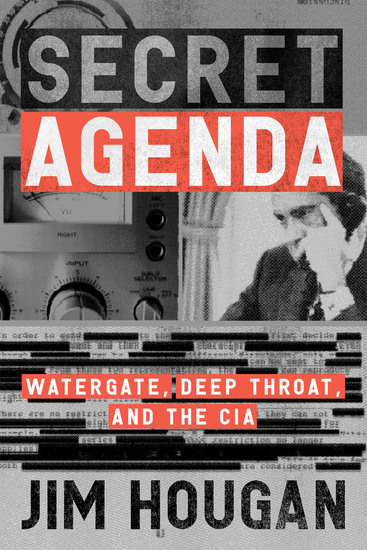
Secret Agenda - Watergate Deep Throat and the CIA - cover

Secret Agenda - Watergate Deep Throat and the CIA

Jim Hougan

Maison d'édition: Open Road Media

  • 0
  • 0
  • 0

Synopsis

The exposé that reveals “a prostitution ring, heavy CIA involvement, spying on the White House as well as on the Democrats, and plots within plots” (The Washington Post) Ten years after the infamous Watergate scandal that brought down the Nixon presidency, Jim Hougan—then the Washington editor of Harper’s Magazine—set out to write a profile of Lou Russell, a boozy private-eye who plied his trade in the vice-driven underbelly of the nation’s capital. Hougan soon discovered that Russell was “the sixth man, the one who got away” when his boss, veteran CIA officer Jim McCord, led a break-in team into a trap at the Watergate. Using the Freedom of Information Act to win the release of the FBI’s Watergate investigation—some thirty-thousand pages of documents that neither the Washington Post nor the Senate had seen—Hougan refuted the orthodox narrative of the affair. Armed with evidence hidden from the public for more than a decade, Hougan proves that McCord deliberately sabotaged the June 17, 1972, burglary. None of the Democrats’ phones had been bugged, and the spy-team’s ostensible leader, Gordon Liddy, was himself a pawn—at once, guilty and oblivious. The power struggle that unfolded saw E. Howard Hunt and Jim McCord using the White House as a cover for an illicit domestic intelligence operation involving call-girls at the nearby Columbia Plaza Apartments. A New York Times Notable Book, Secret Agenda “present[s] some valuable new evidence and explored many murky corners of our recent past . . . The questions [Hougan] has posed here—and some he hasn’t—certainly deserve an answer” (The New York Times Book Review). Kirkus Reviews declared the book “a fascinating series of puzzles—with all the detective work laid out.”
Disponible depuis: 26/04/2022.
Longueur d'impression: 366 pages.

D'autres livres qui pourraient vous intéresser

  • Political Economy - cover

    Political Economy

    John Ruskin

    • 0
    • 0
    • 0
    John Ruskin was a Victorian-era writer, art critic, and social thinker who wrote extensively on political economy. He was critical of the industrialization and capitalism that were taking hold in Britain during his time, and he believed that these developments were causing great harm to both the natural environment and human society. 
    Ruskin believed that the capitalist system was inherently flawed because it focused solely on maximizing profits and disregarded the well-being of workers, the environment, and society as a whole. He argued that the pursuit of wealth at all costs led to the exploitation of labor, the destruction of natural resources, and the degradation of art and culture. 
    In response to these problems, Ruskin advocated for a different economic system that was more in tune with the needs of people and the environment. He believed that the economy should be organized around the principles of social justice, sustainability, and community. 
    Ruskin's ideas were influential in the development of the Arts and Crafts movement, which sought to promote traditional crafts and design in opposition to the mass-produced goods of industrial capitalism. His critique of the capitalist system also influenced later socialist and environmental movements.
    Voir livre
  • Movement Parties of the Far Right - Understanding Nativist Mobilization - cover

    Movement Parties of the Far...

    Pietro Castelli Gattinara,...

    • 0
    • 0
    • 0
    In an era of traditional political party decline, this book explores a new phase of nativist mobilization, in which street politics plays an increasingly important role. Movement parties offer an exceptional object of study since they challenge the conventional distinction between institutional and non-institutional politics. Examining the "production structure" of ten movement parties across nine European countries, the authors identify key factors that affect their engagement in protest activity. They address the organizational capacity, decision-making processes, and external mobilization of these collective actors using unique empirical material, including quantitative data on far-right protest mobilization spanning over a decade, protest network visualizations, and qualitative interviews with high-ranking officials. 


    The book provides fresh insights into how the far right spreads its influence and relates to non-institutional politics, making it essential for anyone concerned about the way in which nativist collective actors transform society from the ground up. A compelling study looking at the relationship between electoral politics and grassroots activism, Movement Parties of the Far Right illuminates the complex organizational and strategic choices underlying far-right mobilization.
    Voir livre
  • A Better Nation - The Challenges of Scottish Independence - cover

    A Better Nation - The Challenges...

    Simon Barrow, Gerry Hassan

    • 0
    • 0
    • 0
    ­­­As the battle of words over the future of Scotland as a democracy, nation and society continues, A Better Nation: The Challenges of Scottish Independence aims to go beyond the superficial divisions and media noise in order to address matters of real substance. Drawing on a range of original thinkers from a wide range of backgrounds, it tackles key issues about money, culture, equality, energy, borders, jobs, Europe and other 'big questions' head on.
    
    A Better Nation illustrates the high stakes in this debate, as well as the opportunities it affords. Outlining political approaches which are respectful of different views, doubts and ambiguities, it asks what kind of society we want to create and how we want to govern ourselves. The nature of the British state and Scottish democracy, the need to tackle inequalities, the challenges of centre-left politics, the climate emergency and the pressing need for a wellbeing economy are put at the heart of the discussion about independence.
    
    Contributors include:
    Ciaran Martin, Roz Foyer, Paul Mason, Gavin Esler, Joyce McMillan, John Curtice, Dani Garavelli, David Clark, Tanja Bueltmann, Malcolm Chalmers, Kirsty Hughes, John Kay, Lisa Clark, Colin Kidd, Hannah Graham, Paul Sweeney and many others.
    Voir livre
  • Pandemic Panic - How Canadian Government Responses to COVID-19 Changed Civil Liberties Forever - cover

    Pandemic Panic - How Canadian...

    Joanna Baron, Christine Van Geyn

    • 0
    • 1
    • 0
    In October 2022, the economist Emily Oster wrote a plea for a “pandemic amnesty.” After detailing various ill-conceived public health policies throughout the pandemic, Oster concluded that “The standard saying is that those who forget history are doomed to repeat it. But dwelling on the mistakes of history can lead to a repetitive doom loop as well.” She reasoned that many admittedly poor, public health decisions were made in an information vacuum and that the salubrious thing to do going forward would be to forgive and forget.
    		 
    Oster was concerned about the fraying social fabric because of polarizing online discourse and urged the need to move forward. However, our anecdotal experience has shown a second common response to pandemic mishaps—going blank entirely on what occurred during the pandemic. We have observed a phenomenon of the surreal, sometimes inane, often unprecedented and unusual public health measures taken over the roughly three-year pandemic period being a “memory hole,” where the mind completely fogs over. Many times in the course of writing this book, we have messaged one another upon unearthing one public policy absurdity upon another: the City of Toronto taping off cherry blossoms, Quebec requiring unvaccinated people to be chaperoned in plexiglass carts through the essential aisles of big-box stores.
    		 
    We are not psychologists, but no doubt there is an evolutionary benefit to allowing a collective trauma to dissolve into the slip-stream: it is unproductive to dwell on how we got by and how our government coped in real-time. Our memories are warped, first, by the “primacy effect” our tendency to remember “firsts” exemplified by people universally naming George Washington when asked to recall former U.S. presidents. Most people have a crystal clear memory of the moment their plague year started in earnest; for us and many others; it was March 11, 2020, the day the NBA suspended games for the rest of the season.
    Voir livre
  • Deceptive Practices - Actions Taken to Mislead or Misinform - cover

    Deceptive Practices - Actions...

    Cito Harder

    • 0
    • 0
    • 0
    Deception has been a fundamental part of human interaction throughout history, shaping societies, relationships, and institutions. Whether through subtle manipulation, outright lies, or carefully crafted misinformation, deception influences decisions, perceptions, and behaviors in both personal and collective spheres. While often viewed negatively, deception is not always malicious; in some cases, it serves strategic, protective, or even necessary functions. Understanding the role deception plays in society requires examining its various forms, motivations, and consequences. 
    One of the most common areas where deception is prevalent is in personal relationships. People deceive for different reasons, ranging from self-preservation to maintaining social harmony. White lies, for example, are often used to spare feelings or avoid unnecessary conflict, while more harmful deceptions, such as infidelity or emotional manipulation, can cause deep and lasting damage. The complexity of deception in relationships highlights its dual nature—sometimes beneficial, sometimes destructive. 
    Beyond personal interactions, deception extends into professional and institutional environments. In workplaces, deceptive practices can manifest as misleading job descriptions, false performance evaluations, or office politics designed to manipulate outcomes. Deception in business, such as false advertising or hidden fees, can mislead consumers, erode trust, and cause financial harm. Similarly, political deception—through propaganda, misinformation, and strategic framing of facts—shapes public opinion, influencing elections, policies, and societal norms.
    Voir livre
  • In Trump We Trust: Book Summary and Analysis - cover

    In Trump We Trust: Book Summary...

    Briefly Summaries

    • 0
    • 0
    • 0
    This is a concise summary and analysis of In Trump We Trust, by Ann Couletr .
     
    It is not the original book and is not affiliated with or endorsed by Ann Couletr.
     
    Ideal those seeking a quick and insightful overview.


    In this audiobook, we dive deep into the strategies and leadership lessons drawn from the bold rise of a controversial figure. This summary and analysis of In Trump We Trust provides listeners with valuable insights into leadership, branding, populism, loyalty, and the power of media manipulation. With a dynamic, motivational tone, the audiobook is designed to inspire and empower those seeking to improve their productivity, leadership, and influence.
     
    Through a chapter-by-chapter breakdown, we explore how a political outsider leveraged boldness and an unorthodox approach to reshape the American political landscape. We look at the power of building a strong, memorable brand, embracing controversy, and understanding the media’s role in shaping public perception. By focusing on loyalty and populist messaging, we uncover the essential elements that contributed to the leader's rise and continued success.
    Voir livre