Begleiten Sie uns auf eine literarische Weltreise!
Buch zum Bücherregal hinzufügen
Grey
Einen neuen Kommentar schreiben Default profile 50px
Grey
Jetzt das ganze Buch im Abo oder die ersten Seiten gratis lesen!
All characters reduced
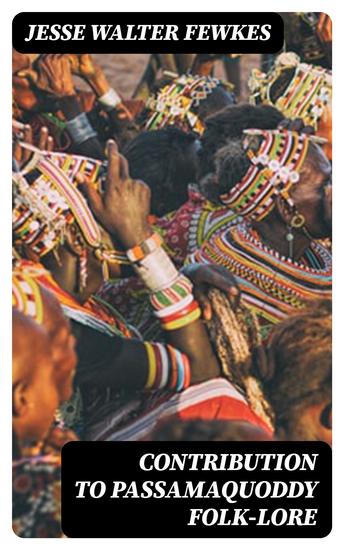
Contribution to Passamaquoddy Folk-Lore - cover

Contribution to Passamaquoddy Folk-Lore

Jesse Walter Fewkes

Verlag: DigiCat

  • 0
  • 0
  • 0

Beschreibung

In "Contribution to Passamaquoddy Folk-Lore," Jesse Walter Fewkes embarks on an ethnographic exploration of the rich tapestry of stories, beliefs, and traditions that define the Passamaquoddy people. Utilizing a meticulous, descriptive approach, Fewkes delves into oral histories, rituals, and myths, offering a vivid portrayal of the community's cultural heritage during the early 20th century. His scholarly work not only captures the essence of Passamaquoddy folklore but also situates it within a broader context of American indigenous studies, making significant contributions to the understanding of regional and cultural identity. As an American anthropologist and archaeologist, Fewkes possessed a keen interest in Native American cultures, which was shaped by his experiences in the field and his dedication to preservation and representation of indigenous narratives. His extensive fieldwork among the Passamaquoddy, alongside his academic credentials, equipped him with the necessary tools to document and analyze the intricate customs and stories he encountered, while advocating for the significance of these cultures in the American historical narrative. Readers interested in folklore, anthropology, or indigenous studies will find Fewkes's work an invaluable resource. This book not only serves as a crucial record of Passamaquoddy tradition but also invites reflection on the importance of preserving cultural narratives in our increasingly homogenized world.
Verfügbar seit: 04.09.2022.
Drucklänge: 30 Seiten.

Weitere Bücher, die Sie mögen werden

  • Charlemagne - King of the Franks King of Lombardy and Emperor of the Romans - cover

    Charlemagne - King of the Franks...

    Kelly Mass

    • 0
    • 0
    • 0
    From 768 to 800, Charlemagne, also referred to as Charles the Great, was King of the Franks, King of the Lombards, and Emperor of the Romans. Charlemagne combined many western and main Europe at the time of the Early Middle Ages. Since the fall of the Western Roman Empire 3 centuries before, he was the first acknowledged emperor to rule from western Europe. The Carolingian Empire is the name given to Charlemagne's broadening Frankish world. Antipope Paschal the Third later canonized him.Pepin the Short and Bertrada of Laon had an oldest child, Charlemagne, who was born before their main marriage.Following his dad's death in the year 768, he ended up being king of the Franks, at first as co-ruler with his brother Carloman I till the latter's death in the year 771. He followed his dad's position to the papacy as sole king and became its protector, driving the Lombards out of northern Italy and leading an attack into Muslim Spain. He waged a project against the Saxons to his east, requiring them to convert to Christendom or face death, resulting in events like the Massacre of Verden. He reached the peak of his power in the year 800, when Pope Leo the Third crowned him "Emperor of the Romans" on Christmas Day at Rome's Old St. Peter's Basilica.
    Zum Buch
  • Make to Know - From spaces of uncertainty to creative discovery - cover

    Make to Know - From spaces of...

    Lorne Buchman

    • 0
    • 0
    • 0
    A journey through the minds of some of the most creative people on the planet reveals that creativity is rarely a “lightbulb moment” and instead arrives through a process of making and self-understanding. The creative process is winding. It involves entertaining uncertainty and improvising new paths to knowing. In this insightful and informed book, Lorne M. Buchman, an international leader in art and design education and president of ArtCenter College of Design in Pasadena, California, guides readers through stories of a diverse and talented group of artists, entrepreneurs, innovators, and designers. Including such luminaries as Yves Béhar, Chris Kraus, Zack Snyder, Paula Scher, and Frank Gehry and businesses like Apple and Tesla who have changed the world as we know it, Buchman focuses on the revelatory nature of the creative journey itself. Michelangelo is said to have seen the angel in the stone and carved away until he set him free. Make to Know is about making as a path to knowing?presenting creativity as a “carving away” toward a revelation, not as a fully formed epiphany gleaned from a mysterious ether. As Buchman reveals throughout this provocative book, uncertainty is the space where discovery happens and where creators can be both playful and imaginative. Whether you’re an artist, designer, writer, daydreamer, or doodler, anyone can learn from these lessons on the varied paths to self-expression.
    Zum Buch
  • Experiential and Somatic Therapies - Healing Through Experience (4 in 1) - cover

    Experiential and Somatic...

    Vivian Westlake

    • 0
    • 0
    • 0
    This book contains 4 books, which are: 
    Somatic Experiencing - Trauma is a deeply impactful event that can leave lasting scars on the body and mind. While traditionally associated with physical injury or life-threatening events, trauma also encompasses psychological and emotional experiences that overwhelm the body's ability to cope. These experiences can range from major events, such as accidents, abuse, or natural disasters, to more subtle forms of chronic stress and neglect. Regardless of the cause, trauma has profound effects on the nervous system and the way individuals experience the world around them. 
    Equine-Assisted Therapy - Horses have long been admired for their strength, grace, and beauty, but their role in human healing extends far beyond these physical qualities. Over the years, research and practice have increasingly shown that horses possess a unique ability to promote emotional, psychological, and even physical well-being. Equine-Assisted Therapy (EAT) leverages this connection between humans and horses to foster healing in individuals facing a variety of challenges, from trauma and mental health struggles to physical disabilities. 
    Art Therapy - Art has been an integral part of human expression for millennia, transcending language and culture to communicate thoughts, emotions, and experiences. In the realm of therapy, art serves as a transformative tool, offering individuals a unique way to process their emotions, explore their identities, and navigate life’s challenges.  
    Music Therapy - Music has long been recognized as a universal language, transcending cultural and linguistic barriers to evoke emotions, inspire creativity, and foster connections. Its profound ability to influence the human mind and body makes it a powerful tool in the realm of healing.
    Zum Buch
  • Thomas Paine - Common Sense and the Age of Reason Explained - cover

    Thomas Paine - Common Sense and...

    Kelly Mass

    • 0
    • 0
    • 0
    Thomas Paine was a political activist, theorist, political theorist, and revolutionary who was born in England. He wrote 2 of the most popular handouts at the beginning of the American Revolution, Common Sense (1776) and The American Crisis (1776-- 1783) and helped motivate patriots to announce independence from Great Britain in 1776. His thoughts echoed the Knowledge's global human rights concepts. 
    Paine, who was born in Thetford, Norfolk, relocated to the British American groups with the support of Benjamin Franklin in 1774, in the nick of time to participate in the American Revolution. Practically each rebel read (or heard to a reading of) his 47-page brochure Good sense, which was proportionally the very popular American title of perpetuity and catalyzed the defiant need for independence from Great Britain. The American Crisis was a pamphlet series that promoted for revolution. Paine spent the most of the 1790s in France, where he ended up being deeply immersed in the Reign of terror. He wrote Rights of Man (1791), which was partially a defense to the challengers of the Reign of terror. In 1792, he was tried and found guilty in England for seditious libel in his lack for his attacks on Anglo-Irish conservative author Edmund Burke. 
    Thomas Paine has certainly left his mark. He’s become a historical figure worth remembering. Let’s explore more about his life and mission in this book.
    Zum Buch
  • Story Behind Hyperface - cover

    Story Behind Hyperface

    Rekha Balakrishna

    • 0
    • 0
    • 0
    This woman entrepreneur's startup is reimagining how technology can empower transactional credit offered to customers
    Zum Buch
  • Rus’ The: The History and Legacy of the Group that Established a Russian State in the Middle Ages - cover

    Rus’ The: The History and Legacy...

    Editors Charles River

    • 0
    • 0
    • 0
    For many, the Rus might be synonyms for Russia or Russians, perhaps an early form of the civilization that later became Russia. This is partly true. Modern-day Russia lays claim as a successor to the Rus, particularly the Kievan Rus empire that dominated, with oscillating borders, the area around today’s Kiev and Ukraine between the 8th and 11th centuries. Crucially, the Rus had roots in the Nordic region. Initially, they would travel into modern-day Russia, Ukraine, and beyond to trade. Only later would they start to settle in the region and then become known as the Rus. 
    As with many other groups, the origins of the Rus are tied to the dominance of the Vikings over Western Europe in the early part of the Dark Ages or Medieval Era. Their Scandinavian brethren also traveled eastwards, behaving in similar ways but ultimately settling and assimilating in the region in an idiosyncratic manner. The Rus focused on several trade routes. The most important of these was the “eastern” route towards the Caspian Sea and stretching as far as Baghdad in the Middle East. This then gave way to the “western” route leading through Kiev to the Black Sea and Byzantine capital city Constantinople. The Rus also developed other trade routes, including to Western Europe. 
    Eventually, the Rus began to establish permanent settlements, firstly in Novgorod and then south to Kiev. This will be accompanied by the exploration of growing Rus dominance of this region, particularly through historical figures in the Rurikid dynasty such as Rurik, Oleg, Igor, Olga, Svyatoslav, Vladimir, and Yaroslav. During this time, the Kievan Rus empire was established and rose steadily to become a major regional power, even challenging the dominant Byzantines.
    Zum Buch