Begleiten Sie uns auf eine literarische Weltreise!
Buch zum Bücherregal hinzufügen
Grey
Einen neuen Kommentar schreiben Default profile 50px
Grey
Jetzt das ganze Buch im Abo oder die ersten Seiten gratis lesen!
All characters reduced
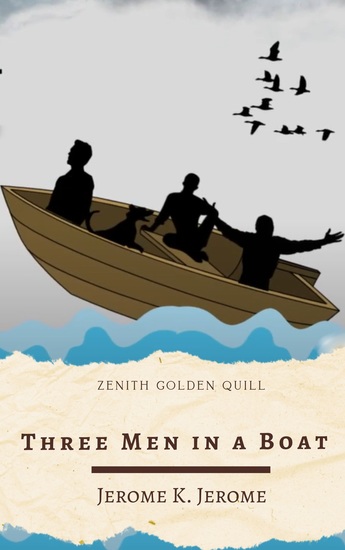
Three Men in a Boat - An Outrageous Journey on the Thames with Laughter at Every Bend - cover

Three Men in a Boat - An Outrageous Journey on the Thames with Laughter at Every Bend

Jerome K, Zenith Golden Quill

Verlag: Zenith Golden Quill

  • 0
  • 0
  • 0

Beschreibung

Three friends, one dog, and endless laughs on the River Thames.

Three Men in a Boat is Jerome K. Jerome's hilarious and enduring comic novel about three bumbling friends—J., George, and Harris—and their loyal fox terrier Montmorency, as they set out on a boating holiday that quickly turns into a series of ridiculous and unforgettable escapades.

Published in 1889, this quintessentially British farce blends dry wit, absurdity, and keen social observation. Whether fumbling with tents or philosophizing on the miseries of packing, Jerome's characters reflect universal human folly with charm and good humor.

This edition includes classic illustrations and annotations for modern readers, making it the perfect escape for lovers of humor, satire, and travel gone wonderfully wrong.

"Still as funny today as it was over a century ago." — The Guardian
"A comic masterpiece of the English language." — The Times Literary Supplement

Click Buy Now and join the most delightfully disastrous river cruise in literature.
Verfügbar seit: 14.05.2025.
Drucklänge: 213 Seiten.

Weitere Bücher, die Sie mögen werden

  • Leonid Andreyev - A Short Story Collection - Considered to be a father of Expressionism in Russian literature and the Russian Edgar Allan Poe we bring a unique collection of amazing stories for you to hear - cover

    Leonid Andreyev - A Short Story...

    Leonid Andreyev

    • 0
    • 0
    • 0
    Leonid Nikolaievich Andreyev was born on 21st August in Oryol, Russia to a middle-class family of Polish, Ukranian and Finnish ancestry. 
     
    He studied law in Moscow before working as a police-court reporter for a daily newspaper.  His literary efforts at this time were confined to poetry and those he did try to get published were all rejected.  
     
    In 1898 his first short story ‘Bargamot and Garaska’, published in the ‘Kurier’ newspaper caught the attention and friendship of Maxim Gorky.  Andreyev now discarded any other career path apart from that of author. 
     
    His first collection of short stories appeared in 1901 and sold over a quarter of a million copies.  He was a sensation. Using his interest in psychology and psychiatry gave him an almost unrivalled ability to delve into the human psyche and create astonishing characters. 
     
    During the first Russian revolution Andreyev was a staunch defender of democratic ideals and many of his stories reflected the heated mood of the times. With the 1905 Revolution’s failure his work became pessimistic and despairing. By the beginning of the following decade he began losing his audience to new literary movements such as the Futurists. 
     
    He published little after 1914 except political writings, instead working as the literary editor of the ‘Russian Will’ newspaper.  When the Bolsheviks took power he sensed catastrophe was coming and moved to Finland where he spent his last years in poverty distraught at the outcome of the Revolution. 
     
    Leonid Andreyev died of heart failure on 12th September 1919 at the age of 48 in Mustamäki, Finland.
    Zum Buch
  • The Picture of Dorian Gray - cover

    The Picture of Dorian Gray

    Oscar Wilde

    • 0
    • 0
    • 0
    The Picture of Dorian Gray is an acclaimed novel by Oscar Wilde, first published in 1890. It tells the story of a handsome and wealthy young man, Dorian Gray, who discovers a portrait of himself. After making a wish to stay young and beautiful forever, the painting begins to age instead of him and Dorian must keep it hidden from the world. As he lives a life of pleasure and excess, the painting continues to reveal Dorian's true self and ultimate fate. With its themes of morality, innocence, and self-destruction, The Picture of Dorian Gray remains one of the most important and influential works of literature. 
    Oscar Wilde (1854-1900) was an Irish playwright, novelist, poet, and wit. He was one of the most prominent figures of the late Victorian era and a leading light of the Aesthetic Movement. Wilde is best known for his plays “The Importance of Being Earnest” and “An Ideal Husband”, as well as his novel “The Picture of Dorian Gray”. His work was heavily influenced by his Irish background, as well as his love of the theater. His witticisms and epigrams are still widely quoted today. Wilde was also an outspoken critic of Victorian morality, often challenging the conventions of the day. His personal life was also the subject of much controversy and he was imprisoned for two years for “gross indecency”. Wilde’s life and work have inspired generations of writers, artists, and thinkers. He is still regarded as one of the most influential writers in English literature.
    Zum Buch
  • Beowulf - Hall Translation - cover

    Beowulf - Hall Translation

    John Lesslie Hall

    • 0
    • 0
    • 0
    Composed toward the end of the first millennium, Beowulf is the elegiac narrative of the adventures of Beowulf, a Scandinavian hero who saves the Danes from the seemingly invincible monster Grendel and, later, from Grendel's mother. He then returns to his own country and dies in old age in a vivid fight against a dragon. The poem is about encountering the monstrous, defeating it, and then having to live on in the exhausted aftermath. In the contours of this story, at once remote and uncannily familiar at the beginning of the twenty-first century, Nobel laureate Seamus Heaney finds a resonance that summons power to the poetry from deep beneath its surface. Drawn to what he has called the "four-squareness of the utterance" in Beowulf and its immense emotional credibility, Heaney gives these epic qualities new and convincing reality for the contemporary reader.
    Zum Buch
  • Top 10 Short Stories The - Men 1880s - The top ten Short Stories of the 1880's written by male authors - cover

    Top 10 Short Stories The - Men...

    Guy de Maupassant, Leo Tolstoy,...

    • 0
    • 0
    • 0
    Short stories have always been a sort of instant access into an author’s brain, their soul and heart.  A few pages can lift our lives into locations, people and experiences with a sweep of landscape, narration, feelings and emotions that is difficult to achieve elsewhere. 
     
    In this series we try to offer up tried and trusted ‘Top Tens’ across many different themes and authors. But any anthology will immediately throw up the questions – Why that story? Why that author?  
     
    The theme itself will form the boundaries for our stories which range from well-known classics, newly told, to stories that modern times have overlooked but perfectly exemplify the theme.  Throughout the volume our authors whether of instant recognition or new to you are all leviathans of literature. 
     
    Some you may disagree with but they will get you thinking; about our choices and about those you would have made.  If this volume takes you on a path to discover more of these miniature masterpieces then we have all gained something. 
     
    This decade is resplendent with literature and its many prodigiously talented authors who write on as varied a range of subjects as might be thought possible. Yet each is studded with careful literary precision and narrative verve.  It is a remarkable decade. 
     
    1 - The Top 10 - The 1880's - The Men - An Introduction 
    2 - The Horla by Guy de Maupassant 
    3 - How Much Land Does A Man Need by Leo Tolstoy 
    4 - The Body Snatcher by Robert Louis Stevenson 
    5 - The Lady with the Dog by Anton Chekhov 
    6 - The Withered Arm by Thomas Hardy 
    7 - The Canterville Ghost - Part 1 by Oscar Wilde 
    8 - The Canterville Ghost - Part 2 by Oscar Wilde 
    9 - A Horseman in the Sky by Ambrose Bierce 
    10 - The Phantom Rickshaw by Rudyard Kipling 
    11 - The Lady, or the Tiger by Frank Stockton 
    12 - The Signal by Vsevolod Garshin
    Zum Buch
  • Antigone - Full Cast Drama - cover

    Antigone - Full Cast Drama

    Sophocles

    • 0
    • 0
    • 0
    "Antigone" is a Greek tragedy written by Sophocles in the 5th century BCE. The play is part of a trilogy, but only "Antigone," the third installment, has survived. The narrative revolves around Antigone, the daughter of Oedipus, who defies the king's decree and buries her brother Polynices, in defiance of the law. The king, Creon, orders that Polynices' body should remain unburied as punishment for his rebellion against the city. 
     
    Antigone's act of burial is not only an expression of familial loyalty but also an assertion of divine laws over human laws. She believes in the moral duty to honor her brother, even in death and is willing to face the consequences. Creon, however, sees her actions as an affront to his authority and issues a decree that anyone attempting to bury Polynices will be put to death. 
     
    As the plot unfolds, the clash between divine and human laws intensifies. Antigone is caught and brought before Creon, where she staunchly defends her actions. Creon remains resolute in his decision to punish her, regardless of her familial ties. The play explores themes of morality, duty, and the consequences of pride and authoritarian rule. 
     
    Tragedy unfolds as Antigone is sentenced to be entombed alive. The narrative weaves the fates of various characters, including Antigone, Haemon (Creon's son and Antigone's fiancé), and Eurydice (Creon's wife). The play culminates in a series of tragic events, leading to Creon's realization of his own tragic flaw and the devastating consequences of his decisions.
    Zum Buch
  • A Child's Garden of Verses - cover

    A Child's Garden of Verses

    Robert Louis Stevenson

    • 0
    • 0
    • 0
    Here is a delightful look at childhood, written by master poet and storyteller Robert Louis Stevenson. In this collectionA Child's Garden of Verses of 64 poems, Stevenson recalls the joys of his childhood, from sailing boats down a river, to waiting for the lamplighter, to sailing off to foreign lands in his imagination. 
    Nothing has ever been written that appeals to a child's nature more than "A Child's Garden of Verses." It is written in a simple verse that a child can readily understand.
    Zum Buch