Begleiten Sie uns auf eine literarische Weltreise!
Buch zum Bücherregal hinzufügen
Grey
Einen neuen Kommentar schreiben Default profile 50px
Grey
Jetzt das ganze Buch im Abo oder die ersten Seiten gratis lesen!
All characters reduced
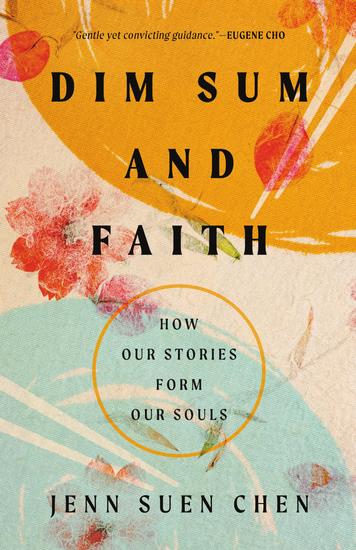
Dim Sum and Faith - How Our Stories Form Our Souls - cover

Dim Sum and Faith - How Our Stories Form Our Souls

Jenn Suen Chen

Verlag: IVP Formatio

  • 0
  • 0
  • 0

Beschreibung

Discover the Sacred in Your Story
Imagine gathering around a dim sum table, a lively setting where stories are shared over flavorful bites and heartfelt moments. This is the inviting atmosphere Jenn Suen Chen recreates in Dim Sum and Faith. Drawing from her own rich tapestry of experiences, Jenn helps readers to explore how our personal narratives shape our spiritual journeys.
Dim Sum and Faith invites you to examine the phases of your life—shaping, undoing, awakening, and reshaping. Through guided scripture reading and reflective prompts, each chapter becomes a steppingstone toward understanding the profound ways God's presence is woven through every joy and trial in your story. This isn't just about looking back; it's about seeing how our stories are a part of God's continuous formation in our lives.
Dim Sum and Faith is an invitation to pause, reflect, and rediscover the joy and peace that comes from knowing you are lovingly crafted by God.
Verfügbar seit: 12.08.2025.
Drucklänge: 208 Seiten.

Weitere Bücher, die Sie mögen werden

  • The Kybalion - A Modern Version of The Spiritual Classic - cover

    The Kybalion - A Modern Version...

    The Three Initiates, Bootsy...

    • 0
    • 0
    • 0
    The Kybalion is the fundamental book on Hermetic Philosophy. 
    This book explains the nature of existence in Seven Principles according to Ancient Egyptian Philosophy. This information was kept hidden and passed down throughout the ages and contains the underlying principles of Truth found in all systems of thought. 
    This information can be applied to life in a practical or magical way. 
    This book was created based on the message inscribed on the Emerald Tablet of Thoth or “Hermes Trismigestus”. Thoth is said to be an Ascended Master who came back to Egypt to share the secrets of the Universe with Civilization. 
    Some of the most prominent thinkers and inventors credit the Emerald Tablet as the Secret to their achievements including Sir Isaac Newton, Madam Blavatsky, Fulcanelli and many more. 
    This mythological knowledge is the basis of Hermetic Law, explained by the Seven Hermetic axioms which describe by nature, the operating principles of existence. 
    These principles can be used to experience maximum fulfillment in life, make new discoveries and attain extraordinary goals. These are the secret principles on which our world operates and they can be applied in order to fulfill our deepest desires. 
    The Kybalion was written anonymously by the Three Initiates in the early 1900’s as a book to share the secrets of the Hermetic Order. 
    These initiates claim to be Masons of the highest degree although they never disclose their identities. Much speculation has gone into who the actual author(s) of the book were but regardless of who wrote it, this document serves to be the fundamental guide to the structure of reality as we know it. 
    “The Lips of Wisdom are Closed. Except to the Ears of Understanding.” 
    —The Kybalion
    Zum Buch
  • Thus Spake Zarathustra - A Book for All and None - cover

    Thus Spake Zarathustra - A Book...

    Friedrich Nietzsche

    • 0
    • 0
    • 0
    Zarathustra, is a prophet who has spent years in solitude in the mountains, seeking enlightenment. He eventually descends from the mountains to share his wisdom with humanity. Throughout the book, Nietzsche presents his ideas on a variety of topics, including morality, religion, the nature of existence, and the human condition. He challenges traditional views on these subjects, advocating for a new, individualistic perspective that encourages the pursuit of one's own path in life. "Thus Spake Zarathustra" is known for its poetic and often cryptic language, as well as its challenging ideas. It has been interpreted in many different ways, and remains a cornerstone of Nietzsche's philosophy. Read in English, unabridged.
    Zum Buch
  • From Penal Colony to Paper Justice - The Hidden Truth of Australia’s Justice System - cover

    From Penal Colony to Paper...

    Ylia Callan

    • 0
    • 0
    • 0
    This audiobook is narrated by an AI Voice.   
    From its very beginnings as a penal colony, Australia's justice system was designed not for fairness, but for control. From Penal Colony to Paper Justice investigates how this history continues to shape modern courts, laws, and policing. 
    This hard-hitting exposé explores: 
    The colonial foundations of punishment and control. 
    How British legal traditions still dominate an "independent" nation. 
    The role of judges, police, and public servants in maintaining the system. 
    Real-world cases that reveal systemic injustice. 
    The cost to ordinary citizens - financial, social and personal. 
    Practical solutions for a fairer, more transparent legal system. 
    Blending history, analysis, and shocking examples, this book challenges the illusion of equality before the law. It shows how justice often functions as "paper justice" - words and procedures that protect power while leaving ordinary people vulnerable. 
    Engaging, uncompromising, and thought-provoking, this audiobook is for anyone who wants to understand the truth behind Australia’s justice system - and what must change for it to finally deliver justice for all.
    Zum Buch
  • Spanish Made Easy - Beginner - Volume 2 of 3 - cover

    Spanish Made Easy - Beginner -...

    Lingo Wave

    • 0
    • 0
    • 0
    We broke our new series on learning Spanish down into different learning stages. Start with the "Lower Beginner" books followed by the "Beginner" and "Upper Beginner" books. Next, progress to the "Intermediate" series, then test and reinforce your knowledge with the "Conversations" series. 
    This audiobook is divided into units.While it provides different learning patterns and accommodates various needs, this audiobook focuses on helping you improve your ability to understand, speak, and memorise Spanish.  
    In Unit 1 you will hear Spanish decoded with each syllable spoken very slowly and clearly with repetition. Immediately before each sentence is spoken, you will hear the translation, so you will always understand what is being said. 
    Unit 2 focuses solely on increasing your listening ability, which will improve your abilities to engage in dialogue with a native Spanish speaker. This chapter requires you to listen very carefully to nuances in the language. 
    By Unit 3 you will already notice progress in your abilities to speak and understand Spanish. The spoken translation is followed by two repetitions in Spanish at a completely natural speed. While you are learning to process naturally spoken Spanish, Units 3 and 4 will help you memorise new vocabulary and full sentences. 
    In Unit 5 you can test yourself on how much you have learned. If you are having difficulties, we suggest you revisit the listening, speaking, or memorisation section of Units 1, 2 3 or 4, according to what you need more help with. 
    Topics covered in this book: 
    1. Asking about family 
    2. Asking about relationship status 
    3. Expressing frequency 
    4. Talking about spare time activities and hobbies 
    5. Using quantifiers/determiners 
    6. Talking about preference 
    7. Talking about abilities 
    8. Talking about location of places 
    9. Describing appearance 
    10. Talking about personality 
    ...
    Zum Buch
  • Set Good Boundaries - Where You Stop And I begin - cover

    Set Good Boundaries - Where You...

    Zera Young

    • 0
    • 0
    • 0
    Setting healthy boundaries can be a real challenge, especially if you find yourself in codependent dynamics. If you often prioritize others' needs over your own, Set Good Boundaries is your go-to manual. It equips you with essential skills to define boundaries within your current relationships and kick-start new connections on the right foot. 
    Master the art of confidently and assertively communicating your needs. This book caters to anyone aiming to improve relationships, break free from people-pleasing tendencies, and find lasting inner peace. Whether you're dealing with an overbearing parent, a pushy friend, or someone displaying narcissistic traits, this book equips you to understand and address the core reasons behind boundary challenges.In this book you'll explore: 
    ✅Deconstruct the lie of selfishness 
    ✅How to handle a toxic relationship or a person who invalidates your emotions (for example, gaslighting, manipulation, or narcissism) 
    ✅ Proven tips for saying “no” and making it stick 
    ✅Step-by-step strategies that train you to assert yourself with confidence 
    ✅How to break away from people-pleasing habits and prioritize your needs - without fracturing healthy relationships 
    ✅And so much more! 
    Even if you're always prioritizing others, steering clear of conflicts, or feeling unsure about where to begin, this book is your solution. It offers a comprehensive insight into the boundaries necessary for your well-being.Get ready to step into a life of genuine connections and sustained happiness.
    Zum Buch
  • How to Teach Buddhism to Children - cover

    How to Teach Buddhism to Children

    Dr. Helmuth Klar

    • 0
    • 0
    • 0
    This is an audiobook of Bodhi Leaves No. 9 by Dr. Helmuth Klar, 'How to Teach Buddhism to Children' found in the Pariyatti Edition of Collected Bodhi Leaves Vol. I, narrated by Christa Michel.
     
    Excerpt:
     
    "...How can Buddhist parents best teach their own children Buddhism? since they will seldom have the opportunity to teach it to other children, let alone the children of non-Buddhist parents. As I do not wish to theorize, I shall speak only from practical experience with my own children, and so of Western children in general. It is moreover particularly the Western child which is exposed to a Christian or materialistic environment, and hence is in need of a carefully considered Buddhist education. In a Buddhist country, steeped in its centuries-old Buddhist tradition, the position of a Buddhist child is (or should be) far easier. In such a favourable environment a good and effective Buddhist educational system may have developed. But even if it had it would be a great mistake for us, as Westerners, to copy it without due consideration.
    Zum Buch