Begleiten Sie uns auf eine literarische Weltreise!
Buch zum Bücherregal hinzufügen
Grey
Einen neuen Kommentar schreiben Default profile 50px
Grey
Jetzt das ganze Buch im Abo oder die ersten Seiten gratis lesen!
All characters reduced
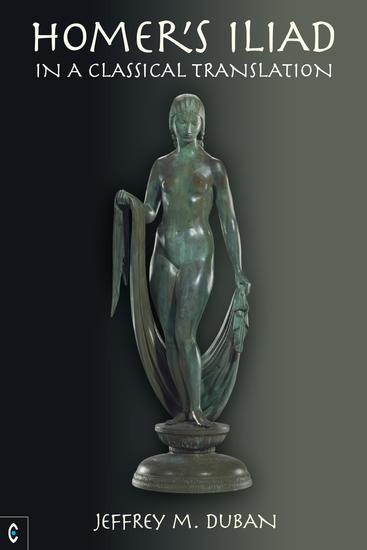
Homer's Iliad - In a Classical Translation - cover

Homer's Iliad - In a Classical Translation

Jeffrey Duban

Verlag: Clairview Books

  • 0
  • 0
  • 0

Beschreibung

The Iliad presents superhuman heroes and superhuman rage, brutal death, unbounded sorrow, the craving for revenge, the shortness of life, the glory quest, and, ultimately, reconciliation and forgiveness. As human nature is unchanging, the Iliad's themes concern us as much today as they did Homer's audiences 2,700 years ago. Not for nothing did Ezra Pound observe that "a civilization was founded on Homer."
The Iliad is always relevant, even as it is timeless. Of interest to readers in every generation, it is a classic in the root sense. Homer was "the Bible of the Greeks." He was their mythology and history (still fairly merged at the time), their religion, their storehouse of ethics and exempla under an Olympian dispensation. And while the Odyssey is the more popular of Homer's epics, the Iliad is the more profound.
This is not merely another new translation of Homer's Iliad. It is sooner and foremost Homer's Iliad in a Classical Translation – the first-ever into a consistently 12-syllable line and, at the same time, the longest such work in the English language (the Iliad consisting of 15,639 lines in Greek). This translation by Jeffrey M. Duban uses a mildly archaizing style and other poetic devices to suggest the antiquity and flavor of Homeric composition. Like the original, it is both alliterative and polysyllabic – excessive monosyllabism the scourge of many a modern translation. Duban further observes epic decorum with recourse to poetic diction. Decorum entails the avoidance of colloquialisms and commonplaces, again in contrast to other translations.
"Through its masterful deployment of archaism, inversion, elevated diction, and other techniques of aesthetic distanciation, Duban's uniquely metered rendering re-Homerizes the Iliad, as it were, casting its remoteness and peculiarity into sharp relief." – Robert Pogue Harrison, Rosina Pierotti Professor in Italian Literature, Stanford University, Author, The Body of Beatrice (1988)
"While Homer's style can be plain and direct, it is also often very grand and even, at times, ornate. You will find plainness in many modern translations of Homer, but you will likely search in vain for elevation. In his spirited rendering of the Iliad, Jeffrey Duban aims high. Through a carefully crafted use of heightened poetic diction and a consistent metrical formalism, Duban offers us, in English verse, a singular version of Homer's epic poem." – Steven Shankman, University of Oregon, Author, Pope's Iliad: Homer in the Age of Passion (1983), Editor, Pope's Iliad (Penguin ed., 1996)
"Like the campfires scene concluding Book 8, Duban's Iliad, with the antique luster of burnished bronze, glints smartly across the plain. Think what you will of the contemporary or 'new' translations a'flood the market, this one, classically conceived and executed, is special. Duban does not merely translate but conveys his vision for the Iliad." – C. J. Mackie, La Trobe University, Author, Rivers of Fire: Mythic Themes in Homer's Iliad (2008)
Verfügbar seit: 05.05.2025.
Drucklänge: 672 Seiten.
Weitere Bücher, die Sie mögen werden

  • 3 Stories About - Class & Status - A trio of classic tales perfect for a commute walk or quiet night in - cover

    3 Stories About - Class & Status...

    Guy de Maupassant, Katherine...

    • 0
    • 0
    • 0
    There is something about the number 3.    
     
    The Ancient Greeks believed 3 was the perfect number, and in China 3 has always been a lucky number, and they know a thing or two.   
     
    Most religions also have 3 this and 3 that and, of course, in these more modern times, three’s a crowd may be too many, except when it’s a ménage à trois.  It seems good things usually come in threes. 
     
    Whatever history and culture says WE think 3, a hat-trick of stories, is a great number to explore themes and literary avenues that classic authors were so adept at creating. 
     
    From their pens to your your ears. 
     
    01 - 3 Stories About - Class and Status 
    02 - The Garden Party by Katherine Mansfield 
    03 - The Necklace by Guy de Maupassant 
    04 - The Lost Reflection by E T A Hoffman
    Zum Buch
  • Value of System In Home Life The (Unabridged) - cover

    Value of System In Home Life The...

    Booker T. Washington

    • 0
    • 0
    • 0
    Booker Taliaferro Washington (April 5, 1856 - November 14, 1915) was an American educator, author, orator, and adviser to several presidents of the United States. Between 1890 and 1915, Washington was the dominant leader in the African American community and of the contemporary black elite. Washington was from the last generation of black American leaders born into slavery and became the leading voice of the former slaves and their descendants. They were newly oppressed in the South by disenfranchisement and the Jim Crow discriminatory laws enacted in the post-Reconstruction Southern states in the late 19th and early 20th centuries.
    THE VALUE OF SYSTEM IN HOME LIFE: Most of you are going out from Tuskegee sooner or later to exert your influence in the home life of our people. You are going to have influence in homes of your own, you are going to have influence in the homes of your mothers and fathers, or in the homes of your relatives.
    Zum Buch
  • A Journey of Little Profit - From their pens to your ears genius in every story - cover

    A Journey of Little Profit -...

    John Buchan

    • 0
    • 0
    • 0
    The Scottish novelist John Buchan enjoyed a remarkable career as politician, historian and Governor General. He was born John Buchan on 26th August 1875 and later added 1st Baron Tweedsmuir PC GCMG GCVO CH to his name.  
    Buchan studied at Hutchesons’ Grammar School, Glasgow and at seventeen won a scholarship to the University of Glasgow to study classics. There he began to write poetry. In 1895 he transferred to Oxford to continue his study of Classics and in 1896 ‘Sir Quixote of the Moors’ was published followed by the non-fiction ‘Scholar-Gipsies’. His prolific literary output now hardly faltered. 
    He graduated in 1900 and became the private secretary to Alfred Milner, the High Commissioner for Southern Africa and other colonies. Buchan found the same inspiration in the African landscape as he had in the Scottish Borders, and would later set many works here. Returning to London he became a partner in a publishing house, and garnered an editorial role at The Spectator. He also completed his law studies. He was called to the bar in 1901 but never practiced.  
    On 15th July 1907 Buchan married Susan Charlotte Grosvenor, the cousin of the Duke of Westminster. In 1910 he wrote ‘Prester John’, the first of a series set in South Africa.  
    In 1911 Buchan entered politics as a Unionist candidate in the Scottish Borders advocating the support of free trade, women’s suffrage, national insurance, and reducing the power of the House of Lords.  
    The Great War saw Buchan writing for the War Propaganda Bureau and as Times correspondent in France. In 1915, he published ‘The Thirty-Nine Steps’, his most famous book and a follow-up Richard Hannay novel, ‘Greenmantle’, in 1916.  
    In 1916 Buchan enlisted in the Intelligence Corps which included writing speeches for Sir Douglas Haig. By 1917 he was Director of Information under Lord Beaverbrook. Buchan called it “the toughest job he ever took on”. He somehow found time to assist in a history of the war magazine. This was later published in 24 volumes: Nelson’s History of the War. 
    After the war his writing focused on historical studies. In 1927 Buchan became the Unionist Party Member of Parliament for the Combined Scottish Universities. In a speech to Parliament he said “I believe every Scotsman should be a Scottish nationalist. If it could be proved that a Scottish parliament were desirable… Scotsmen should support it.”  
    Over the next decade he continued to distinguish himself politically and in literature.  On the 1st June 1935 he became 1st Baron Tweedsmuir of Elsfield in the County of Oxford.  
    He was now also given the position of Governor General in Canada and resolved to travel all over Canada to gain a better insight of the country. Having crossed both length and breadth he saw the cultural shift between areas and their common ground and helped bring about a clear national Canadian identity. 
    On the 6th February 1940 he collapsed from a stroke and sustained a very serious head injury in falling. Two rounds of surgery to stabilise his condition were unsuccessful and Buchan died on the 11th February. After a state funeral in Ottawa his ashes were returned to his estate in Oxfordshire.
    Zum Buch
  • How Watson Learnt the Trick - cover

    How Watson Learnt the Trick

    Arthur Conan Doyle

    • 0
    • 0
    • 0
    How Watson Learnt the Trick is a Sherlock Holmes parody written by Arthur Conan Doyle in 1924. It concerns Doctor Watson attempting to demonstrate to Holmes how he has learned the latter's "superficial trick" of logical deduction by giving a summary of Holmes' current state of mind and plans for the day ahead, only for Holmes to then reveal that every single one of Watson's deductions is incorrect.Conan Doyle was one of several authors commissioned to provide books for the library of Queen Mary's Dolls' House; others included J. M. Barrie, Thomas Hardy, Rudyard Kipling and W. Somerset Maugham. Conan Doyle was provided with a book approximately 1.5" x 1.25" (3.75 cm x 3.15 cm) into which he wrote the 503-word story of How Watson Learned the Trick by hand, taking up 34 pages. The original manuscript is still part of the Dolls' House library.
    Zum Buch
  • Pride and Prejudice - cover

    Pride and Prejudice

    Jane Austen

    • 0
    • 0
    • 0
    Pride and Prejudice unfolds the timeless tale of spirited Elizabeth Bennet and the brooding Mr. Darcy, set against the elegant backdrop of Regency-era England. This classic Jane Austen novel weaves sharp social commentary with an enduring romance that has captivated readers for over two centuries. Narrated by Amelia Clarke, this audiobook brings every witty exchange and heartfelt confession to life, from Elizabeth’s first, prickly impressions of Darcy to the triumphant overcoming of pride and prejudice on both sides. 
    With memorable characters, keen observations on class and manners, and a narrative that balances humor and emotion, Pride and Prejudice remains one of the most beloved works of English literature. Amelia Clarke’s warm yet nuanced performance highlights the novel’s rich dialogue and vivid settings—from grand country estates to lively balls—making this edition an irresistible experience for both longtime fans and newcomers alike. Whether you’re discovering Elizabeth Bennet’s independent spirit or Darcy’s hidden kindness for the first time, this rendition of Pride and Prejudice is sure to enchant and inspire.
    Zum Buch
  • The Classic A Christmas Carol - cover

    The Classic A Christmas Carol

    Charles Dickens

    • 0
    • 0
    • 0
    "A Christmas Carol" follows the transformation of Ebenezer Scrooge, a miserly and cold-hearted old man, throughout one magical Christmas Eve. The narrative begins with Scrooge, a wealthy but stingy moneylender, dismissing the Christmas season with contempt and refusing to give to charity. He dislikes the idea of Christmas joy and generosity, considering them a waste of time and money. On Christmas Eve, as Scrooge is visited by the ghost of his former business partner, Jacob Marley. Marley, burdened with heavy chains as punishment for his greed and selfishness in life, warns Scrooge that he will suffer a similar fate unless he changes his ways. 
     
    Marley tells Scrooge that he will be visited by three spirits that night. The first the Ghost of Christmas Past, takes Scrooge on a journey through his childhood and early adulthood. Scrooge witnesses scenes from his past, including his lonely and neglected childhood, lost love, and moments when he chose money over relationships. The second spirit, the Ghost of Christmas Present, shows Scrooge scenes of people joyfully celebrating Christmas in the present. Scrooge is particularly moved by the Cratchit family, especially Bob Cratchit and his son Tiny Tim, who is ill. Despite their poverty, the Cratchits find happiness in each other and embody the true spirit of Christmas. The third spirit, the Ghost of Christmas Yet to Come (or the Ghost of Christmas Future), shows Scrooge a bleak future if he continues on his current path. Scrooge sees his lonely death and the lack of mourning from those around him. He also witnesses Tiny Tim's death, which is a result of the family's inability to afford proper medical care. 
    Frightened and remorseful, Scrooge pleads for a chance to change. He promises to embrace the Christmas spirit and become a better person. Awakening on Christmas morning, Scrooge is overjoyed to discover that he has been given a second chance
    Zum Buch