Rejoignez-nous pour un voyage dans le monde des livres!
Ajouter ce livre à l'électronique
Grey
Ecrivez un nouveau commentaire Default profile 50px
Grey
Abonnez-vous pour lire le livre complet ou lisez les premières pages gratuitement!
All characters reduced
The Reveries of the Solitary Walker - Enriched edition - cover

The Reveries of the Solitary Walker - Enriched edition

Jean-Jacques Rousseau

Maison d'édition: DigiCat

  • 0
  • 0
  • 0

Synopsis

In "The Reveries of the Solitary Walker," Jean Jacques Rousseau presents a profound exploration of solitude and self-reflection through a series of contemplative essays. Written in the latter years of his life, this work embodies Rousseau's lyrical style and philosophical inquiries, weaving together themes of nature, identity, and the essence of human experience. The narrative reflects the Enlightenment's preoccupation with individualism, yet it uniquely diverges into a deep personal journey, serving both as a philosophical treatise and a richly textured memoir of his walks through nature and his inner thoughts. Rousseau, a seminal figure in the Enlightenment, grappled with concepts of society, education, and human emotion throughout his life, often finding himself at odds with the conventions of his time. His exile and continuous search for belonging and authenticity heavily informed the reflective tone of this work, showcasing his belief in the transformative power of nature and solitude. The reveries allow a glimpse into his soul, capturing the tension between societal expectations and personal freedom. This book is highly recommended for readers interested in philosophical literature and the human condition. Rousseau's eloquence invites readers to join him on his introspective journey, encouraging a dialogue between the self and the world, making it an essential read for anyone seeking to understand the complexities of solitude and enlightenment.

In this enriched edition, we have carefully created added value for your reading experience:
- A succinct Introduction situates the work's timeless appeal and themes.
- The Synopsis outlines the central plot, highlighting key developments without spoiling critical twists.
- A detailed Historical Context immerses you in the era's events and influences that shaped the writing.
- An Author Biography reveals milestones in the author's life, illuminating the personal insights behind the text.
- A thorough Analysis dissects symbols, motifs, and character arcs to unearth underlying meanings.
- Reflection questions prompt you to engage personally with the work's messages, connecting them to modern life.
- Hand‐picked Memorable Quotes shine a spotlight on moments of literary brilliance.
- Interactive footnotes clarify unusual references, historical allusions, and archaic phrases for an effortless, more informed read.
Disponible depuis: 22/11/2022.
Longueur d'impression: 104 pages.
D'autres livres qui pourraient vous intéresser

  • Asuka Period - Buddhism Reform and the Birth of Japanese Civilization - cover

    Asuka Period - Buddhism Reform...

    Rolf Hedger

    • 0
    • 0
    • 0
    The Asuka Period (538–710) marks a pivotal era in Japan’s history, serving as the transitional phase between the ancient Kofun Period and the Nara Period. This era is often considered the birthplace of Japanese civilization, a time when the political, religious, and cultural foundations of the nation began to take shape. It was during this period that Japan first came into direct contact with continental Asia, particularly through the introduction of Buddhism, the establishment of a centralized government, and the adoption of Chinese-style political and legal systems. 
    The early years of the Asuka Period were dominated by the Soga clan, who played a crucial role in the political and religious developments of the time. Their influence can be seen in their advocacy for the adoption of Buddhism, which arrived in Japan from Korea around the mid-sixth century. Buddhism’s introduction, however, was met with resistance from the powerful native Shinto religious leaders and aristocracy, creating a conflict that would shape the religious landscape of Japan for centuries to come. 
    Despite early opposition, Buddhism gradually took hold in Japan. The Soga clan, with the support of the royal family, used Buddhism as a tool to consolidate power and gain legitimacy. By the late 6th century, the religion had become deeply integrated into the fabric of Japanese society, influencing not only spiritual practices but also politics, art, and culture.
    Voir livre
  • What Wise Men Do - The Secret World of Conan Doyle Bram Stoker Jules Verne and the Unseen Hand - cover

    What Wise Men Do - The Secret...

    Philip Gardiner

    • 0
    • 2
    • 0
    Over the course of human history there have been many men who have stood out amongst the crowd. Whether writers of fiction, great physicians or even politicians, these men may in fact share a common purpose, regardless of the age in which they lived. What Wise Men Do analyses various great men such as:
    
    Paracelsus
    Grand Master Pinto of the Knights of Malta
    Sir Arthur Conan Doyle
    Jules Verne
    H. G. Wells
    Bram Stoker
    Bob Kane the creator of Batman
    
    In this series of investigations, a thread of truth is discovered, revealing an inner yearning linked to our own evolutionary path and shared by each and every one of the individuals in question. This book investigates concepts of magic as seen in each age and questions the truth of the statements against modern science and even theoretical science. In each case some new and startling discovery is made, making this compelling book a revelation from chapter to chapter.
    Voir livre
  • Movies under the Influence - cover

    Movies under the Influence

    Jocelyn Szczepaniak-Gillece

    • 0
    • 0
    • 0
    Movies under the Influence charts the entangled histories of moviegoing and mind-altering substances from early cinema through the psychedelic 1970s. Jocelyn Szczepaniak-Gillece examines how the parallel trajectories of these two aspects of American culture resulted in them being treated and regulated in similar ways. Rather than looking at drug use within film, she regards cinema and intoxicants as kindred experiences of immersion that have been subject to corresponding forces of ideology and power. 


    Szczepaniak-Gillece demonstrates how American movie theaters sought to cultivate a dual identity, presenting themselves as both a place of wholesome entertainment and a zone of illicit behavior. Movies under the Influence highlights the legislative, legal, and corporate powers that held sway over theaters, locating the convergence of moviegoing and drug use as a site of mediation and social control. 


    As much as substances and cinema are points where power intervenes, they are also settings of potential transcendence, and Movies under the Influence maintains this paradox as a necessary component of American film history. This book examines the relationship intoxicants suggest between mass media, spectatorship, and governmental regulation and provides a new angle from which to understand cinema's lasting role in evolving American culture.
    Voir livre
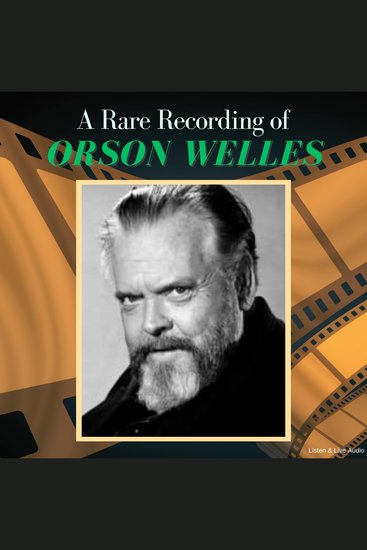
  • A Rare Recording of Orson Welles - cover

    A Rare Recording of Orson Welles

    Orson Welles

    • 0
    • 0
    • 0
    George Orson Welles (May 6, 1915 – October 10, 1985) was an American actor, director, screenwriter, and producer who is remembered for his innovative work in film, radio, and theatre. He is considered to be among the greatest and most influential filmmakers of all time, creating such classics as Citizen Kane, The Third Man and The Magnificent Ambersons.
    Voir livre
  • Trauma Tresses and Truth - Untangling Our Hair Through Personal Narratives - cover

    Trauma Tresses and Truth -...

    Lyzette Wanzer

    • 0
    • 0
    • 0
    Black women continue to have a complex and convoluted relationship with their hair. 


    From grammar and high schools to corporate boardrooms and military squadrons, Black and Afro Latina natural hair continues to confound, transfix, and enrage members of White American society. Why, in 2022, is this still the case? Why have we not moved beyond that perennial racist emblem? And why are women so disproportionately affected? 


    Why does our hair become most palatable when it capitulates, and has been subjugated, to resemble Caucasian features as closely as possible? Who or what is responsible for the web of supervision and surveillance of our hair? Who in our society gets to author the prevailing constitution of professional appearance? 


    Particularly relevant during this time of emboldened White supremacy, racism, and provocative othering, this work explores how writing about one of the still-remaining systemic biases in schools, academia, and corporate America might lead to greater understanding and respect.
    Voir livre
  • The History of England - cover

    The History of England

    Jane Austen

    • 0
    • 0
    • 0
    The History of England from Henry IV to Charles I, by a partial, prejudiced, and ignorant historian.  N.B. There will be very few dates in this History! Jane Austen wrote The History of England in 1791, at the age of just 15, as a satirical parody of 18th-century historical textbooks.  It pokes fun at the apparent impartiality of contemporary historians and contains more opinions about the monarchs' relative characters than any facts or dates. The History of England was not published until 1922, more than a century after Austen's death.
    Voir livre