Rejoignez-nous pour un voyage dans le monde des livres!
Ajouter ce livre à l'électronique
Grey
Ecrivez un nouveau commentaire Default profile 50px
Grey
Abonnez-vous pour lire le livre complet ou lisez les premières pages gratuitement!
All characters reduced
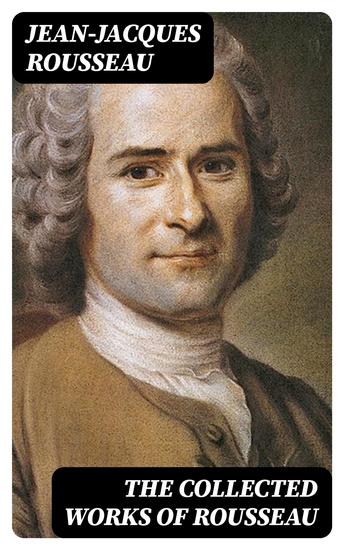
The Collected Works of Rousseau - Enriched edition - cover

The Collected Works of Rousseau - Enriched edition

Jean-Jacques Rousseau

Traducteur Barbara Foxley, G. D. H. Cole, Samuel William Orson

Maison d'édition: DigiCat

  • 0
  • 0
  • 0

Synopsis

The Collected Works of Rousseau presents a comprehensive compilation of the writings of one of the Enlightenment's most pivotal figures. This anthology showcases Rousseau's provocative ideas on social contract theory, education, and the nature of human freedom, melding philosophical rigor with deeply personal reflections. His innovative literary style often blurs the boundaries between autobiography and political treatise, as seen in seminal works such as "The Social Contract" and "Emile, or On Education." The collection captures the essence of 18th-century philosophical discourse, highlighting Rousseau's keen critique of contemporary society and his call for authentic self-expression in a rapidly modernizing world. Jean-Jacques Rousseau, born in Geneva in 1712, was a profoundly influential thinker whose ideas helped lay the groundwork for modern political and educational thought. His tumultuous life, characterized by personal strife and a deep sense of existential inquiry, shaped his views on the corrupting influence of civilization and the innate goodness of humanity. Rousseau's experiences, including his estrangement from society and his passionate writings, bring a unique authenticity and urgency to his works. This collection is indispensable for any reader seeking to understand the complexities of human nature and the social contract's enduring relevance. It not only offers insight into Rousseau's philosophical tenets but also invites contemplation on contemporary issues of individuality and community, making it a vital resource for students, scholars, and anyone interested in the evolution of democratic thought.

In this enriched edition, we have carefully created added value for your reading experience:
- An Introduction draws the threads together, discussing why these diverse authors and texts belong in one collection.
- Historical Context explores the cultural and intellectual currents that shaped these works, offering insight into the shared (or contrasting) eras that influenced each writer.
- A combined Synopsis (Selection) briefly outlines the key plots or arguments of the included pieces, helping readers grasp the anthology's overall scope without giving away essential twists.
- A collective Analysis highlights common themes, stylistic variations, and significant crossovers in tone and technique, tying together writers from different backgrounds.
- Reflection questions encourage readers to compare the different voices and perspectives within the collection, fostering a richer understanding of the overarching conversation.
Disponible depuis: 13/11/2022.
Longueur d'impression: 1769 pages.

D'autres livres qui pourraient vous intéresser

  • Mission Iran - Special Forces Berlin & Operation Eagle Claw JTF 1-79 - cover

    Mission Iran - Special Forces...

    James Stejskal

    • 0
    • 0
    • 0
    On November 4, 1979, "student" supporters of the Ayatollah seized the U.S. Embassy with over sixty hostages. Although the Cold War was in full swing, the Iran hostage crisis was a watershed for the United States. 


    Detachment A had been established in Berlin early in the Cold War to harass and delay any Soviet military advance west. This Special unit trained relentlessly for every aspect of unconventional warfare, and was later assigned a second mission of counterterrorism. 


    The plan for Operation Eagle Claw, as it became known, was extremely complex. The first stage was intelligence gathering—no mean feat as most of the CIA's capabilities in the country had been eliminated. With operatives trained in intelligence work, fluent in many languages, and adept at blending in, Det A took on the advanced recon of the targets. Then, when Delta Force admitted that it could only manage the assault of the Embassy, Det A volunteered to rescue the three Americans at the Foreign Ministry. 


    Veteran and historian James Stejskal details Det A's unique and integral role in Operation Eagle Claw, based upon firsthand accounts of the operatives involved.
    Voir livre
  • The Legacy of the Roman Empire - cover

    The Legacy of the Roman Empire

    Rogan Fish

    • 0
    • 0
    • 0
    The rise of Rome is one of the most remarkable stories in world history, transforming from a small settlement on the banks of the Tiber River into one of the most powerful empires the world has ever seen. The foundation of Rome is traditionally dated to 753 BCE, attributed to the legendary figure Romulus. Over time, Rome evolved through three major phases: the monarchy, the republic, and the empire, each contributing to its dominance. The city's location played a crucial role in its growth, offering natural protection, fertile land, and access to trade routes that facilitated economic and military expansion. 
    During the period of the Roman Kingdom, Rome was ruled by a series of kings, who laid the groundwork for its legal and social structures. However, dissatisfaction with monarchical rule led to the establishment of the Roman Republic in 509 BCE. This new form of government introduced a complex system of checks and balances, with power divided among elected officials, including consuls, senators, and popular assemblies. The republic was built on the idea of civic duty and military service, which helped unify its citizens under a shared sense of identity. It was during this time that Rome expanded its influence, conquering neighboring territories through strategic military campaigns. The Roman legions, known for their discipline and tactical superiority, played a key role in these conquests. 
    Rome’s transition from a republic to an empire was marked by internal conflicts and power struggles. As Rome’s territories expanded, so did the challenges of governance. The late republic saw growing economic inequality, political corruption, and civil wars between powerful leaders. Figures like Julius Caesar, Pompey, and Crassus sought control, leading to the eventual downfall of the republic. The assassination of Caesar in 44 BCE created further instability, but it ultimately paved the way for the rise of Augustus, who became the first emperor in 27 BCE.
    Voir livre
  • Sacred Tension - Rebuilding the Church Through Love Action and Community - cover

    Sacred Tension - Rebuilding the...

    Martin Toe

    • 0
    • 0
    • 0
    Sacred Tension by Martin Toe 
    In a world that often pulls us in opposing directions-faith and doubt, action and stillness, tradition and progress-how do we find balance? Sacred Tension explores the delicate dance between spirituality and the struggles of everyday life, offering profound insights into the power of faith, resilience, and community. 
    With a voice that is both poetic and deeply personal, Martin Toe weaves together reflections, real-life stories, and timeless wisdom to guide readers through the complexities of living a purpose-driven life. Whether you're wrestling with spiritual questions, seeking deeper meaning, or looking for a fresh perspective on faith in modern times, this book offers a compelling roadmap to navigate the tension between the sacred and the secular. 
    For those yearning for a renewed sense of connection and clarity, Sacred Tension is more than a book-it's an invitation to embrace the beauty of life's contradictions and find strength in the in-between. 
    Perfect for readers of inspirational nonfiction, faith-based reflection, and spiritual growth.
    Voir livre
  • The Persian Empire – The Forgotten Superpower - The Rise Glory and Legacy of the First Great Empire in History - cover

    The Persian Empire – The...

    Andrew Rogers

    • 0
    • 0
    • 0
    Before Rome, before Greece, there was Persia—a vast empire that revolutionized governance, culture, and warfare. It was the first empire to embrace religious tolerance, international trade networks, and complex administration. Yet today, it remains overshadowed by its rivals. 
    This audiobook takes you deep into the history of the Persian Empire, revealing its greatest rulers, monumental achievements, and legendary battles. Discover: 
    ✅ How Cyrus the Great built the first global empire 
    ✅ The rise of Darius I and Xerxes, and their wars with Greece 
    ✅ The Persian system of governance, roads, and military tactics 
    ✅ How Alexander the Great conquered Persia—and what he admired about it 
    The Persian Empire – The Forgotten Superpower is a must-listen for history lovers, ancient warfare enthusiasts, and anyone fascinated by the rise and fall of great civilizations.
    Voir livre
  • The Republic - Plato - cover

    The Republic - Plato

    Plato

    • 0
    • 0
    • 0
    The Republic is a Socratic dialogue, authored by Plato around 375 BCE, concerning justice, the order and character of the just city-state, and the just man.It is Plato's best-known work, and one of the world's most influential works of philosophy and political theory, both intellectually and historically. 
    In the dialogue, Socrates discusses the meaning of justice and whether the just man is happier than the unjust man with various Athenians and foreigners. He considers the natures of existing regimes and then proposes a series of hypothetical cities in comparison, culminating in Kallipolis , a utopian city-state ruled by a philosopher-king. They also discuss ageing, love, theory of forms, the immortality of the soul, and the role of the philosopher and of poetry in society. The dialogue's setting seems to be the time of the Peloponnesian War
    Voir livre
  • The Cholera Years - The United States in 1832 1849 and 1866 - cover

    The Cholera Years - The United...

    Charles E. Rosenberg

    • 0
    • 0
    • 0
    Cholera was the classic epidemic disease of the nineteenth century, as the plague had been for the fourteenth. Its defeat was a reflection not only of progress in medical knowledge but of enduring changes in American social thought. Rosenberg has focused his study on New York City, the most highly developed center of this new society. Carefully documented, full of descriptive detail, yet written with an urgent sense of the drama of the epidemic years, this narrative is as absorbing for general audiences as it is for the medical historian. In a new Afterword, Rosenberg discusses changes in historical method and concerns since the original publication of The Cholera Years. 
     
    “A major work of interpretation of medical and social thought . . . this volume is also to be commended for its skillful, absorbing presentation of the background and the effects of this dread disease.”—I.B. Cohen, New York Times 
     
    ”The Cholera Years is a masterful analysis of the moral and social interest attached to epidemic disease, providing generally applicable insights into how the connections between social change, changes in knowledge and changes in technical practice may be conceived.”—Steven Shapin, Times Literary Supplement 
     
    ”In a way that is all too rarely done, Rosenberg has skillfully interwoven medical, social, and intellectual history to show how medicine and society interacted and changed during the 19th century. The history of medicine here takes its rightful place in the tapestry of human history.”—John B. Blake, Science
    Voir livre