Rejoignez-nous pour un voyage dans le monde des livres!
Ajouter ce livre à l'électronique
Grey
Ecrivez un nouveau commentaire Default profile 50px
Grey
Abonnez-vous pour lire le livre complet ou lisez les premières pages gratuitement!
All characters reduced
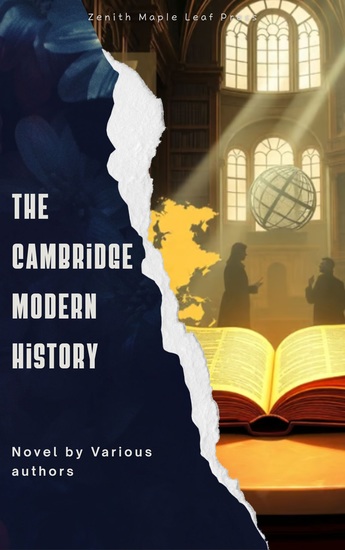
The Cambridge Modern History - cover

The Cambridge Modern History

J.B. Bury, Mandell Creighton, R. Nisbet Bain, George Prothero, Adolphus William Ward, Lord Acton

Maison d'édition: Zenith Maple Leaf Press

  • 0
  • 0
  • 0

Synopsis

A landmark in historical scholarship — the complete story of the modern world.

The Cambridge Modern History is one of the most ambitious and influential works of history ever published. Compiled by leading scholars under the direction of Lord Acton in the early 20th century, this multi-volume masterpiece offers a sweeping narrative of world history from the Renaissance through the 19th century.

Why readers value it:

Comprehensive scope. Covers politics, religion, science, economics, and culture across centuries.

Scholarly authority. Written by some of the most distinguished historians of its era.

Definitive reference. Long regarded as a foundational resource for students, teachers, and history enthusiasts.

A monumental achievement
From the Reformation to the French Revolution, from the rise of nations to the shaping of modern Europe, The Cambridge Modern History provides unparalleled detail and perspective. More than a record of events, it is a deep exploration of the forces that created the modern world.

✨ Rediscover history through one of the greatest intellectual projects of all time.

👉 Click "Buy Now" and own The Cambridge Modern History—a definitive collection of knowledge, scholarship, and insight.
Disponible depuis: 27/08/2025.
Longueur d'impression: 5708 pages.

D'autres livres qui pourraient vous intéresser

  • The Immortality Complex - A Science Fiction Short Story - cover

    The Immortality Complex - A...

    Jeff Walker

    • 0
    • 0
    • 0
    A science fiction short story from Jeff Walker, author of such titles as: The Long Lost War, The Massive Planet: The Adventures Of Deep Contact, Your Service Is Required, The Jungle Planet and The Mysterious World of Professor Darkk and Miss Shadow. 
    Simon Janson died at the end of his life, only to be reborn into a new body and his mind uploaded to it. Now he must live in a world where death is no longer a factor in human beings anymore. Simon travels beyond Earth to find meaning in his life now, stumbling upon a new love and new challenges. But can he cope with living forever? Is better to die rather than live on and on with no end? As humanity continues to improve and stretch out into the cosmos, Simon feels the burden of being immortal.
    Voir livre
  • Send Her Back and Other Stories - cover

    Send Her Back and Other Stories

    Munashe Kaseke

    • 0
    • 0
    • 0
    In Send Her Back and Other Stories, Munashe Kaseke offers an awfully intimate, fresh telling of the immigrant black woman experience in the United States, equally awash with a myriad of challenges as well as the joys of exploring a new world. With sumptuous candor, her complicated, and often tangled, female Zimbabwean protagonists navigate issues of identity, microaggressions, and sexism in vibrant and indelible settings, and at times a tense US political climate. Yet again, these are not only stories of overcoming, they're also marked by characters who've risen to the top of their professional fields, seized the American dream, and who travel the world in glee. Kaseke peels back on the inner wranglings of characters caught between two worlds be it by stories of dating outside one's culture and race or failing to assimilate upon returning home after spending time abroad. Uncanny. Witty. Gripping. Send Her Back and Other Stories dazzles, leaving you newly awakened to the world we live in. 
    Voir livre
  • The Doorway Prince - cover

    The Doorway Prince

    Dawn Blair

    • 0
    • 0
    • 0
    The king’s advisor has a problem. The dead king left no heirs. 
    Eclipse searches for the kingdom's next ruler, but his calculations are skewed and unfocused. He doesn’t understand why he can’t get a handle on them. Worse, the royal council presses him for a decision. 
    He has only a star to assist his way through these dark times, and it lights his way to a teen, frightened, alone, and sleeping in a doorway. 
    In escorting the boy to the back to the castle, the young man is genuinely afraid of crossing through doorways. In one moment, Eclipse has a hold of him, and in the next, the teen is gone. 
    Will the star guide Eclipse across time and space, against others who also pursue the teen, to find the boy who would be king? 
    Travel the Wells of the Onesong for an epic fantasy quick read adventure by the author of The Loki Adventures.
    Voir livre
  • The Murderer - Bulgakov expertly explores life and death choices set on the backdrop of the Bolshevik Revolution - cover

    The Murderer - Bulgakov expertly...

    Mikhail Bulgakov

    • 0
    • 0
    • 0
    Mikhail Bulgakov was born on 15th May 1891 in Kiev, in the Kiev Governorate of the Russian Empire, into a Russian family.  He was one of seven children. 
     
    In 1901, Bulgakov attended the First Kiev Gymnasium, and developed a keen interest in Russian and European literature, theatre and opera.  After the death of his father in 1907, his mother assumed responsibility for his education.  After graduating Bulgakov entered the Medical Faculty of Kiev University and then took up a post as physician at the Kiev Military Hospital. 
     
    At the outbreak of the First World War, he volunteered as a doctor and was sent directly to the front, where he was badly injured at least twice.  To suppress chronic pain, especially in the abdomen, he injected morphine.  It took years to wean himself off. 
     
    He now took up medical posts in various towns and in 1919, he was mobilised by the Ukrainian People's Army and assigned to the Northern Caucasus.  There, he became seriously ill with typhus and barely survived.  
     
    After this illness, Bulgakov abandoned his medicine to pursue writing.  He moved to Vladikavkaz and had two plays staged there with great success.  He wrote too for various newspapers and other outlets, but his critics were many.  And growing. 
     
    When a Moscow's theatre director severely criticised Bulgakov, Stalin personally protected him, saying that a writer of Bulgakov's quality was above ‘party words’ like ‘left’ and ‘right’.   Indeed, it is said that Stalin watched ‘The Days of the Turbins’ at least 15 times. 
     
    It was not to last and by March 1929, Bulgakov's career was ruined when Government censorship stopped publication of any of his work and plays. 
     
    In despair, Bulgakov wrote a personal letter to Stalin.  He requested permission to emigrate.  He received a phone call from the Soviet leader, who asked the writer whether he really desired to leave. He replied that a Russian writer cannot live outside of his homeland.  Stalin thus gave him permission to continue working. In May 1930, he re-joined the theater, as stage director's assistant.  
     
    During the last stressful decade of his life, and in poor health, Bulgakov continued to work on ‘The Master and Margarita’, wrote plays, critical works, stories, and continued translations and dramatisations of novels.  Many of them were not published, others were derided by critics.  
     
    On 10th March 1940, Mikhail Afanasyevich Bulgakov died from nephrosclerosis.  He was 48. 
     
    ‘The Master and Margarita’ was not published in any form until the mid-1960’s 
     
    Here Bulgakov relates a story as told by a doctor describing the terrible things that humanity is capable of doing in times of war.
    Voir livre
  • Dracula's Guest - From their pens to your ears genius in every story - cover

    Dracula's Guest - From their...

    Bram Stoker

    • 0
    • 0
    • 0
    Abraham Stoker was born in Dublin, Ireland on the 8th of November 1847, the third of seven children.  
    His early years were plagued with such ill-health that he was unable to start school until the age of seven.  He turned the long periods of recovery into an opportunity for thinking and said “I was naturally thoughtful, and the leisure of long illness gave opportunity for many thoughts which were fruitful according to their kind in later years”.  
    Strikingly at Trinity College, Dublin his health had returned with such vigour that he was named their University Athlete whilst also achieving a BA in Mathematics with honours.  
    At this time his interest in theatre became a job offer to be the Dublin Evening Mail’s theatre critic, co-owned by Sheridan Le Fanu.  He now began to also write short stories and in 1872 ‘The Crystal Cup’ was published.  An interest in art developed and he co-founded the Dublin Sketching Club.  
    In 1878 came marriage to Florence Balcombe.  She had formerly been courted by Stoker’s acquaintance, Oscar Wilde.  The marriage produced one child.   
    Stoker had some years before reviewed Henry Irving’s Hamlet and had dined with him.  That friendship now resulted in a proposal from Irving to move to London and to manage his Lyceum Theatre.  His numerous commercial innovations ensured both he and the theatre thrived.  Irving would also often take Stoker with him when he toured abroad. 
    Despite this busy life Stoker continued to write and these works paved the way for his most famous creation, published in 1897, ‘Dracula’.  It is rightly recognised as one of the greatest horror novels of all time and although not the first with a theme of Vampires, it is undoubtedly the most well-known. 
    Stoker also wrote poetry and many excellent short stories and continued to write novels and other works throughout his career. 
    Politically Stoker supported Home Rule, though only by peaceful means.  He was also keen on following scientific trends particularly in medicine. 
    In 1902 his tenure at the Lyceum Theatre ended and although he continued to write his health was deteriorating, mainly due to a series of debilitating strokes. 
    Bram Stoker died on the 20th April 1912, in Pimlico, London.  He was 64.
    Voir livre
  • The Mappined Life - cover

    The Mappined Life

    Saki Saki

    • 0
    • 0
    • 0
    In Saki's short story "The Mappined Life," the narrative unfolds through a conversation between Mrs. James Gurtleberry and her niece, who reflect on the nature of existence and the illusion of freedom within societal constraints. The story is set against the backdrop of the Mappin Terraces at the Zoological Gardens, which symbolize a façade of natural living for both animals and humans.
    Voir livre