Join us on a literary world trip!
Add this book to bookshelf
Grey
Write a new comment Default profile 50px
Grey
Subscribe to read the full book or read the first pages for free!
All characters reduced
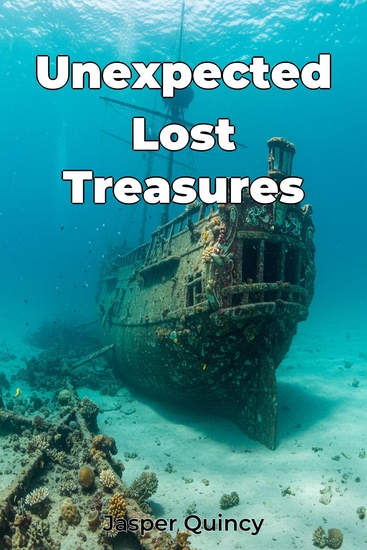
Unexpected Lost Treasures - cover

Unexpected Lost Treasures

Jasper Quincy

Translator A AI

Publisher: Publifye

  • 0
  • 0
  • 0

Summary

"Unexpected Lost Treasures" embarks on a historical adventure, investigating the enduring allure of real, undiscovered artifacts and riches. The book argues that the search for these lost items transcends mere monetary gain, representing a quest to understand human history and civilization.

 
Consider the Flor de la Mar, a Portuguese ship lost in 1511 while carrying a vast treasure, or the Amber Room, the lavish chamber stolen during World War II. These stories, and others, offer potential keys to unlocking new perspectives on trade routes, artistic achievements, and pivotal historical events.

 
The book weaves together maritime, art, and military history to provide a comprehensive context for these mysteries. Starting with a definition of what constitutes a significant lost treasure, the narrative progresses through specific examples, detailing their histories and the ongoing searches.

 
By exploring historical documents, archaeological reports, and eyewitness accounts, "Unexpected Lost Treasures" presents factual information in an accessible and engaging manner, much like a historical mystery. The narrative acknowledges the speculative nature of some claims, focusing on well-documented cases where rediscovery remains plausible.
Available since: 04/03/2025.
Print length: 60 pages.

Other books that might interest you

  • How to Master Technical Communication - The ultimate guide to specialist writing and tips not to be fooled by spin doctors - cover

    How to Master Technical...

    Ingrid Beauvez-Denis

    • 0
    • 0
    • 0
    Experience a truly HUMAN audiobook, brought to life by a warm, expressive voice artist. Her calm yet engaging delivery, paired with varied pacing and intonation, makes every concept instantly clear—boosting your comprehension and memory. 
     
    Prefaced by NATO’s lead interpreter and head of training, this book provides a simple formula for speaking and writing about specialist topics so they are understood by anyone. Achieve two seemingly opposite goals: be clear and comprehensive, yet succinct and to the point. Prevent misunderstandings and ensure you never bore or annoy your audience. As a bonus, you will learn to recognize when others use "savant words" to manipulate you. 
     
    Is this book for you? 
    - Have you struggled to explain topics that were complex or strange to your listeners? 
    - Have you ever felt lost by someone’s jargon but weren’t sure how to ask for clarity? 
    - Have you ever sensed that some people were trying to fool you by throwing fancy words at you? 
     
    This is a fantastic tool for professionals across all fields, including public speakers, translators, interpreters, and B2–C2 TESOL/ESL students and teachers. 
     
    What you will learn: 
    - Putting yourself in your partners’ shoes 
    - Mastering standard structures and active language 
    - Choosing the right subjects 
    - Explaining your specialised terms in everyday English 
    - Making coherent lists 
    - Why ‘looks matter’ 
     
    Listening time: 3 hours, a small investment for a lifetime of impressing your audience, colleagues, teachers, and students with brilliant explanations. 
     
    The Superpower Combo: Pair this audiobook with the slim paperback featuring illustrations, recap tables, and space for notes. Present your completed exercises to a coach for professional feedback. 
     
    Ready to start? Press play and learn how to turn the nuts and bolts of technical jargon into a crystal-clear flow of language!
    Show book
  • Hurlbut's Story of the Bible Part 7 - cover

    Hurlbut's Story of the Bible Part 7

    Jesse Lyman Hurlbut

    • 0
    • 0
    • 0
    Some years ago, the editor of an English magazine sent a communication to "the hundred greatest men in Great Britain" asking them this question: "If for any reason you were to spend a year absolutely alone, in a prison for instance, and could select from your library three volumes to be taken with you as companions in your period of retirement please to inform us what those three books would be." The inquiry was sent to peers of the realm, prominent leaders in politics, judges, authors, manufacturers, merchants, gentlemen of leisure—men who would represent every aspect of successful life. In the answers it was found that ninety-eight of the hundred men named "The Bible" first on the list of the three books to be chosen. (From Book introduction)
    Show book
  • Adult Survivors of Emotionally Abusive Parents - How to Heal Cultivate Emotional Resilience and Build the Life and Love You Deserve - cover

    Adult Survivors of Emotionally...

    PhD Sherrie Campbell

    • 0
    • 0
    • 0
    When your parents are pathologically self-centered, manipulative, or emotionally abusive, the pain they cause is deep and often difficult to put into words. You may experience anxiety, depression, complex post-traumatic stress disorder (C-PTSD), low self-esteem, addiction, or other mental health conditions as an adult. But it was not your fault, and there are tools you can use to heal the trauma caused by your childhood. 


    This compassionate guide will help you gain a greater understanding of what happened in your past; transform deep pain into emotional resilience; and build the loving, meaningful relationship with yourself that you deserve. You'll also learn to set boundaries with others, assert your needs, and overcome emotional avoidance to develop warm, loving relationships with others. 


    Author Sherrie Campbell offers powerful skills drawn from a range of evidence-based treatments, including mindfulness, acceptance and commitment therapy (ACT), cognitive behavioral therapy (CBT), self-compassion, lived experience, and body-based practices to help you heal from the past and reconnect with your authentic self. 


    Let this book guide you on the path to healing, wholeness, and self-discovery.
    Show book
  • Chernobyl - The Night the Reactor Exploded - cover

    Chernobyl - The Night the...

    Dante Benegas

    • 0
    • 0
    • 0
    This audiobook is narrated by an AI Voice.   
    Chernobyl: The Night the Reactor Exploded is a documentary audiobook that reconstructs the events of April 26th, 1986 — when Reactor Number Four at the Chernobyl Nuclear Power Plant exploded and changed the course of nuclear history. 
    This is not a dramatization. It is a structured, factual analysis of what happened, why it happened, and what followed. 
    The audiobook traces the technical design of the RBMK reactor, the failed safety test that triggered the explosion, the response of firefighters and liquidators, and the long-term environmental and health consequences. It then moves beyond the event itself to examine the deeper systemic causes: organizational pressure, suppressed warnings, and the institutional dynamics that allowed risk to escalate unchecked. 
    Chernobyl was not only a technological accident. It was a failure of design, culture, and decision-making under constraint. 
    Clear, analytical, and grounded in documented history, this audiobook offers a sober examination of one of the most consequential industrial disasters of the twentieth century — and the enduring lessons it carries for complex technological systems today.
    Show book
  • The Chemical Marriage - cover

    The Chemical Marriage

    Manly Palmer Hall

    • 0
    • 0
    • 0
    The self-admitted author of The Chemical Marriage, Johann Valentin Andreæ, born in Württemberg in 1586, was twenty-eight years of age when that work was first published. It was presumably written about twelve years prior to its publication--or when the author was fifteen or sixteen years old. The fact is almost incredible that one so young could produce a volume containing the wealth of symbolic thought and philosophy hidden between the lines of The Chemical Marriage. This book makes the earliest known reference to Christian Rosencreutz, and is generally regarded as the third of the series of original Rosicrucian manifestoes. As a symbolic work, the book itself is hopelessly irreconcilable with the statements made by Andreæ concerning it. The story of The Chemical Marriage relates in detail a series of incidents occurring to an aged man, presumably the Father C.R.C. of the Fama and Confessio. If Father C.R.C. was born in 1378, as stated in the Confessio, and is identical with the Christian Rosencreutz of The Chemical Marriage, he was elevated to the dignity of a Knight of the Golden Stone in the eighty-first year of his life (1459). In the light of his own statements, it is inconceivable that Andreæ could have been Father Rosy Cross.
    Show book
  • Numidians The: The History of the Ancient Berbers Who Fought with Carthage against Rome - cover

    Numidians The: The History of...

    Editors Charles River

    • 0
    • 0
    • 0
    Carthage was one of the great ancient civilizations, and at its peak, the wealthy Carthaginian empire dominated the Mediterranean against the likes of Greece and Rome, with commercial enterprises and influence stretching from Spain to Turkey. In fact, at several points in history it had a very real chance of replacing the fledgling Roman empire or the failing Greek poleis (city-states) altogether as master of the Mediterranean. Although Carthage by far preferred to exert economic pressure and influence before resorting to direct military power (and even went so far as to rely primarily on mercenary armies paid with its vast wealth for much of its history, it nonetheless produced a number of outstanding generals, from the likes of Hanno Magnus to, of course, the great bogeyman of Roman nightmares himself: Hannibal.  
    	What is often overlooked is how Carthage interacted with other groups in North Africa, some of which fought with them and against them. North Africa is generally thought of as a land devoid of life, full of nothing but desert wastelands and populated only by desert Bedouins, and while the Sahara Desert does comprise the majority of North Africa’s landmass, it is far from being the only significant sub-region of the area. Just to the north of the Sahara Desert, in what are today the modern nation-states of Algeria, Tunisia, and parts of Libya and Morocco, the land was known as Numidia in antiquity. Numida was the complete opposite of the North African stereotype of a desolate place - it was a land of plenty, the home of rich agricultural land that provided a good share of the Roman Empire’s food. Numidia was also home to the Numidian people, who were known for their horsemanship skills, bellicosity, and capriciousness when it came to their friends and allies. From the 3rd century BCE until the mid-1st century BCE, the Numidians ruled their land as independent kingdoms that dealt with their more powerful neighbors.
    Show book