Rejoignez-nous pour un voyage dans le monde des livres!
Ajouter ce livre à l'électronique
Grey
Ecrivez un nouveau commentaire Default profile 50px
Grey
Abonnez-vous pour lire le livre complet ou lisez les premières pages gratuitement!
All characters reduced
Precolonial Mapping - cover

Precolonial Mapping

Jasper Quincy

Traducteur A AI

Maison d'édition: Publifye

  • 0
  • 0
  • 0

Synopsis

Precolonial Mapping explores how indigenous cultures understood and navigated their environments without formal cartography. Challenging Western-centric views, it reveals sophisticated alternative knowledge systems used for centuries. The book focuses on mental maps, cognitive representations of space crucial for daily life, and oral traditions, dynamic archives of geographical information transmitted through stories and rituals. These systems, tailored to specific cultural values, demonstrate effective ways of interacting with the environment. The book examines diverse indigenous societies, highlighting the cultural significance of landscapes and their connection to identity.

 
Beginning with an introduction to precolonial mapping, it progresses through the creation of mental maps and the role of oral traditions. It investigates applications in resource management, navigation, and conservation.

 
Readers will gain insights into sustainable living and alternative ways of knowing, making it valuable for those interested in history, geography, and indigenous cultures.
Disponible depuis: 29/03/2025.
Longueur d'impression: 62 pages.


D'autres livres qui pourraient vous intéresser

  • King Frederick the Great: A short biography - 5 Minutes: Short on time - long on info! - cover

    King Frederick the Great: A...

    5 Minutes, 5 Minute Biographies,...

    • 0
    • 0
    • 0
    King Frederick the Great, Prussian leader and artist: Life and work in a short biography! Everything you need to know, brief and concise. Infotainment, education and entertainment at its best!
    Voir livre
  • Skull and Bones: The History and Mystery of Yale University’s Notorious Secret Society - cover

    Skull and Bones: The History and...

    Editors Charles River

    • 0
    • 0
    • 0
    Conspiracy theories, and particularly the belief that elements of the world are secretly controlled by individuals or groups, have been around for as long as people have lived in groups. Perhaps that’s inevitable - after all, those who are excluded from power are very likely to be inclined to see their position not as an outcome of their own choices or situation but because of the secret machinations of shadowy groups. 
    When members of a secret society are some of the wealthiest and most powerful people in the world, it’s easy to see why rumors persist about the group, and among such secret societies, few have engendered interest quit like Skull and Bones, an undergraduate senior society at Yale University. Its members have included American presidents and the CEOs of some of the largest companies in the world, but the group’s secrecy has maintained itself to the extent that some of the membership is virtually all anyone knows for certain, leaving most of what is found in books and websites speculation and unproven legend. Is there any truth to the suggestion that this society is linked to the 18th century Illuminati? Is it a mafia-like organization that intends to see the creation of a New World Order? Why, during its almost 200-year history, has no member of this group ever talked publicly about what it involves? Have those who attempted to reveal more really been subject to intimidation, threats of violence, and even murder? Is the skull of the legendary Geronimo really kept within the group’s secret lair? 
    Writing about any secret society is difficult, and writing about a group that has maintained absolute privacy for a long time is even more difficult.
    Voir livre
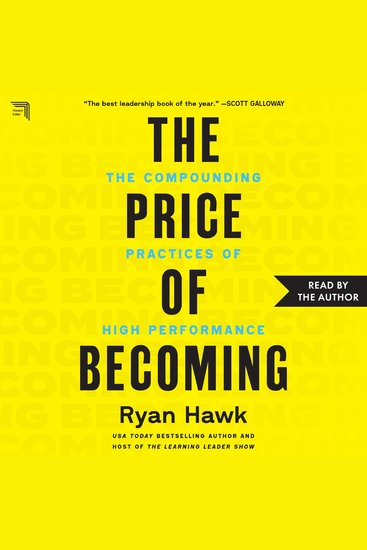
  • The Price of Becoming - The Compounding Practices of High Performance - cover

    The Price of Becoming - The...

    Ryan Hawk

    • 0
    • 0
    • 0
    The acclaimed host of The Learning Leader Show delivers the bracing message that growth comes at a cost and equips readers with a rigorous, practical roadmap for paying that price and achieving lasting excellence in work and life. 
    Ambitious people know what they want to do and where they want to go, but they aren’t sure how to get there. Abstract advice feels good but ultimately changes nothing. Only concrete action can change habits, which in turn changes lives. 
    The Price of Becoming is a clear guide with instructions for overcoming complacency, mastering communication, and making better decisions under pressure. Ryan Hawk draws from over 700 interviews with some of the world’s leading experts, leaders, thinkers, movers, and doers, including Jim Collins, Simon Sinek, Adam Grant, Tony Robbins, James Clear, Paul Rabil, Jocko Willink, Susan Cain, Alex Hutchinson, Seth Godin, and General Stanley McChrystal, to answer one powerful question: “What can I do today to build a better me?” 
    Ryan distills their numerous insights, data, and direct personal experiences into a practical, actionable framework he divides into three sections:Learn—Fuel Your Intake EngineWork—Take ActionLead—Teach Others 
    Personal growth is about pushing your edges. Going beyond your current zone of comfort and competency. Clear, practical, and timeless, The Price of Becoming is an empowering and informative handbook designed to help you practice daily improvement, sustain excellence, and build the life and career you envision through intentional, continuous learning and active growth.
    Voir livre
  • Drunks: An American History - An American History - cover

    Drunks: An American History - An...

    Christopher M. Finan

    • 0
    • 0
    • 0
    A social history of alcoholism in the United States, from the seventeenth century to the present day 
    Today, millions of Americans are struggling with alcoholism, but millions are also in long-term recovery. Alcoholics Anonymous and a growing number of recovery organizations are providing support for alcoholics who will face the danger of relapse for the rest of their lives. We have finally come to understand alcoholism as a treatable illness, rather than a moral failure. Today’s advocates can draw inspiration from the victories of sober drunks throughout American history. 
    Christopher Finan recounts the nation’s history with alcohol and its search for sobriety, which began among Native Americans in the colonial period, when liquor was used to cheat them of their property. He introduces us to the first of a colorful cast of characters, a remarkable Iroquois leader named Handsome Lake, who dedicated his life to helping his people renounce hard liquor. And we meet Carrie Nation, the wife of an alcoholic who destroyed bars with an ax in her anger over what alcohol had done to her family, as well as the idealistic and energetic Washingtonians, reformed drunks who led the first national movement to save men like themselves. 
    Finan also tells the dramatic story of Bill Wilson and Dr. Bob Smith, the two drunks who helped each other stay sober and then created AA, which survived its tumultuous early years and has made it possible for millions of men and women to quit drinking. This is narrative history at its best: entertaining and authoritative, an important portrait of one of America’s great liberation movements.
    Voir livre
  • Island Hopping across the Pacific Theater in World War II: The History of America’s Victorious Leapfrogging Strategy against Imperial Japan - cover

    Island Hopping across the...

    Editors Charles River

    • 0
    • 0
    • 0
    The waters of the Pacific Ocean – stretching deep blue under the tropical sun, or scourged by typhoons – provided World War II's most far-flung battlefield. Two of the world's premier mid 20th century maritime powers, the United States of American and the Empire of Japan, grappled for supremacy across that vast expanse. 
    By the time the Battle of Midway was over in June 1942, the defeat was so devastating for Japan that it was actually kept secret from all but the highest echelons of the Japanese government. Along with the loss of hundreds of aircraft and over 3,000 men killed, the four Japanese aircraft carriers lost, when compared to America’s one lost carrier, was critical considering America’s huge shipbuilding superiority.  
    By the spring of 1943, American military planners had begun to create a plan to dislodge Japan from east and southeast Asia. To do so, parts of the Philippines were considered main strategic points in the potential Allied attack in the Pacific. The end goal of the Allied plan was an invasion of the Japanese home islands, in which heavy aerial bombardment would precede a ground assault. In order for this to occur, Allied forces would have to occupy areas surrounding Japan, with China adding to Luzon (the largest island in the Philippines) and Formosa (a large island off the coast of China) to create a triangle from which they could launch their bombers. 
    The Allied advance across the Pacific was based on this 1943 plan, with General MacArthur and his forces moving to the north through New Guinea, then Morotai Island, and then to Mindanao, which was the southernmost major island in the Philippines chain. At the same time, Admiral Chester Nimitz sent his fleet through the central Pacific, where they engaged Japanese forces at the Gilbert, Marshall, Marianas and Palau Islands en route to Mindanao.
    Voir livre
  • Science Ideated - The Fall Of Matter And The Contours Of The Next Mainstream Scientific Worldview - cover

    Science Ideated - The Fall Of...

    Bernardo Kastrup

    • 0
    • 0
    • 0
    Leading-edge empirical observations are increasingly difficult to reconcile with "scientific" materialism. Laboratory results in quantum mechanics, for instance, strongly indicate that there is no autonomous world of tables and chairs out there. Coupled with the inability of materialist neuroscience to explain consciousness, this is forcing both science and philosophy to contemplate alternative worldviews. Analytic idealism—the notion that reality, while equally amenable to scientific inquiry, is fundamentally mental—is a leading contender to replace "scientific" materialism.  


    In this book, the broad body of empirical evidence and reasoning in favor of analytic idealism is reviewed in an accessible manner. The book brings together a number of highly influential essays previously published by major media outlets such as Scientific American and the Institute of Art and Ideas. The essays have been revised and improved, while two never-before-published essays have been added. The resulting argument anticipates a historically imminent transition to a scientific worldview that, while elegantly accommodating all known empirical evidence and predictive models, regards mind not matter as the ground of all reality.
    Voir livre