Rejoignez-nous pour un voyage dans le monde des livres!
Ajouter ce livre à l'électronique
Grey
Ecrivez un nouveau commentaire Default profile 50px
Grey
Abonnez-vous pour lire le livre complet ou lisez les premières pages gratuitement!
All characters reduced
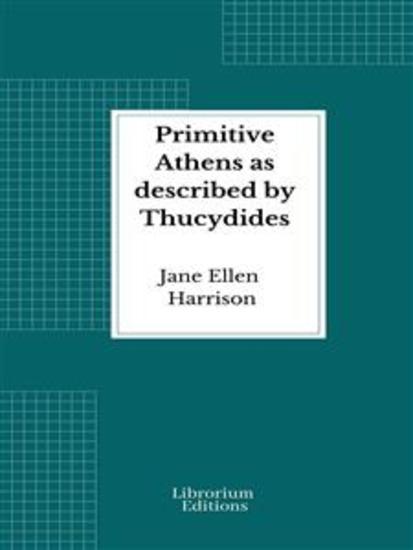
Primitive Athens as described by Thucydides - cover

Primitive Athens as described by Thucydides

Jane Ellen Harrison

Maison d'édition: Librorium Editions

  • 0
  • 0
  • 0

Synopsis

The traveller who visits Athens for the first time will naturally, if he be a classical scholar, devote himself at the outset to the realization of the city of Perikles. His task will here be beset by no serious difficulties. The Acropolis, as Perikles left it, is, both from literary and monumental evidence, adequately known to us. Archaeological investigation has now but little to add to the familiar picture, and that little in matters of quite subordinate detail. The Parthenon, the Propylaea, the temple of Nike Apteros, the Erechtheion (this last probably planned, though certainly not executed by Perikles) still remain to us; their ground-plans and their restorations are for the most part architectural certainties. Moreover, even outside the Acropolis, the situation and limits of the city of Perikles are fairly well ascertained. The Acropolis itself was, we know, a fortified sanctuary within a larger walled city. 
Disponible depuis: 01/08/2024.

D'autres livres qui pourraient vous intéresser

  • God Sees the Truth But Waits - From their pens to your ears genius in every story - cover

    God Sees the Truth But Waits -...

    Leo Tolstoy

    • 0
    • 0
    • 0
    Leo Tolstoy was born in 1828 in the Russian province of Tula to a wealthy noble family. As a child, he had private tutors but he showed little interest in any formal education. When he went to the University of Kazan in 1843 to study oriental languages and law, he left without completing his courses.  Life now was relaxed and idle but with some writing also taking place.  Gambling debts forced an abrupt change of path and he joined the army to fight in the Crimean War.  He was commended for his bravery and promoted but was appalled at the brutality and loss of life.  He recorded these and other earlier experiences in his diaries which formed the basis of several of his works. 
    In 1852 ‘Childhood’ was published to immediate success and was followed by ‘Boyhood’ and ‘Youth’. 
    His experience in the army and the horrors he witnessed resulted in ‘The Cossacks’ in 1862 and the trilogy ‘Sevastopol Tales’. After the war he travelled around Europe, visiting London and Paris and meeting such luminaries as Victor Hugo and Charles Darwin.  
    It was now that Tolstoy began his masterpiece, ‘War and Peace’. Published in 1869 it was an epic work that changed literature. He quickly followed this with ‘Anna Karenina’.  
    These successes made Tolstoy rich and helped him accomplish many of his dreams but also brought problems as he grappled with his faith and the lot of the oppressed poor. These revolutionary views became so popular that the authorities now kept him under surveillance.  
    He led a life of asceticism and vegetarianism and put his socialist ideals into practice by establishing numerous schools for the poor and food programmes. He also believed in giving away his wealth, which caused much discord with his wife.  
    His writing continued to bring forth classics such as ‘The Death of Ivan Ilyich’ and many brilliant and incisive short stories such as ‘How Much Land Does A Man Need’.  
    In 1901 Tolstoy was excommunicated from the Church and controversially deselected for the Nobel Prize for Literature. 
    Whilst undertaking a pilgrimage by train in October 1910 with his daughter Aleksandra he caught pneumonia in the nearby town of Astapovo.  Leo Tolstoy died on November 9th, 1910, he was 82.
    Voir livre
  • Running on Empty - 18000 Miles down Africa with Parkinson's - cover

    Running on Empty - 18000 Miles...

    Guy Deacon

    • 0
    • 0
    • 0
    'An immense feat of endurance, a remarkable achievement, and a truly inspirational adventure filled with courage and hope' – Sir Ranulph Fiennes 
    At the age of sixty, and having lived with Parkinson’s disease for over ten years, Guy Deacon CBE set out on one last adventure: to drive solo from his home in the UK 18,000 miles and through twenty-five countries to Cape Town on the southern tip of Africa. This incredible journey, across Europe and down the full length of Africa, took the former British Army officer over twelve months. Along the way, he broke down five times, underwent one emergency evacuation, and took 3,650 prescription pills. 
    There are only a handful of vehicles each year which attempt this difficult journey; many never complete it. Ongoing conflicts in Libya, South Sudan, Mozambique and many other countries make any journey exceptionally dangerous. In central Africa, road conditions, particularly in the rainy season, often make the going treacherous. Further hazards include illegal checkpoints, extortion, contaminated fuel and a lack of services. 
    Guy drove, lived and slept in his VW Transporter, often in remote spots, hundreds of miles from the nearest village or town. Reliant on patchy GPS, he often got lost. His journey was, quite simply, an incredible feat by a man travelling alone with Stage 3 Parkinson’s disease, when simply putting on a pair of shoes can take half an hour. 
    But not only did Guy’s journey fulfil a childhood dream to drive the length of Africa, his mission was also to raise global awareness of Parkinson’s disease, for which there is currently still no cure.
    Voir livre
  • Facing the Lion - Memoirs of a Young Girl in Nazi Europe - cover

    Facing the Lion - Memoirs of a...

    Simone Arnold-Liebster

    • 0
    • 0
    • 0
    FACING THE LION is the autobiographical account of a young girl's faith and courage. In the years immediately preceding World War II, Simone Arnold is a young girl who delights in life – her doting parents, her loving aunts and uncles, and her grandparents at their mountain farm in the Alsace-Lorraine region of France. As Simone grows into her preteen years, her parents turn from the Catholic Church and become devout Jehovah's Witnesses. Simone, too, embraces the faith. The Nazi party (the "Lion") takes over Alsace-Lorraine, and Simone's schools become Nazi propaganda machines. Simone refuses to accept the Nazi party as being above God. Her simple acts of defiance lead her to be persecuted by the school staff and local officials, and ignored by friends. With her father already taken away to a German concentration camp, Simone is wrested away from her mother and sent to a reform school to be "reeducated."There, Simone learns that her mother has also been put in a camp. Simone remains in the harsh reform school until the end of the war. She emerges feeling detached from life, but the faith that sustains her through her ordeals helps her rebuild her world. Facing the Lion provides an interesting and detailed view of ordinary country and town life in the pre-war years and during Hitler's regime. This inspiring story of a young girl standing up for her beliefs in the face of society's overwhelming pressure to conform is a potent reminder of the power of remaining true to one's beliefs.
    Voir livre
  • Laurence Olivier and Richard Burton: The Lives and Careers of Britain’s Most Famous Shakespearean Actors - cover

    Laurence Olivier and Richard...

    Editors Charles River

    • 0
    • 0
    • 0
    Of all the great actors of the 20th century, none personifies acting royalty more than Laurence Olivier, and some of this is simply due to the fact that he was actually knighted in 1947, along with a lengthy list of other honors that include being named a life peer in 1970 and admission to the Order of Merit in 1984. To speak of The Right Honourable Lord Laurence Olivier is not a figure of speech but rather a fact. Of course, in addition to the literal sense of the term, there is undeniably a manner in which Laurence Olivier qualifies as acting royalty, as it is not for nothing that Spencer Tracy once referred to Olivier as “the greatest actor in the English-speaking world” (Bacall). It is also important to note that Tracy refers to Olivier not as a film or theater actor specifically, because much of Olivier’s lofty standing derives from his ability to successfully navigate different mediums like stage, film, and television. The breadth of mediums in which he worked, the various roles he inhabited within them (actor, producer, director), and the formidable time span of his career lend Olivier’s career a scope of perhaps unmatched magnitude.   
    	In the 1960s, the most popular actor in the world was Richard Burton, a hard-drinking Welshman who was nevertheless so professional that he was one of the preeminent stage performers of his day. In fact, he performed Shakespeare so magnificently that he was compared to British legend Laurence Olivier, and that success ultimately led to a film career that earned him 7 Academy Award nominations, as well as BAFTA and Golden Globe awards for Best Actor. Given his accomplishments on the stage and in Hollywood, Burton became one of the world’s most recognizable leading men, so it seemed fitting that he engaged in one of Hollywood’s most legendary romances with Elizabeth Taylor.
    Voir livre
  • S Theodore Baskaran: Tamil Teller Of Tails - cover

    S Theodore Baskaran: Tamil...

    Ranjan Kamath

    • 0
    • 0
    • 0
    Sunderaraj Theodore Baskaran is a man of many parts, watchful guardian, memory-keeper and nature messenger, As a prolific author in Tamil, he brings cinema and conservation to people in their own language. He retired as Chief Postmaster General of Tamil Nadu 
    After graduating in history from Madras Christian College, followed by a job as researcher in Tamil Nadu State Archives for two years he joined the Indian Postal Service in 1964 
    During his career in the IPS in 1974 took study leave to research Tamil film history in 1976 he presented his first research article titled Film Censorship as an Instrument of Political Control in British India at the Indian History Congress at the Aligarh. 
    This and other articles formed the core of his first book The Message Bearers published in 1981. His second book The Eye of the Serpent (1996) won the Golden Lotus (Best Book on Cinema) Award in 1997. 
    In addition to his scholarly work on cinema, Baskaran is a keen bird watcher and a naturalist. He is a former honorary wild life warden, the South India Representative of the International Primate Protection League and served as a trustee of WWF-India. His collection of essays on nature and wild life conservation has been published as The Dance of the Saras (Oxford University Press) in 1999. He edited a book of articles on nature titled "The Sprint of The Black Buck" ; Penguin (2009) 
    In 2020 he was honoured by Sanctuary Foundation as a conservation hero with Sanctuary Lifetime Service Award 2020 for his role in wildlife conservation and his continuing legacy of writings in Tamil and English to the conservation discourse
    Voir livre
  • Greed & Grace - One Woman's Faith-Filled Journey to Freedom from Generational Deceit - cover

    Greed & Grace - One Woman's...

    Dena McCoy

    • 0
    • 0
    • 0
    ONE WOMAN'S STORY OF DISCOVERING UNEXPECTED GREED BEHIND A FAMILY SHE THOUGHT SHE KNEW AND LOVED, AND WHAT RENEWED FAITH TAUGHT HER DURING THE BATTLE TO BREAK FREE. 
    Greed & Grace is a powerful memoir of resilience, faith, and truth during the discovery of deception in a close family. When Dena requests unconditional love from hers, unexpected circumstances threaten to destroy her emotionally, financially, and spiritually. Can one remain hopeful when a lifetime of family love, emotional support, and inclusiveness suddenly becomes conditional and turns legal? Greed & Grace is an empowering story of personal clarity --- a memoir of a woman who discovers that her values and position in a complex family system have always been different from what she believed and with those she loved most.
    Voir livre