Junte-se a nós em uma viagem ao mundo dos livros!
Adicionar este livro à prateleira
Grey
Deixe um novo comentário Default profile 50px
Grey
Assine para ler o livro completo ou leia as primeiras páginas de graça!
All characters reduced
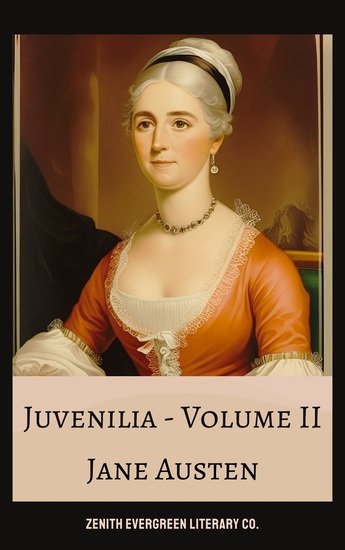
Juvenilia: Volume II - The Sparkling Wit and Early Genius of a Literary Icon - cover
LER

Juvenilia: Volume II - The Sparkling Wit and Early Genius of a Literary Icon

Jane Austen, Zenith Evergreen Literary Co.

Editora: Zenith Evergreen Literary Co.

  • 0
  • 0
  • 0

Sinopse

Before she was the queen of romantic satire, Jane Austen was a teenager with a pen—and an unshakable sense of humor.

Juvenilia: Volume II collects more of Austen's early, often outrageous short stories and parodies, written in her teens and full of bold heroines, wild plots, and a fearless wit that hinted at the brilliance to come.

These tales are not just literary curiosities—they're playful, clever, and surprisingly modern, offering fans a glimpse into the young mind that would eventually write Pride and Prejudice, Emma, and Persuasion.

💬 "For Austen devotees, this is like discovering a hidden diary—witty, wicked, and wonderfully unrefined."

✨ Why You'll Love It
Reveals Austen's earliest literary voice—brilliant, unfiltered, and hilarious

A must-have for collectors, scholars, and fans of Lady Susan, Sanditon, and Emma

Perfect for readers who love strong female voices and classic British literature

📣 Meet the Bold, Brilliant Girl Who Became Jane Austen.
Add Juvenilia: Volume II to your Kindle or shelf and enjoy the rebellious beginnings of one of literature's greatest storytellers.
Disponível desde: 17/04/2025.
Comprimento de impressão: 146 páginas.

Outros livros que poderiam interessá-lo

  • A Garland of Earth - From their pens to your ears genius in every story - cover

    A Garland of Earth - From their...

    Dorothy Edwards

    • 0
    • 0
    • 0
    Amelia Ann Blanford Edwards was born on 7th June 1831 in Islington, London.  She was educated at home by her mother and showed early promise as a writer, publishing her first poem at the age of 7 and her first story at 12.  Thereafter several popular periodicals published her poetry, stories and articles. 
    In addition she also illustrated some of her own writings and painted scenes from books she had read.  This talent was not supported by her parents, who saw an artist’s life as scandalous.  Undeterred Amelia took up composing and performing music until a bout of typhus caused throat damage.  Other interests soon followed until, early in the 1850s, Amelia focused exclusively on writing.  Her early novels were well received, and with ‘Barbara's History’ in 1864, a work revolving around bigamy, her reputation was established.  
    Amelia’s pen was also the purveyor of ghost stories for magazines and are still anthologized as classic tales to this day. 
    In January 1851, Amelia became engaged, apparently to please her parents, but she quickly broke it off.  In reality her emotional attachments were almost exclusively with women.  From the early 1860s she lived with Ellen Drew Braysher, a widow 27 years her senior, until both women died in early 1892.  During this relationship other women also entered and left her life.  Her frequent travelling companion, Lucy Renshaw, accompanied her to Egypt in the winter of 1873 and there she found a life-changing interest in Egyptology.  Aware of increasing threats from tourism and modern development she became an advocate for their research and preservation.  
    To advance the work Amelia largely abandoned much of her writing in favour of Egyptology and even took on strenuous lecture tours to raise funds. 
    After catching influenza, Amelia Edwards, ‘the Godmother of Egyptology’ died on 15th April 1892 at Weston-super-Mare.  She was 60.
    Ver livro
  • The Many Loves of Dobie Gillis - Stories - cover

    The Many Loves of Dobie Gillis -...

    Max Shulman

    • 0
    • 2
    • 0
    Riotous tales of the college playboy-next-door—the basis for the iconic television show. “Shulman’s creation was born a sitcom hero” (The A.V. Club). Including stories first published in Cosmopolitan and the Saturday Evening Post, this bestselling collection follows the romantic escapades of Max Shulman’s famed collegiate Don Juan. Like most undergraduates, Dobie Gillis is a bit scattered—sometimes he’s as quick as a whip, other times dull as a doorstop, and his major keeps changing from chemistry to law to journalism. But no matter what subject he should be studying, Dobie always has a girl on his mind.   In “Love Is a Fallacy,” Shulman’s best-known short story that to this day is taught in writing classes and English survey courses as an archetypal example of the genre, Dobie finds the perfect bride-to-be. She’s beautiful and gracious, but not too smart—a flaw that he sets out to fix, with the most hilarious and ironic of consequences. In “The Unlucky Winner,” Dobie and Clothilde Ellingboe cut corners in class to make more time for their dates. But after an impossible English assignment sends the couple deep into the stacks to plagiarize an obscure essay, Dobie finds himself in a ridiculous bind. And in “She Shall Have Music,” Dobie can’t focus on his duties as circulation manager for the college humor magazine because his girlfriend, Pansy, has been shipped off to New York by her purple-faced father. The desperate Romeo hatches a plan to save the magazine and visit his girl, but a series of bad decisions and a Lithuanian wedding band threaten to ruin everything.
    Ver livro
  • Interview with a #Vanlifer - cover

    Interview with a #Vanlifer

    M.K. Williams

    • 0
    • 0
    • 0
    The one question no one is asking in the current climate crisis is, "how does this affect the vampire population?" 
    Scoring an exclusive interview with Peter and Ursula, the now internet-famous influencers and #vanlifers, our narrator details their evening in Yosemite National Park with a pair of vampires. 
    In this satirical short story, we will learn about Peter and Ursula’s experience as vampires, their unique risks as the climate continues to change, and how they plan to use their celebrity to influence public policy and help the climate insecure. This story presents itself as an interview where the reader will go through the well-documented challenges of vampires among us and new issues arising from climate chaos. 
    A continuation of the fictional evolution of vampires, following in the footsteps of Anne Rice’s Interview with a Vampire, this story shows a different class of vampires. Socially conscious environmentalists with an eye for photography and a growing online brand, these influencers are looking to bring the vampire community into the light.
    Ver livro
  • Home Life Relayed - BBC presents a live show from a family house with disastrous consequences - cover

    Home Life Relayed - BBC presents...

    E M Delafield

    • 0
    • 0
    • 0
    Edmée Elizabeth Monica Dashwood, née de la Pasture, and more commonly known as E M Delafield, was born in Steyning, Sussex on 9th June 1890.   
     
    Raised in the fading years of the Victorian era with its Empire and strict moral codes Delafield, not yet married at twenty-one, joined a French religious order, in Belgium, but soon decided that this was a totally wrong choice for her.   
     
    Her next challenge was her work during the horror of the First World War.  Delafield decided to take up a position as a nurse in a Voluntary Aid Detachment in Exeter.  It was whilst here that she managed to write her first novel, ‘Zella Sees Herself’.   
     
    With the end of the war new opportunities were sought and she now took up a position for the South-West Region of the Ministry of National Service in Bristol.  With it came enough time to write two more novels: ‘The War Workers’ (1918) and ‘The Pelicans’ (1918).   
     
    On 17th July 1919, she married Colonel Arthur Paul Dashwood, OBE, an engineer responsible for building the massive docks at Hong Kong Harbour.  The marriage produced two children; Lionel and Rosamund.  That same year her fourth novel, ‘Consequences’, was published.   
     
    The couple spent their early years in Malaya but returned to England to live in Croyle, an old house in Kentisbeare, Devon.  Delafield continued to collect responsibilities and organise whatever she could.  At the initial meeting of the Kentisbeare Women's Institute, Delafield was unanimously elected president, and also became a Justice of the Peace, raised the children and, of course, continued to write her best-selling novels.   
     
    Her greatest work is undoubtedly the largely autobiographical ‘Diary of a Provincial Lady’, which is a simply structured journal of the life of an upper-middle class Englishwoman, living mostly in a Devon village of the 1930s.  It spawned several best-selling sequels.  Her works also includes stage and radio plays, film scripts and short stories.  
     
    After the death of her son in 1940, her health began to markedly decline.    
     
    E M Delafield died on 2nd December 1943 after collapsing whilst giving a lecture in Oxford.  She was 53.
    Ver livro
  • Chelkash by Maxim Gorky - A small time thief is caught up in a larger scheme testing his willpower and showing the dangers of greed - cover

    Chelkash by Maxim Gorky - A...

    Maxim Gorky

    • 0
    • 0
    • 0
    Alexei Maximovich Peshkov was born on 28th March 1868, in Nizhny Novgorod, Russia. 
     
    Better known as Maxim Gorky he was orphaned at 11 and ran away from home at 12.  At 19 he had already attempted suicide and thereafter travelled, by foot, across the Russian Empire for 5 years. 
     
    His first book ‘Essays & Stories’ in 1898 was a sensation and so began a long career as an author of short stories, novels and plays.  Gorky saw writing as a moral and political act that would help to change the unjust world around him.  He was an ardent early advocate of the emerging Marxist movement and publicly opposed the Tsarist regime leading several times to his arrest.  
     
    In 1904 he began his own theatre but the censor banned every play and Gorky was forced to abandon the project. 
     
    But Gorky was a financially successful author, editor, and playwright and gave monies to political parties as well as for civil rights and social reform.  The brutal shooting of workers, which set in motion the Revolution of 1905, pushed Gorky more decisively toward radical solutions.  
     
    In 1906 he went to the United States to raise funds for the Bolsheviks. Those experiences including a scandal over travelling with his lover and not his wife deepened his contempt for the ‘bourgeois soul.’ 
     
    Gorky now moved to Capri in Italy, both for health reasons and to escape the increasingly repressive times in Russia.  
     
    An amnesty for the 300th anniversary of the Romanov dynasty saw him return to Russia in 1914. His politics remained close to the Bolshevik cause.  But soon, after the 1918 revolution, his essays referred to Lenin as a tyrant for his senseless arrests and repression.  He was soon appealing to the outside world for food aid after the catastrophic crop failure. 
     
    In October 1921 Gorky returned to Italy, now in Fascist hands, and settled in Sorrento until 1932.  His health worsened with the onset of tuberculosis. 
     
    He wrote several successful books there but now decided to find an understanding with the communist regime. Stalin invited him home and his return was hailed as a major propaganda victory.  He was decorated with the Order of Lenin, and a province, a park, and various streets re-named in his honour. 
     
    But he had his faults too.  In 1933, Gorky co-edited a book on the White Sea-Baltic Canal and denied even a single prisoner died during its construction, but thousands had. As well, knowing that some Nazis were homosexual, a phrase was attributed to him that said ‘exterminate all homosexuals and fascism will vanish’.  Although he was himself was quoting another he was decidedly homophobic. 
     
    With the increase of Stalinist repression in 1935 Gorky was placed under unannounced house arrest. 
     
    Maxim Gorky died on the 18th June 1936 from pneumonia.  He was 68. 
     
    Stalin and Molotov were among those who carried Gorky's urn of ashes at his funeral.  
     
    In Gorky’s story, a thief, Chelkash, ensnares a young man into his scheme to steal silk from a ship.  When he then sells the stolen goods he is set upon by the young accomplice.  What happens then is as unexpected as it is remarkable.
    Ver livro
  • The Hand that Feeds - cover

    The Hand that Feeds

    Mike DeFrench

    • 0
    • 0
    • 0
    A woman gets a cursed tattoo on her hand. A crow. 
    If she does something against "the rules" it pecks at her. 
    At first the rules are easy. Don't eat this food. Can't use that color lighter... 
    But they've gotten worse. So has the pain from the bites.
    Ver livro