Rejoignez-nous pour un voyage dans le monde des livres!
Ajouter ce livre à l'électronique
Grey
Ecrivez un nouveau commentaire Default profile 50px
Grey
Abonnez-vous pour lire le livre complet ou lisez les premières pages gratuitement!
All characters reduced
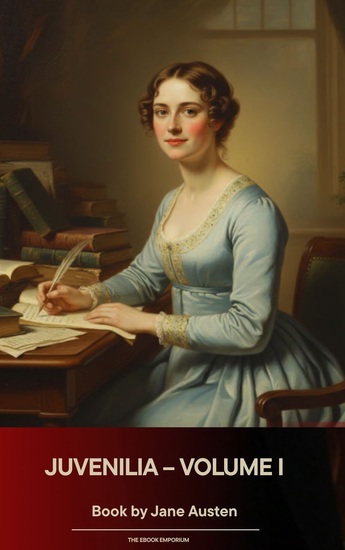
Juvenilia – Volume I - cover

Juvenilia – Volume I

Jane Austen

Maison d'édition: The Ebook Emporium

  • 0
  • 0
  • 0

Synopsis

"I have a great mind to go to Italy and be a nun, but I don't think I should like it."

Long before she created Elizabeth Bennet or Emma Woodhouse, a teenage Jane Austen was already skewering the tropes of 18th-century literature. Juvenilia – Volume I is a riotous collection of "scraps" and "sketches" that displays none of the refined restraint of her later novels. Instead, readers are treated to dark humor, absurd plots, and characters who drink too much, marry too often, and faint with alarming frequency. From the chaotic social blunders of "Frederic and Elfrida" to the wild escapades of "Henry and Eliza," this volume offers a rare, unvarnished look at the birth of a satirist who would go on to change the world of fiction.

The Roots of Satire: In these early pages, Austen mocks the "Sirs" and "Madams" of the sentimental novels she grew up reading. She takes the dramatic clichés of her time—vows of eternal friendship, tragic coincidences, and fainting fits—and pushes them to a level of hilarious absurdity. It is a masterclass in parody that shows a young girl already in full command of her wit.

A Window into the Austen Household: These stories were meant to be read aloud to the Austen family at Steventon Rectory. They reflect the lively, intellectual, and often irreverent atmosphere in which Jane was raised. Many stories are dedicated to her siblings or cousins, making the volume an intimate piece of literary history that bridges the gap between a private family hobby and public masterpiece.

Dark Comedy and High Energy: Readers expecting the polite drawing rooms of Mansfield Park will be surprised by the energy here. In "Jack and Alice," for example, we find a world of "red-faced" drinking and physical comedy. This volume proves that Austen was always a rebel at heart, using her pen to puncture the pomposity of the world around her from the very start.

Discover the girl behind the genius. Purchase "Juvenilia – Volume I" today.
Disponible depuis: 12/01/2026.
Longueur d'impression: 140 pages.
D'autres livres qui pourraient vous intéresser

  • My Astral Body - From their pens to your ears genius in every story - cover

    My Astral Body - From their pens...

    Anthony Hope

    • 0
    • 0
    • 0
    Sir Anthony Hope Hawkins was born on 9th February 1863 in Clapton, London.  
    He was educated at St John's School, Leatherhead, Marlborough College and Balliol College, Oxford.  Hope trained as a lawyer and barrister and was called to the Bar by the Middle Temple in 1887. Despite what was thought to be a promising legal career he had literary ambitions and wrote in his spare time. 
    His early works appeared in various periodicals of the day but for his first book ‘A Man of Mark’ (1890), with no publisher interested, he published with his own resources.  
    More novels and short stories followed, including the mildly successful ‘Mr Witt's Widow’ in 1892. Hope even found time to run as the Liberal candidate for Wycombe in the election that same year but was unsuccessful. 
    His first major literary success came with ‘The Dolly Dialogues’, a collection of previously published magazine pieces followed very quickly by his instant classic, ‘The Prisoner of Zenda’. He now gave up the vestiges of his legal career to pursue writing full-time. 
    Despite never again reaching the same pinnacle of success he was popular and wrote prolifically across novels, plays and of course, short stories though his writing output rapidly diminished after the war. 
    In 1918 he was knighted for his contribution to propaganda efforts during World War I.  
    His short stories are delicate, mannered and often surprising with their wit, humour and interplay of characters who say one thing and usually mean another.  He was very definitely a writer of escapist rather than serious fare but they are no less enjoyable for that. 
    Anthony Hope died of throat cancer on 8th July 1933 at his country home, Heath Farm at Walton-on-the-Hill in Surrey. He was 70.
    Voir livre
  • The Tragedy of Coriolanus - cover

    The Tragedy of Coriolanus

    William Shakespeare

    • 0
    • 0
    • 0
    Coriolanus is a tragedy by William Shakespeare, believed to have been written between 1605 and 1608. The play is based on the life of the legendary Roman leader Caius Marcius Coriolanus. The tragedy is one of the last two tragedies written by Shakespeare, along with Antony and Cleopatra.
    Coriolanus is the name given to a Roman general after his military success against various uprisings challenging the government of Rome. Following this success, Coriolanus becomes active in politics and seeks political leadership. His temperament is unsuited for popular leadership and he is quickly deposed, whereupon he aligns himself to set matters straight according to his own will. The alliances he forges along the way result in his ultimate downfall.
    The play opens in Rome shortly after the expulsion of the Tarquin kings. There are riots in progress, after stores of grain were withheld from ordinary citizens. The rioters are particularly angry at Caius Marcius, a brilliant Roman general whom they blame for the loss of their grain. The rioters encounter a patrician named Menenius Agrippa, as well as Caius Marcius himself. Menenius tries to calm the rioters, while Marcius is openly contemptuous, and says that the plebeians were not worthy of the grain because of their lack of military service. Two of the tribunes of Rome, Brutus and Sicinius, privately denounce Marcius. He leaves Rome after news arrives that a Volscian army is in the field.
    Among the most significant works William Shakespeare: Hamlet, Othello, King Lear, Macbeth, Orpheus, Romeo and Juliet, Julius Caesar, Troilus and Cressida, The Tempest, Venus and Adonis, Antony and Cleopatra, Measure for Measure, The Winter's Tale and many more.
    Voir livre
  • A Vine on a House - cover

    A Vine on a House

    Ambrose Bierce

    • 0
    • 0
    • 0
    More classic horror narrations on Jonathan's YouTube channel: https://www.youtube.com/@JonathanDunneHorrorAudiobooks 
    Title: A Vine on a House 
    Author: Ambrose Bierce 
    Narrator: Jonathan Dunne 
    Original Publication: 1905 
    Public Domain: Yes 
    Series Placement: Timeless Terrors No. 83 
    Description: 
    A Vine on a House is one of Ambrose Bierce’s most quietly disturbing works of supernatural and psychological horror—a subtle meditation on decay, obsession, and the slow intrusion of the unnatural into everyday life. What begins as an ordinary, even innocuous presence—a vine growing along the side of a house—gradually becomes something far more unsettling. 
    Central to the story is the vine itself, a living presence that grows with unnatural persistence, clinging to the house as if guided by an unseen will. As it spreads, so too does an atmosphere of unease, transforming a familiar domestic space into a symbol of encroaching dread. Bierce allows tension to build not through overt shocks, but through the quiet realization that something is deeply wrong. 
    Rather than relying on spectacle, Bierce crafts horror through implication and psychological pressure, letting the reader feel the weight of an unseen menace tightening its grip. Narrated by Amazon-bestselling horror author Jonathan Dunne, this performance captures the story’s creeping unease, restrained menace, and lingering sense of doom. 
    A Vine on a House endures as a masterclass in understated horror—a reminder that terror often grows slowly, taking root long before it is fully understood, and once established, may be impossible to remove.
    Voir livre
  • Alls Well That Ends Well - cover

    Alls Well That Ends Well

    William Shakespeare

    • 0
    • 0
    • 0
    Despite its optimistic title, Shakespeare's All's Well That Ends Well has often been considered a "problem play." Ostensibly a comedy, the play also has fairy tale elements, as it focuses on Helena, a virtuous orphan, who loves Bertram, the haughty son of her protectress, the Countess of Rousillon. When Bertram, desperate for adventure, leaves Rousillon to serve in the King's army, Helena pursues him.
    Voir livre
  • Dream-Land - cover

    Dream-Land

    Edgar Allan Poe

    • 0
    • 0
    • 0
    Dream-Land: Edgar Allan Poe was an American writer, poet, editor, and literary critic who is best known for his poetry and short stories.
    
    By a route obscure and lonely,
    Haunted by ill angels only,
    Where an Eidolon, named NIGHT,
    On a black throne reigns upright,
    I have reached these lands but newly
    From an ultimate dim Thule—
    From a wild weird clime that lieth, sublime,
    Out of SPACE—out of TIME.
    Voir livre
  • A Clergyman's Daughter - cover

    A Clergyman's Daughter

    George Orwell

    • 0
    • 0
    • 0
    A Clergyman's Daughter is a 1935 novel by English author George Orwell. It tells the story of Dorothy Hare, the clergyman's daughter of the title, whose life is turned upside down when she suffers an attack of amnesia. 
    It is Orwell's most formally experimental novel, featuring a chapter written entirely in dramatic form, but he was never satisfied with it and he left instructions that after his death it was not to be reprinted. 
    Despite these instructions, Orwell did consent that to cheap editions "of any book which may bring in a few pounds for my heirs" following his death.
    Voir livre