Rejoignez-nous pour un voyage dans le monde des livres!
Ajouter ce livre à l'électronique
Grey
Ecrivez un nouveau commentaire Default profile 50px
Grey
Abonnez-vous pour lire le livre complet ou lisez les premières pages gratuitement!
All characters reduced
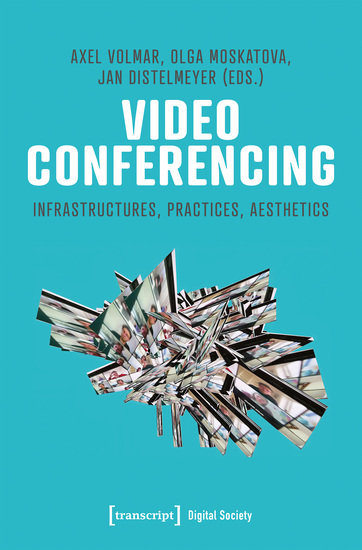
Video Conferencing - Infrastructures Practices Aesthetics - cover

Video Conferencing - Infrastructures Practices Aesthetics

Jan Distelmeyer, Axel Volmar, Olga Moskatova

Maison d'édition: transcript Verlag

  • 0
  • 0
  • 0

Synopsis

The COVID-19 pandemic has reorganized existing methods of exchange, turning comparatively marginal technologies into the new normal. Multipoint videoconferencing in particular has become a favored means for web-based forms of remote communication and collaboration without physical copresence. Taking the recent mainstreaming of videoconferencing as its point of departure, this anthology examines the complex mediality of this new form of social interaction. Connecting theoretical reflection with material case studies, the contributors question practices, politics and aesthetics of videoconferencing and the specific meanings it acquires in different historical, cultural and social contexts.
Disponible depuis: 30/11/2023.
D'autres livres qui pourraient vous intéresser

  • Lost Heirs of the Medieval Crown - The Kings and Queens Who Never Were - cover

    Lost Heirs of the Medieval Crown...

    J.F. Andrews

    • 0
    • 0
    • 0
    When William the Conqueror died in 1087, he left the throne of England to William Rufus . . . his second son. The result was an immediate war as Rufus's elder brother Robert fought to gain the crown he saw as rightfully his; this conflict marked the start of 400 years of bloody disputes as the English monarchy's line of hereditary succession was bent, twisted, and finally broken when the last Plantagenet king, Richard III, fell at Bosworth in 1485. 


    The Anglo-Norman and Plantagenet dynasties were renowned for their internecine strife, and in Lost Heirs we will unearth the hidden stories of fratricidal brothers, usurping cousins, and murderous uncles; the many kings—and the occasional queen—who should have been but never were. History is written by the winners, but every game of thrones has its losers too, and their fascinating stories bring richness and depth to what is a colorful period of history. King John would not have gained the crown had he not murdered his young nephew, who was in line to become England's first King Arthur; Henry V would never have been at Agincourt had his father not seized the throne by usurping and killing his cousin; and as the rival houses of York and Lancaster fought bloodily over the crown during the Wars of the Roses, life suddenly became very dangerous indeed for a young boy named Edmund.
    Voir livre
  • Can we make truth great again? - cover

    Can we make truth great again?

    François Noudelmann

    • 0
    • 0
    • 0
    During the 2024 US presidential campaign, the proliferation of lies reached an unprecedented level. This confirms that we have entered the era of post-truth and alternative facts. Beyond true and false, anyone can claim their interpretation and narrative. Is there a way to prevent fake news and political manipulation that threaten democracy?
    This essay traces the path that has led to this relativism over the last forty years on both sides of the ideological spectrum: the reign of storytelling, the empire of emotion, identity politics, victimization, autofiction, cancelation, philosophical deconstruction, the virtualization of the world by artificial intelligence… have all decimated universal reason. To save truth and the positivity of facts, François Noudelmann explores other resources, such as indignation in the face of lies and the alliance of doubt and revolt, which allow us to still believe in a common language.
    Voir livre
  • Philosophers of Knowledge and Thought - Exploring the Interplay of Language Knowledge and Reality (3 in 1) - cover

    Philosophers of Knowledge and...

    Hector Davidson

    • 0
    • 0
    • 0
    This book consists of the following titles: 
    - Ludwig Wittgenstein: Ludwig Wittgenstein, one of the most influential philosophers of the 20th century, profoundly shaped modern thought, particularly in the realms of language, logic, and the philosophy of mind. His philosophy spans two distinct periods, marked by an evolution in his views on the relationship between language, meaning, and reality. Wittgenstein’s work challenges the way we think about and use language, positing that philosophical problems often arise from misunderstandings of language and its limitations. 
    - Martha Nussbaum: Martha Nussbaum is one of the most influential philosophers of our time, particularly known for her contributions to feminist theory, political philosophy, and ethics. A professor at the University of Chicago, her work spans a wide array of topics including justice, human capabilities, human rights, and the role of emotions in moral decision-making. Nussbaum’s ideas have significantly impacted both academic philosophy and practical policy, with her innovative theories offering valuable insights into the intersection of ethics, politics, and human development. 
    - Bertrand Russell: Bertrand Russell, born on May 18, 1872, in Trellech, Monmouthshire, Wales, was a British philosopher, logician, mathematician, and social critic. Coming from a prominent aristocratic family, with his grandfather, Lord John Russell, having served as a British Prime Minister, Russell had an influential upbringing. He attended Cambridge University, where he studied under Alfred North Whitehead, a notable logician and philosopher. Russell was deeply influenced by the works of Gottlob Frege and David Hilbert.
    Voir livre
  • The Power of Magic - cover

    The Power of Magic

    Raphael Terra

    • 0
    • 0
    • 0
    This audiobook has been recorded using Text to speech (TTS). 
     
    The great Manly P. Hall once said: “To live in the world without becoming aware of the meaning of the world is like wandering about in a great library without touching the books.” 
     
    Magic is key to understanding our existence and Manly P. Hall knew this. It is is much more than the tricks of a children’s entertainer. Magic is all there is. In fact the word comes down to us originally from Old Persian and means “to have power”. Understanding true magic brings us power. 
     
    There are many things we can learn from our foray into the world of magic. Of these many things, this film will focus in on the mystical world, the magical world, the strange and wonderful. Within magic we will find reality like never before. It is the very fabric of the universe in which we live out our lives. 
     
    For us to be able to understand magic, we have to understand the science behind the fabric of existence. It is within the mind expanding complexities of quantum physics that we will discover the truth behind the secrets of magic that our ancestors searched for. Knowledge is magic and magic is powerful. 
     
    Prepare to be empowered.
    Voir livre
  • The Book of Life - cover

    The Book of Life

    Upton Sinclair

    • 0
    • 0
    • 0
    In "The Book of Life," Upton Sinclair presents a profound exploration of human existence, unravelling the threads that connect society, politics, and personal growth. This enlightening work serves as a guide through the complexities of life, urging readers to seek truth and justice. With incisive social commentary, Sinclair delves into the human condition, advocating for the empowerment of individuals to shape a more equitable and conscious world.
    Voir livre
  • No Self No God No Clue - David Hume and the Joy of Destroying Everything - cover

    No Self No God No Clue - David...

    Sophia Blackwell

    • 0
    • 0
    • 0
    ohn Locke: Enlightenment philosopher, father of liberalism, inventor of “natural rights,” and accidental spiritual patron of land developers, libertarians, and your uncle who won’t shut up about property taxes. 
    In this gloriously sarcastic takedown of one of Western philosophy’s most over-quoted minds, Sophia Blackwell (Kant You Not, No Self, No God, No Clue) guides you through Locke’s greatest hits—including: 
    The blank slate theory, which basically says you’re born dumb and the world makes you worse 
    His ideas on identity, which collapse the second you forget your phone password 
    His version of consent, which mostly consists of “You didn’t leave, so I assume you’re fine with it.” 
    And of course, property rights—where mixing your labor with the earth somehow makes it yours, and stealing land becomes morally correct as long as you bring a shovel 
    Locke’s political philosophy inspired democracies, revolutions, and every 400-comment Reddit thread titled “Taxation is theft.” 
    This is not a respectful biography. 
    This is a roast. A eulogy. A survival guide for understanding how Locke gave us: 
    Liberalism 
    Landlords 
    Legal headaches 
    And a political system that thinks fencing off a patch of dirt = moral superiority 
    Perfect for: 
    Recovering philosophy students 
    Political skeptics 
    Enlightenment haters 
    Property law survivors 
    And anyone who wants to laugh while questioning whether government is just a giant metaphor for a really passive-aggressive roommate agreement 
    You don’t need to read Two Treatises of Government. 
    You just need to know Locke said, “I think I own that,” and people believed him.
    Voir livre