Join us on a literary world trip!
Add this book to bookshelf
Grey
Write a new comment Default profile 50px
Grey
Subscribe to read the full book or read the first pages for free!
All characters reduced
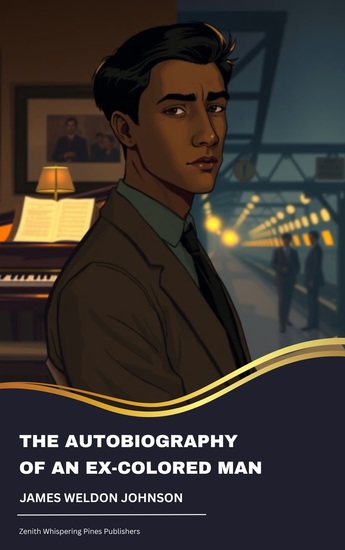
The Autobiography of an Ex-Colored Man - cover

The Autobiography of an Ex-Colored Man

James Weldon Johnson

Publisher: Zenith Whispering Pines Publishers

  • 0
  • 0
  • 0

Summary

He could choose how the world would see him—but at what cost to himself?
Told as a deeply personal confession, this groundbreaking novel follows a gifted young man of mixed race as he navigates America's rigid color line. Faced with discrimination, opportunity, fear, and ambition, he ultimately makes a life-altering decision to "pass" as white—gaining security while sacrificing a vital part of his identity.

Hailed as "one of the most important novels of the Harlem Renaissance," James Weldon Johnson's work is both intimate and political, exposing the psychological toll of racism and the quiet pain behind outward success. Its themes of identity, belonging, and moral compromise remain urgently relevant.

If you seek literature that challenges, enlightens, and reveals the hidden costs of conformity, this essential classic will leave a lasting impression.

Open the book—and confront the question of who we become when survival demands silence.
Available since: 12/16/2025.
Print length: 154 pages.

Other books that might interest you

  • Another Freak - From their pens to your ears genius in every story - cover

    Another Freak - From their pens...

    Mary Angela Dickens

    • 0
    • 0
    • 0
    The bookshelves of British literature are incredible collections that have gathered together centuries of very talented authors.  From these Isles their fame spread and whilst among their number many are now forgotten or neglected their talents endure.  Among them is Mary Angela Dickens.
    Show book
  • George Silverman's Explanation - cover

    George Silverman's Explanation

    Charles Dickens, Dominic Gerrard

    • 0
    • 0
    • 0
    George Silverman’s Explanation (published in The Atlantic in 1868) is one of Charles Dickens’ rarer short stories. Here the author immerses himself entirely in his character of George Silverman: addressing the reader in a dramatic monologue in which he is reticent, perhaps even unwilling to open up to us, but at the same time compelled to unburden his heart.  
    So deeply does Dickens embody the role of Silverman that in a letter to an editor he writes that: 'I feel as if I had read something (by somebody else) which I should never get out of my head …’ 
    This tale is an indictment against poverty as powerful as you will find in any of Dickens’ larger works. It is also a biting satire against the 'daring ignorance' and little 'meannesses' found in many non-conformist movements. Above all it is a deeply affecting examination of how far a childhood of of both want and punishing religious control can impact a man’s self-worth and future happiness. 
    Narrated by Dominic Gerrard 
    Cover Art by Léna Gibert
    Show book
  • A Lesson on a Tortoise - From their pens to your ears genius in every story - cover

    A Lesson on a Tortoise - From...

    D H Lawrence

    • 0
    • 0
    • 0
    David Herbert Lawrence was born on the 11th September 1885 in Eastwood, Nottinghamshire, a coal mining town where the reality of a harsh life was only useful as experiences for future literary works. 
    He was educated at Beauvale Board School and became the first local boy to receive a scholarship to attend Nottingham High School. After 3 years he became a junior clerk in Haywood’s surgical appliances factory. He was also attempting a literary career which, in the short term, led to a teacher training position in Eastwood and later a teaching qualification from University College, Nottingham.  
    Lawrence’s first efforts were poems, short stories and a draft of ‘The White Peacock’. Moving to London and a teaching position in Croydon his writing attracted the attention of Ford Madox Ford, editor of The English Review, and he commissioned him to write ‘Odour of Chrysanthemums’.  
    Wanting to write full-time he now began work on what would become ‘Sons and Lovers.   
    In 1912 he met the older and married mother-of-three Frieda Weekley. They eloped to Germany and here Lawrence could see for himself the growing tensions with France.  So keen was his interest that he was arrested and accused of being a British spy.  
    In early 1914 Frieda obtained her divorce and they returned to Britain to be married just days before the outbreak of war. Owing to her German parentage, and his own public dislike of militarism and violence, the couple were treated with contempt and suspicion throughout the war years.  
    Despite this he continued to write but his reputation in England was so tarnished and, mirrored by his own disdain for the country, he and Frieda left England in November 1919, first for Europe and then America via Ceylon and Australia. 
    They bought a ranch in Taos, New Mexico and visited Mexico several times. The third visit in March 1925 caused a near fatal attack of malaria. To convalesce they moved to Florence. Here he continued work on ‘Lady Chatterley’s Lover’ which for many years would cause controversy. A renewed interest in oil painting resulted in an exhibition in 1929 which was raided by the police and several works were confiscated.  
    D H Lawrence died of complications arising from a bout of tuberculosis on the 2nd of March 1930 in Vence, France.  He was 44.
    Show book
  • King Coal - cover

    King Coal

    Upton Sinclair

    • 0
    • 0
    • 0
    "King Coal" is a novel written by Upton Sinclair, first published in 1917. The book explores the harsh conditions and exploitation faced by coal miners in the United States during the early 20th century. Sinclair, known for his social and political activism, used "King Coal" to expose the oppressive working conditions, corporate greed, and corruption within the coal industry. The novel follows the protagonist, Hal Warner, a wealthy young man who decides to experience life as a coal miner. As he immerses himself in the harsh realities of coal mining, he witnesses the struggles of the working class and becomes an advocate for workers' rights. The story delves into themes of social justice, labor exploitation, and the impact of industrialization on the lives of ordinary people.
    Show book
  • Mr Ledbetter's Vacation (Unabridged) - cover

    Mr Ledbetter's Vacation...

    H. G. Wells

    • 0
    • 0
    • 0
    Mr. Ledbetter's Vacation is a short story by H. G. Wells. Herbert George "H. G." Wells (21 September 1866 - 13 August 1946) was an English writer, now best known for his work in the science fiction genre. He was also a prolific writer in many other genres, including contemporary novels, history, politics and social commentary, even writing textbooks and rules for war games. Wells is sometimes called "The Father of Science Fiction," as are Jules Verne and Hugo Gernsback. His most notable science fiction works include The War of the Worlds, The Time Machine, The Invisible Man and The Island of Doctor Moreau. Wells's earliest specialised training was in biology, and his thinking on ethical matters took place in a specifically and fundamentally Darwinian context. He was also from an early date an outspoken socialist, often (but not always, as at the beginning of the First World War) sympathising with pacifist views. His later works became increasingly political and didactic, and he sometimes indicated on official documents that his profession was that of "Journalist." Most of his later novels were not science fiction. Some described lower-middle class life (Kipps; The History of Mr Polly), leading him to be touted as a worthy successor to Charles Dickens, but Wells described a range of social strata and even attempted, in Tono-Bungay (1909), a diagnosis of English society as a whole. Wells's first non-fiction bestseller was Anticipations of the Reaction of Mechanical and Scientific Progress Upon Human Life and Thought (1901). When originally serialised in a magazine it was subtitled, "An Experiment in Prophecy," and is considered his most explicitly futuristic work. It offered the immediate political message of the privileged sections of society continuing to bar capable men from other classes from advancement until war would force a need to employ those most able, rather than the traditional upper classes, as leaders. Anticipating what the world would be like in the year 2000, the book is interesting both for its hits (trains and cars resulting in the dispersion of population from cities to suburbs; moral restrictions declining as men and women seek greater sexual freedom; the defeat of German militarism, and the existence of a European Union) and its misses (he did not expect successful aircraft before 1950, and averred that "my imagination refuses to see any sort of submarine doing anything but suffocate its crew and founder at sea").
    Show book
  • On Her Majesty’s Secret Service - A James Bond Novel - cover

    On Her Majesty’s Secret Service...

    Ian Fleming

    • 0
    • 0
    • 0
    BOND VS BLOFELD 
    In the aftermath of Operation Thunderball, Ernst Stavro Blofeld’s trail has gone cold―and so has 007’s love for his job. The only thing that can rekindle his passion is Contessa Teresa “Tracy” di Vicenzo, a troubled young woman who shares his taste for fast cars and danger. She’s the daughter of a powerful Corsican crime boss who thinks Bond's hand in marriage may be just the thing to settle his volatile daughter. But Bond's chances at marital bliss are interrupted by a call from MI6—they finally have a lead on Blofeld. 
    After tracking the SPECTRE chief to a stronghold in the Swiss Alps, Bond uncovers the details of Blofeld’s latest plot: a biological warfare scheme more audacious than anything the fiend has tried before. It's up to Bond to save the world once again―and survive Blofeld’s last, very personal, act of vengeance.
    Show book