Begleiten Sie uns auf eine literarische Weltreise!
Buch zum Bücherregal hinzufügen
Grey
Einen neuen Kommentar schreiben Default profile 50px
Grey
Jetzt das ganze Buch im Abo oder die ersten Seiten gratis lesen!
All characters reduced
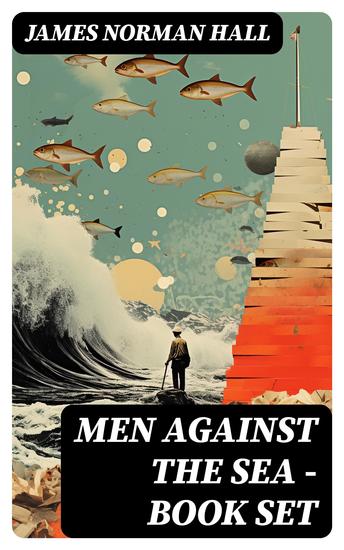
Men Against the Sea – Book Set - The Greatest Maritime Adventure Novels: The Bounty Trilogy Lost Island The Hurricane Botany Bay The Far Lands Tales of the South Seas… - cover

Men Against the Sea – Book Set - The Greatest Maritime Adventure Novels: The Bounty Trilogy Lost Island The Hurricane Botany Bay The Far Lands Tales of the South Seas…

James Norman Hall

Verlag: DigiCat

  • 0
  • 0
  • 0

Beschreibung

In "Men Against the Sea," James Norman Hall crafts a gripping narrative that intertwines themes of survival, camaraderie, and the profound challenges of the human spirit against the vastness of the ocean. This book, a companion to Hall's earlier work, "Mutiny on the Bounty," employs a compelling literary style that oscillates between vivid realism and lyrical prose, delving into the psychological and physical trials faced by castaways stranded in the South Pacific. Set against the backdrop of World War II, Hall expertly captures not just the immediate dangers of the sea but also the deeper emotional currents that propel the characters toward resilience and hope. James Norman Hall, an American writer and aviator, is best known for his collaborations with Charles Nordhoff, which include the acclaimed Bounty trilogy. Drawing from his own extensive maritime experiences and the tumultuous historical context of his time, Hall's writing reflects a profound fascination with the complexities of human nature when confronted with adversities, making "Men Against the Sea" a poignant exploration of endurance. This book is highly recommended for readers interested in nautical fiction, survival narratives, and historical accounts that reflect the human condition. Hall's evocative storytelling and keen insights offer not only an engaging adventure but also a profound meditation on what it means to confront the forces of nature and the very essence of survival.
Verfügbar seit: 23.11.2023.
Drucklänge: 2395 Seiten.

Weitere Bücher, die Sie mögen werden

  • Buddha Socrates and Us - Ethical Living in Uncertain Times - cover

    Buddha Socrates and Us - Ethical...

    Stephen Batchelor

    • 0
    • 0
    • 0
    A renowned Buddhist teacher turns to two of the most influential figures in history for guidance on how to face the ethical challenges of our time The Buddha’s revolutionary teachings transformed Asia, and his contemporary Socrates laid the foundations of Western philosophy. Although they never met, Socrates and the Buddha each addressed in a radically new and surprisingly similar way the core questions of how to lead a good, just, and dignified life amid turbulence and violence. Common to their teachings was an ethics of uncertainty: both refused to make truth claims about the ultimate nature of reality, insisting on the primacy of critical self‑evaluation as the basis of an ethical life. In this illuminating book, best-selling author Stephen Batchelor explores the philosophical, social, and political worlds of the Buddha and Socrates, showing how their teachings continue to provide lessons in how to lead a flourishing and engaged life. Keenly aware of the fickle and conflicted nature of the human mind, Gotama and Socrates inspired their followers to act with humility and courage, risk and resolve, doubt and confidence. Drawing on their insights, and those of their followers, Batchelor uncovers a middle way between Buddhist dharma and Greek philosophy that can serve as a starting point for a “secular faith” that addresses the most pressing spiritual and planetary issues of our age.
    Zum Buch
  • The Prince - cover

    The Prince

    Niccolò Machiavelli

    • 0
    • 0
    • 0
    The Prince is a 16th-century political treatise by the Italian diplomat and political theorist Niccolo Machiavelli. From correspondence a version appears to have been distributed in 1513, using a Latin title, De Principatibus (Of Principalities). However, the printed version was not published until 1532, five years after Machiavelli's death. This was done with the permission of the Medici pope Clement VII, but "long before then, in fact since the first appearance of The Prince in manuscript, controversy had swirled about his writings". Although it was written as if it were a traditional work in the mirrors for princes style, it is generally agreed that it was especially innovative. Niccolò Machiavelli, belongs to such prominent Florentines as Dante Alighieri, Petrarch, Giovanni Boccaccio, Michelangelo, Leonardo da Vinci and Botticelli
    Zum Buch
  • Adventures and Exploration - Journeys into the Unknown (4 in 1) - cover

    Adventures and Exploration -...

    John Harpoon

    • 0
    • 0
    • 0
    This book contains four books, which are: 
    - Forsaken Realms: Throughout history, there have been places where human ambition, industry, or even nature’s cruelty has left behind stark reminders of a world once bustling with life, now standing frozen in time. These forsaken realms—whether born of abandonment, catastrophe, or the slow erosion of human civilization—whisper tales of a forgotten past. They are the remnants of once-thriving cities, sprawling industries, and cultures now reduced to ruins, each holding secrets that time has almost claimed. 
    - Terra Incognita: To document the unknown is to navigate a delicate and often treacherous path. It is an undertaking that demands curiosity and courage, tempered by discipline and respect for the subject at hand. When the unknown takes the form of a remote, enigmatic island, the challenges multiply, and the journey becomes as much about understanding ourselves as it is about uncovering the mysteries of the place. 
    - The Bargain Paradise: An economical dwelling is a home designed with cost-efficiency in mind, blending affordability, functionality, and sustainability. The concept of such a dwelling goes beyond simply being cheap; it involves thoughtful design choices that minimize expenses while maintaining comfort and quality of life. At its core, an economical dwelling aims to reduce the financial burden on its owner without sacrificing the essential aspects of a well-built home. 
    - Himalaya Doomsday Device: In the vast expanse of the Himalayas, hidden beneath centuries of snow and ice, lay a secret that had been buried for generations. The towering peaks, once home to monks and ancient civilizations, now shielded a dark legacy that time itself had forgotten. The truth about this forgotten legacy, however, was about to resurface, altering the course of history and threatening the very future of a nation.
    Zum Buch
  • Richard Sorge: The Life and Legacy of the German Journalist Who Became the Soviet Union’s Most Effective Spy during World War II - cover

    Richard Sorge: The Life and...

    Editors Charles River

    • 0
    • 0
    • 0
    Spies are a feature of countless works of fiction in which they often discover secrets on which the fate of nations hang in the balance. Reality is generally rather more mundane, as spies often gather low-level intelligence that only makes sense when it is examined by analysts and compared to information from other sources. Espionage provides clues to what the enemy is planning, but on its own, it rarely changes the course of a war. Moreover, real spies are generally anonymous, not the bold, swashbuckling action heroes depicted in fiction. Spies must hide in plain sight, and that is best achieved by being as innocuous as possible.  
    	However, there are exceptions. Occasionally, a spy will be so successful that they are able to place themselves in a position where they have access to information at the highest levels, secrets that really can change the course of world events. Sometimes, these spies may even be as handsome, charming, charismatic, and bold as their fictional counterparts. 
    	One such spy was a man named Richard Sorge. Experiencing the horrors of World War I at first-hand turned Sorge into an ardent communist, after which he worked as a spy for the USSR in Germany, China, and Japan before and during World War II. He obtained vital military and political secrets and maintained his cover for over nine years despite frantic searches for the spy who was leaking information to Russia. His effortless charm meant that he didn’t need to steal secrets: people told him willingly, including the many women that he seduced.
    Zum Buch
  • Portuguese Empire and the Americas The: The History and Legacy of Portugal’s Exploration and Colonization in the New World - cover

    Portuguese Empire and the...

    Editors Charles River

    • 0
    • 0
    • 0
    By the start of the 15th century, ships were now much larger and able to support long distance travel with a minimum number of crew aboard. With that, the Portuguese started exploring the west coast of Africa and the Atlantic under orders from Prince Henry the Navigator. At this point, Europeans had not yet been capable of navigating completely around Africa since the ships being built were not yet fully capable of being able to sail very far from the coast and navigation in open waters was difficult, but the Portuguese continued pushing down the western African coast looking for ways to bypass the Ottomans and Muslims of Africa who had been making overland trade routes difficult. In 1451, Prince Henry the Navigator helped fund and develop a new type of ship, the caravel, that featured triangular lateen sails and would be able to travel in the open ocean and sail against the wind. In 1488, Bartholomew Diaz rounded the southern tip of Africa, named the Cape of Good Hope by King John of Portugal, and entered the Indian Ocean from the Atlantic.  
    	One explorer, Christopher Columbus, sought funding from the Portuguese to search for a passage to Asia by sailing westwards, but he was rejected. At this time in the late 15th century, Portugal’s domination of the western African sea routes prompted the neighboring Crown of Castile and the Catholic monarchs in modern Spain to search for an alternative route to south and east Asia (termed Indies), so they provided Columbus with the funding he required. Ultimately, Columbus discovered the Americas in 1492, and European settlements would soon follow. At the same time, when it became clear Columbus hadn’t landed in Asia, it was understood by everyone that this was not necessarily the route the Europeans were searching for, the Portuguese continued to send explorers around the world in several directions in an attempt to reach the East Indies. 
    Zum Buch
  • Aztec Myths and Legends - Gods Rituals and the Cosmic Worldview - cover

    Aztec Myths and Legends - Gods...

    Odessa Nightshade

    • 0
    • 0
    • 0
    The myths and legends of the Aztecs offer a glimpse into a world both vibrant and complex, where gods walked among mortals, and cosmic forces shaped the destiny of an empire. Rooted in the beliefs of the Nahua peoples of central Mexico, Aztec mythology was more than just a collection of stories—it was a sacred system that explained the origins of the universe, the role of humanity, and the ever-present struggle between order and chaos. These myths provided meaning to daily life, justified political and military expansion, and reinforced the religious practices that were central to Aztec society.  
    The origins of Aztec mythology are intertwined with the migrations and conquests that shaped their civilization. The Mexica, the people who would later establish the powerful city of Tenochtitlan, believed they were divinely chosen. According to their legends, they embarked on a long journey from a mythical homeland called Aztlán under the guidance of their patron god, Huitzilopochtli. Their eventual settlement on an island in Lake Texcoco fulfilled a prophecy that marked the beginning of their great empire. By weaving their own history into the fabric of myth, the Aztecs established their right to rule and their connection to the gods.  
    In Aztec society, mythology was inseparable from religion, politics, and even warfare. The gods required constant nourishment through human sacrifice, a practice that was not seen as cruel but as essential for maintaining cosmic balance. Warriors who died in battle were honored as they were believed to ascend to the sun’s domain, while sacrificial victims were thought to sustain the gods with their blood. Mythology also shaped the Aztec worldview through their intricate calendar system, which guided ceremonies, agriculture, and daily life. Time was cyclical, and each era was destined to end and be reborn—a belief that influenced their response to the arrival of the Spanish. 
    Zum Buch