Begleiten Sie uns auf eine literarische Weltreise!
Buch zum Bücherregal hinzufügen
Grey
Einen neuen Kommentar schreiben Default profile 50px
Grey
Jetzt das ganze Buch im Abo oder die ersten Seiten gratis lesen!
All characters reduced
Fort Concho: Its Why and Wherefore - Unveiling the Legacy of Fort Concho: Frontier Life and Military Strategy in Texas - cover

Fort Concho: Its Why and Wherefore - Unveiling the Legacy of Fort Concho: Frontier Life and Military Strategy in Texas

James N. Gregory

Verlag: Good Press

  • 0
  • 0
  • 0

Beschreibung

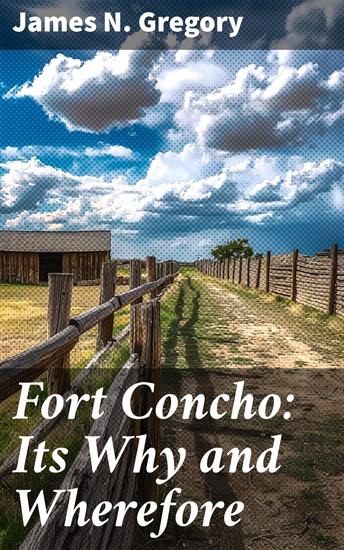
In "Fort Concho: Its Why and Wherefore," James N. Gregory meticulously unravels the historical significance of Fort Concho, established in the mid-19th century in Texas. Through an analytical lens, he explores the fort's functionalities, its interaction with Native American tribes, and its role in the broader narrative of westward expansion. Gregory's scholarly approach is complemented by a rich tapestry of primary sources and historical texts, allowing readers to engage with the era's complex socio-political dynamics as well as the architectural features and military strategies employed at the fort. The book stands not only as a historical account but also as a reflection on the themes of conflict, resilience, and the reshaping of American identities in a frontier context. James N. Gregory, an esteemed historian with a focus on the American West, draws from a wealth of archival research and field studies to illuminate the intricate past of Fort Concho. His expertise in Western history is informed by his academic background and extensive publications on military history and Texas heritage. This book emerges from his passion for uncovering lesser-known narratives that inform the American experience and the transformation of landscapes during tumultuous times. "Fort Concho: Its Why and Wherefore" is highly recommended for scholars and enthusiasts of American history alike. Gregory's robust analysis not only enriches our understanding of Fort Concho's legacy but also invites readers to reflect on the complexities of historical interpretation. Engaging and informative, this work is essential for those seeking a comprehensive view of frontier history and its lingering impacts on contemporary society.
Verfügbar seit: 31.10.2023.
Drucklänge: 41 Seiten.
Weitere Bücher, die Sie mögen werden

  • Red White & Blind - The Truth About Disinformation and the Path to Media Consciousness - cover

    Red White & Blind - The Truth...

    Tony Brasunas

    • 0
    • 0
    • 0
    Why were the sordid deeds of Jeffery Epstein concealed for two decades? Why was inquiry into the origin of covid suppressed? Why are social media sites censoring scientists, doctors, journalists, and scholars? 
    Through dozens of absorbing exposés, Red White & Blind reveals the corporate media's deliberate lies, tendentious censorship, and ironic use of the term "disinformation." This deceit has driven faith in corporate news to all-time lows, but it has also birthed an independent media revolution—a New Enlightenment—enabling Americans to see through the walls of "confirmation bias" and perceive the world more directly and accurately than ever before. 
    In this book, you will learn:How the Father of Propaganda convinced Americans to love bananas, World War I, and the color green.Why the notion of "objective, professional journalism" was invented in the early 1900s.How the CIA placed agents in the media and why they likely still do.How to understand family and friends with any set of political views.Why today's social media censorship violates the First Amendment.Why "fact-checking" websites almost always fail.The meaning of "gaslighting," "shadowbanning," and "narrative management."
    Zum Buch
  • Pure Wit - The Revolutionary Life of Margaret Cavendish - cover

    Pure Wit - The Revolutionary...

    Francesca Peacock

    • 0
    • 0
    • 0
    A biography of the remarkable, and in her time scandalous, seventeenth-century writer Margaret Cavendish, Duchess of Newcastle. 
     
    'My ambition is not only to be Empress, but Authoress of a whole world' - Margaret Cavendish 
     
    Margaret Cavendish, then Lucas, was born in 1623 to an aristocratic family. In 1644, as England descended into civil war, she joined the court of the formidable Queen Henrietta Maria at Oxford. With the rest of the court she went into self-imposed exile in France. Her family's wealth and lands were forfeited by Parliament. It was in France that she met her much older partner, William Cavendish, Marquess of Newcastle-upon-Tyne, a marriage that would remain at the heart of both her life and career. 
     
    Cavendish was a passionate writer. She wrote extensively on gender, science, philosophy, and published under her own name at a time when women simply did not do so. Her greatest work was The Blazing World, published in 1666, a utopian proto-novel that is thought to be one of the earliest works of science fiction. Yet hers is a legacy that divides opinion. And history has largely forgotten her, an undeserved fate for a brilliant, courageous proto-feminist. 
     
    In Pure Wit, Francesca Peacock shines a spotlight on the fascinating, pioneering, yet often complex and controversial life of Margaret Cavendish.
    Zum Buch
  • The Völva’s Apprentice - A Norse Fiction Story of Magic Mythology & Romance - cover

    The Völva’s Apprentice - A Norse...

    Living History

    • 0
    • 0
    • 0
    I had heard tales of women with secret knowledge and powers, but I never imagined that there would be one standing right in front of me.“You’re a Völva?” the word rolled off my tongue strangely...I only knew faintly what a Völva was. They were said to be strange women with strange powers. Not only could they protect and ward against ill omens, but they could also travel the realms and reach into places untapped by most humans. As such, they were often spoken of in whispers of both reverence and mystery.“Yes, I am. And an old one at that,” she said, getting up from her chair.It seemed so casual as if she was just talking about a mindless chore that she was doing. Like it was nothing special that she had just performed some form of magic right in front of me.For two years, I learned everything I could on runes, protections, herbs, medicines, and anything else that Dagmar deemed necessary. In the few moments I had that were not dedicated to lessons from Dagmar, I would seek out Ivar for his quiet presence. There was just something about being near him that set my mind at ease.All that consumed my thoughts was avengement and how close Ulrik was. Soon he would taste the bitter sting of defeat.In the realms of Norse Mythology, a girl sets out to avenge her village, only to meet a powerful teacher on her journey into the abyss of forbidden knowledge.
    Zum Buch
  • Friars and Filipinos - cover

    Friars and Filipinos

    José Rizal

    • 0
    • 0
    • 0
    Friars and Filipinos is a critical and satirical essay in which José Rizal examines the deep-rooted influence of the Spanish colonial friars on Philippine society and governance. Written in response to an article by a Spanish writer, Rizal systematically critiques the hypocrisy, greed, and abuses of power committed by the religious orders, exposing how they manipulated both faith and politics to maintain control over the Filipino people. He contrasts their corruption with the dignity, intelligence, and potential of the Filipino native, advocating for justice, reform, and national consciousness. With clarity and passion, Rizal calls for an end to clerical dominance and the recognition of Filipino rights. This essay stands as a powerful indictment of colonial oppression and a vital piece of the intellectual foundation for Philippine nationalism.
    Zum Buch
  • A Short History of Trans Misogyny - cover

    A Short History of Trans Misogyny

    Jules Gill-Peterson

    • 0
    • 0
    • 0
    "A beautifully written and argued book." —Torrey Peters, author of Detransition, Baby 


    There is no shortage of voices demanding everyone pay attention to the violence trans women suffer. But one frighteningly basic question seems never to be answered: why does it happen? If men are not inherently evil and trans women do not intrinsically invite reprisal—which would make violence unstoppable—then the psychology of that violence had to arise at a certain place and time. The trans panic had to be invented. 


    Award-winning historian Jules Gill-Peterson takes us from the bustling port cities of New York and New Orleans to the streets of London and Paris in search of the emergence of modern trans misogyny. She connects the colonial and military districts of the British Raj, the Philippines, and Hawai'i to the lively travesti communities of Latin America, where state violence has stamped a trans label on vastly different ways of life. Weaving together the stories of historical figures in a richly detailed narrative, the book shows how trans femininity emerged under colonial governments, the sex work industry, the policing of urban public spaces, and the area between the formal and informal economy. A Short History of Trans Misogyny is the first book to explain why trans women are burdened by such a weight of injustice and hatred.
    Zum Buch
  • A Teenage Rhapsody 1966 to 1973 - cover

    A Teenage Rhapsody 1966 to 1973

    R. J. Dickinson

    • 0
    • 0
    • 0
    "A Teenage Rhapsody 1966 to 1973" is autobiographical and describes my transition from adolescence to manhood at a time when the shackles of certain traditional social oppressions were been swept aside by optimism for a better future that previous generations were denied. 
    That better future started with the phenomenon called 'the teenager' who suddenly had a voice, a voice of freedoms, expression and of influence that helped create the Swinging Sixties. 
    I was there, yes I was there. What I was to experience growing up in the suburbs of Leeds at the time the book suggests, was that of hardship, laughter, fun, love and betrayal, juvenile violence and the explosion of alternatives that were now becoming accepted, as inevitable. 
    But also what I was experiencing, with the doctrine of Victorian values to keep me out of harm's way, was the freedom, without concern, to wander and explore for endless hours, the labyrinth of streets of back to back terrace houses that offered adventure around every corner. 
    The simplicity of life during the time of my teenage years, alongside a commonality of certain basic traditions passed down from generation to generation, that still apply and work regardless of generation. This was liberating, allowing me to develop my mind and character through trial and error at a pace of life that was less demanding and frenzied to what is to arrive in the next century, when all this description will be viewed in the format akin to a Sepia painting hanging with obscurity in a corner of a gallery. 
    This story had a need to be told.
    Zum Buch