Rejoignez-nous pour un voyage dans le monde des livres!
Ajouter ce livre à l'électronique
Grey
Ecrivez un nouveau commentaire Default profile 50px
Grey
Abonnez-vous pour lire le livre complet ou lisez les premières pages gratuitement!
All characters reduced
Myths of the Cherokee - Illustrated Edition - cover

Myths of the Cherokee - Illustrated Edition

James Mooney

Maison d'édition: Good Press

  • 0
  • 0
  • 0

Synopsis

In "Myths of the Cherokee," James Mooney delves into the rich tapestry of Cherokee mythology, presenting a meticulously collected and translated corpus of tales that illuminate the tribe's cultural beliefs and worldviews. Written in a combination of ethnographic detail and narrative flair, the book exists at the crossroads of folklore study and anthropology, employing a descriptive style that invites readers into the heart of Cherokee traditions. Mooney's work is significant not only for its scholarly rigor but also for its preservation of narratives that were at risk of disappearing amidst the forces of modernization and cultural assimilation during the late 19th century. James Mooney, an early American anthropologist, dedicated his life to studying Native American cultures, particularly the Cherokee. His extensive fieldwork and profound respect for Indigenous peoples informed his writing, culminating in this seminal text. Mooney's deep engagement with the Cherokee community not only enriched his understanding but also unveiled the intricate layers of meaning in their myths, which reflect their cosmology, moral values, and collective identity. This book is an essential read for anyone interested in folklore, anthropology, or Indigenous studies. It serves as a vital resource for those seeking to understand the nuances of Cherokee culture and offers a compelling insight into the universal themes that resonate across human experience through storytelling. "Myths of the Cherokee" remains a classic in the pantheon of ethnographic literature.
Disponible depuis: 16/11/2023.
Longueur d'impression: 682 pages.

D'autres livres qui pourraient vous intéresser

  • The Edible City - cover

    The Edible City

    Alana Wilcox, Christina Palassio

    • 0
    • 0
    • 0
    If a city is its people, and its people are what they eat, then shouldn’t food play a larger role in our dialogue about how and where we live? The food of a metropolis is essential to its character. Native plants, proximity to farmland, the locations of supermarkets, immigration, the role chefs can and should play in society – how a city nourishes itself makes a statement about the kind of city it is.
       
    With a cornucopia of essays on comestibles, The Edible City considers how one city eats. It includes dishes on peaches and poverty, on processing plants and public gardens, on rats and bees and bad restaurant service, on schnitzel and school lunches. There are incisive studies of food-security policy, of feeding the needy and of waste, and a happy tale about a hardy fig tree.
       
    Together they form a saucy picture of how Toronto – and, by extension, every city – sustains itself, from growing basilon balconies to four-star restaurants. Dig into The Edible City and get the whole story, from field to fork.
       
    'The common theme here is connecting people through food. In the final essay, Wayne Roberts of the Toronto Food Policy Council suggests that this connection is really about empowerment, and empowering readers is exactly what The Edible City is sure to do.'
       
    – Quill and Quire
       
    'Part historical recollection, part rallying cry and part love letter to all things gustatory in our fair city, this compilation has an angle for every taste.'
       
    – Taste T.O.
    Voir livre
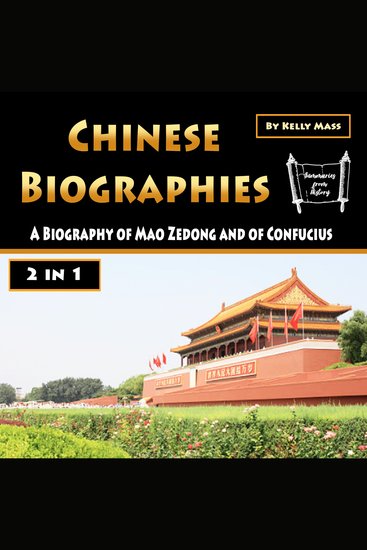
  • Chinese Biographies - A Biography of Mao Zedong and of Confucius - cover

    Chinese Biographies - A...

    Kelly Mass

    • 0
    • 0
    • 0
    This is a book combo with the following subjects: 
    Mao Zedong has had a tremendous impact on the Chinese nation. During his Great Leap Forward, he was responsible for more deaths than both Hitler and Stalin, making him the biggest mass murderer in history. Mao Zedong, typically called Chairman Mao, was a Chinese communist revolutionary who functioned as the starting dad of peoples's Republic of China (PRC), judgment as the chairman of the Chinese Communist Party from 1949 till his death in 1976. Maoism is a Marxist-- Leninist dogma that includes his theories, army operations, and political programs. What happened during the Great Leap Forward? Why did so many farmers starve to death? And what else did Mao Zedong do during his reign? You will find out more about those and other questions in this book. 
    Confucius was a Chinese thinker and political leader who was considered as the apotheosis of Chinese sages. Confucius' theories and philosophy, commonly seen as one of the most essential and prominent individuals in human history, created the structure of East Asian civilization and civilization, and stay appropriate across China and East Asia today.  
    Confucianism, his philosophical theories, highlighted personal and governmental morality, social connection precision, justice, generosity, and genuineness. Confucianism was instilled in Chinese civilization and way of living; for Confucians, daily life was a spiritual arena. Throughout the Hundred Schools of Thought age, his disciples contended efficiently with lots of other schools, only to be repressed in favor of the Legalists throughout the Qin dynasty. Confucius' ideas were formally approved in the new administration following Han's success over Chu after Qin's collapse. Confucianism developed into a system known in the West as Neo-Confucianism, and later as New Confucianism, at the time of the Tang and Tune dynasties.
    Voir livre
  • Persia and Islam: The History of the Islamic Empires that have Ruled Persia Since the Middle Ages - cover

    Persia and Islam: The History of...

    Editors Charles River

    • 0
    • 0
    • 0
    As the Persian Empire’s power makes clear, Persia has been a crucial area throughout history, and thus it has been fought over incessantly, watching empires rise and fall. For most of the past 1,400 years, Islamic powers have struggled for supremacy in the region.  
    The split between the two forms of Islam was already in the process of forming upon the death of the Prophet Muhammad. Muhammad had constructed around himself not only a potent new religious movement but also a powerful young state called the Ummah (the "Community" for lack of a better translation). Belonging to the Islamic faith also meant belonging to the Ummah, which was governed by its own laws and had many of its own institutions. 	Amid the upheaval in the Islamic world following Muhammad’s death, the Umayyad Caliphate lasted for less than a century, but in that time it managed to become one of the most influential of the major caliphates established following him. Its official existence was from 661-750, and the rulers were the male members of the Umayyad dynasty, roughly translated from Arabic as the “Sons of Umayyah.” Its primary base of power was in Syria following the creation of a dynastic, hereditary rule headed by one of Syria’s long-lasting governors, Muawiya ibn Abi Sufyan. 
    	The Ottoman Empire and Safavids would also vie for power in Persia after the caliphates, and the Ottomans in particular spent several centuries expanding their empire’s size, power, and influence, bumping up against Eastern Europe and becoming one of the world’s most important geopolitical players. It was a rise that would not truly start to wane until the 19th century.  Preserving its mixed heritage, coming from both its geographic position rising above the ashes of the Byzantine Empire and the tradition inherited from the Muslim Conquests, the Ottoman Empire lasted more than six centuries.
    Voir livre
  • Kutalaani - From the Stars - cover

    Kutalaani - From the Stars

    Dr Chelinay Gates

    • 0
    • 0
    • 0
    Kutalaani - From the Stars is a stylish unique recording in radio-play style. It reveals the amazing life of Gerry Moses Martin a blind indigenous man who believes that his ancestors are talking to him through iconic Hollywood movies. This audio features traditional indigenous elders singing ancient stories from country (Australia ) as well as contemporary original indigenous music.  
    If you’re ready to hear true life stories … cry … laugh …be inspired and outraged …This is for YOU.
    Voir livre
  • Avatar The Incarnations Of Godhead - The Wisdom Of Bhaktivedanta Swami - cover

    Avatar The Incarnations Of...

    Radha Krsna Das

    • 0
    • 0
    • 0
    “Whenever there is a decline of religion and a rise of irreligion, I incarnate myself. To protect the good, to destroy the wicked, and to re-establish religious principles, I appear in every age.” 
    "In order to deliver the pious and to annihilate the miscreants, as well as to reestablish the principles of religion, I advent Myself millennium after millennium." Sri Krishna  
     
    The incarnations of Godhead are a recurrent theme in Vedic history. Vishnu exists outside the material realm as the creator, and within every being as the Supersoul. He also enters this world as an avatar, ‘one who descends’, to restore balance whenever his presence is needed. There are said to be more incarnations of Godhead than waves on the ocean. The avatars of Vishnu are of particular interest because He takes progressively more developed forms, from the fish, tortoise, and boar to half-animal, half-man, and finally human form. That God should incarnate as an animal, even a supernatural one, shows animals have an important role to play in God’s eyes. They are living expressions of the spirit and presence of God. Here are the subtle secret teachings of A. C. Bhaktivedanta Swami the master of George Harrison and so many more. These ancient yogic mysteries were taught only to Maharaji's most advanced disciples and were thought to be all but lost these many years. Coming now from a nearly 50-year devotee of Srila Prabhupada here is a singular opportunity to enter into the true mystical presence of the divine incarnations of the absolute. 
     
    The Vedas are a 5000-year-old esoteric, intriguing, mystical body of work that carries within it the seed of divine, transcendental knowledge. We live in a world wherein yoga now reigns supreme as the preferred, go-to method of modern spiritual realization, and this unique, exclusive, audio presentation which paves the way for a clearer, more meaningful understanding of these divine sacred
    Voir livre
  • Making of Modern China The: The History of the World’s Most Populous Country from the Qing Dynasty to Today - cover

    Making of Modern China The: The...

    Charles River Editors

    • 0
    • 0
    • 0
    During the 15th century, China had become economically and technologically advanced compared to civilizations in Europe at the time, and its fleet, which had reached a total of 3,500 ships, was unmatched by any other world power. Nevertheless, after conducting several trade expeditions with the massive fleet, the Chinese ships were either burned in the docks or left to rot. With that, China began to revert to the xenophobic policies of its past and reduce its presence in other lands. By 1525, the largest naval fleet in the world had essentially been destroyed or dismantled by China itself.  
    	Meanwhile, the 19th century saw the rise of one of the largest, most powerful empires of the modern era. The sun never set on the British Empire, whose holdings spanned the globe, in one form or another. Its naval supremacy linked the Commonwealth of Canada with the colonies in South Africa and India, and through them trade flowed east and west. An integral but underutilized part of this vast trade network included China, a reclusive Asian kingdom closed off from the Western world that desired none of its goods. 
    	Unfortunately for China, the British had the might of an empire and economic force, not to mention modern arms, on their side. Breaking into China’s lucrative trade markets nearly destroyed the nation, severely discredited the Chinese dynasty, wreaked havoc on its people, and further propelled Britain’s empire into a dominant economic and military position. 
    	The collision of these two empires took many years and caused much bloodshed. In fact, the troubles started well before the eventual hostilities, festering as frustration mounted until finally boiling over. Such was the state of relations between the British Empire and Qing Dynasty for the better part of the century, its footing upended from the very start of relations.
    Voir livre