Join us on a literary world trip!
Add this book to bookshelf
Grey
Write a new comment Default profile 50px
Grey
Subscribe to read the full book or read the first pages for free!
All characters reduced
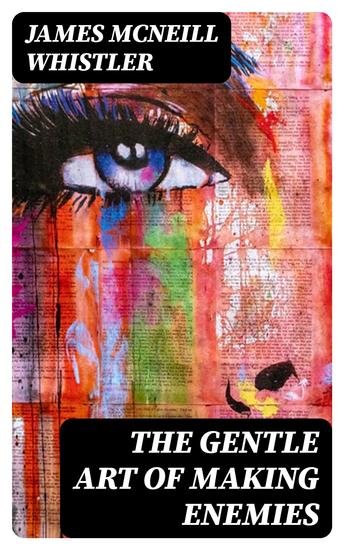
The Gentle Art of Making Enemies - cover

The Gentle Art of Making Enemies

James McNeill Whistler

Publisher: DigiCat

  • 0
  • 0
  • 0

Summary

James McNeill Whistler's "The Gentle Art of Making Enemies" is a captivating exploration of the interplay between art, identity, and society, cleverly interspersed with biting wit and satirical commentary. Written as a series of letters, the book documents Whistler's tumultuous relationship with the art world of the late 19th century, presenting a unique blend of autobiography and critique. His prose is characterized by its elegance and playfulness, offering insights into his experiences with critics, patrons, and fellow artists, while simultaneously serving as a manifesto for an artist's independence and integrity. Whistler, an American-born artist who became a leading figure in the London art scene, was influenced by his own battles against conventional perceptions of artistry. His fierce commitment to aesthetic principles and his disdain for societal expectations shaped not only his artistic output but also his written expressions. "The Gentle Art of Making Enemies" reflects Whistler's belief in the intrinsic connection between an artist's ego and external perception, making this work a deeply personal yet socially resonant narrative. This book is highly recommended for readers interested in the dynamics of art criticism, the personality behind the canvas, and the cultural milieu of the time. Whistler's incisive observations and humor provide a rich commentary that not only entertains but enriches our understanding of the challenges faced by artists, making it an essential read for enthusiasts of art history and literature alike.
Available since: 08/01/2022.
Print length: 192 pages.

Other books that might interest you

  • Summary of Kevin Simler & Robin Hanson’s The Elephant in the Brain - cover

    Summary of Kevin Simler & Robin...

    Falcon Press

    • 0
    • 0
    • 0
    Buy now to get the main key ideas from Kevin Simler & Robin Hanson’s The Elephant in the Brain 
      
    We, the human species, not only act on hidden motives, but we’re naturally designed to do so. Our brains are programmed to act in our own interest, even while we are trying hard not to be selfish. That’s why our brain often keeps our conscious mind in the dark. The more we ignore our ugly, hidden motives, the easier it is for us to keep them hidden from others, too. Self-deception is a strategic ploy that our brain adopts to disguise our bad behavior, and the key to change is understanding it.  
    In The Elephant in the Brain (2017), writer Kevin Simler and professor Robin Hanson uncover the hidden motives behind our main social behaviors and shed light on unexamined aspects of public life: respected social institutions in which nearly all participants are strategically self-interested, self-deceived, and driven by social signaling. 
     
    Show book
  • Anatomy of a Purple State - A North Carolina Politics Primer - cover

    Anatomy of a Purple State - A...

    Christopher A. Cooper

    • 0
    • 0
    • 0
    North Carolina represents a perfect distillation of the promise and peril of modern American democracy: hyperpartisanship, gerrymandering, dissatisfaction with the two-party system, the urban-rural divide—these issues are all brought into sharp relief in the Tar Heel State. For that reason, North Carolina politics and government are increasingly of interest not just to North Carolina citizens but to journalists, political observers, and people across the country. Political scientist Christopher A. Cooper, to whom the national media go when they need a quote about North Carolina politics, offers a primer made for all people, no matter their political leanings. 


    Listeners will be introduced to everything that has made North Carolina the most purple of purple states—from the state constitution and the influence of think tanks to the growing racial diversity of the state and the limitations on the governor's power. By explaining how we came to be in the political situation we are in, Cooper shows us where we might go next. And, as many have said, "As North Carolina goes, so goes the nation."
    Show book
  • Smashing Statues - The Rise and Fall of America's Public Monuments - cover

    Smashing Statues - The Rise and...

    Erin Thompson

    • 0
    • 0
    • 0
    A leading expert’s exploration of the past, present, and future of public monuments in America. 
    An urgent and fractious national debate over public monuments has erupted in America. Some people risk imprisonment to tear down long-ignored hunks of marble; others form armed patrols to defend them. Why do we care so much about statues? And who gets to decide which ones should stay up and which should come down?  
    Erin L. Thompson, the country’s leading expert in the tangled aesthetic, legal, political, and social issues involved in such battles brings much-needed clarity in Smashing Statues. She traces the turbulent history of American monuments and its abundant ironies, starting with the enslaved man who helped make the statue of Freedom atop the US Capitol, and explores the surprising motivations behind such contemporary flashpoints as the toppling of a statue of Columbus at the Minnesota State Capitol. Written with great verve and thoroughly researched, Smashing Statues gives listeners the context they need to consider the fundamental question: Whose voices must be heard and whose pain must remain private?
    Show book
  • GOSPEL MUSIC that LIFT BLACK WOMEN Up In HARD TIMES - cover

    GOSPEL MUSIC that LIFT BLACK...

    Raymond Sturgis

    • 0
    • 0
    • 0
    African American women have always had gospel music to uplift them in times of trouble, heartache, and stress. Raymond Sturgis presents to you an inspirational book of words that inspire and bring happiness to anyone and everyone who is in need of encouragement.
    Show book
  • Fighting in Flanders Fields The: The History of the Major Battles across the Region during World War I - cover

    Fighting in Flanders Fields The:...

    Charles River Editors

    • 0
    • 0
    • 0
    After an initial period of relatively rapid maneuver during which the German forces pushing through Belgium and the French and British forces attempting to stymie them made an endless series of abortive flanking movements that extended the lines to the sea, a stalemate naturally tended to develop. The infamous trench lines soon snaked across the French and Belgian countryside, creating an essentially futile static slaughterhouse whose sinister memory remains to this day. 
    	Until the war of maneuver returned in 1918 and led to a decisive outcome for the war, the nexus of this horror lay in the rainy, sodden levels and low ridges of Flanders, near the medieval town of Ypres. In this tiny fragment of Europe, half a million men died over the course of three major battles and the times of attrition between, perishing in a squelching pit of mud, blood-tinged water, and rotting human flesh. In fact, with the exception of a few hours on Christmas Day 1914, the shelling, sniping, raids, and bloodshed in Flanders never ceased from the moment of first contact between the British Expeditionary Force (BEF) and the Imperial German army.  
    	The Ypres salient bulged a few miles forward into Belgium, representing the only part of that nation the Germans had not occupied. Held by a mix of British, French, Canadian, Belgian, and colonial troops, this thorn in the Germans’ side had held off massive but clumsily handled attacks by barely-trained German volunteers and conscripts in late 1914 at the First Battle of Ypres. Each side had attempted to launch a major offensive through Ypres at the same time, leading to a blood-soaked encounter battle that, after weeks of futile butchery amid the small farms, hedgerows, canals, and tracts of woodland, devolved into a grim stalemate. Lines of trenches faced each other and sniping, artillery bombardment, and small actions led to an ongoing stream of casualties.
    Show book
  • What's Your Enneatype? An Essential Guide to the Enneagram - Understanding the Nine Personality Types for Personal Growth and Strengthened Relationships - cover

    What's Your Enneatype? An...

    Liz Carver, Josh Green

    • 0
    • 0
    • 0
    Harness the power of the Enneagram to learn about yourself, maximize your strengths, and improve your relationships. Pronounced ENN-EE-UH-GRAM, stemming from the Greek words ennea (nine) and grammos (a written symbol), the Enneagram is a centuries-old categorization tool that classifies human personalities into nine interconnected personality types.  Through in-depth descriptions and discussion, learn how to assess how you think, feel, and experience life, so that you can correctly identify which of the nine types you are.  Type 1: The Improver/Reformer/Perfectionist (Life Strategy: “I must be perfect and do what is right.”)  Type 2: The Helper/Giver/Befriender (Life Strategy: “I must be helping, caring, and needed.”)  Type 3: The Achiever/Performer/Motivator (Life Strategy: “I must be impressive and look accomplished and successful.”)  Type 4: The Individualist/Romantic/Artist (Life Strategy: “I must be understood uniquely as I am.”)  Type 5: The Investigator/Observer/Theorist (Life Strategy: “I must be knowledgeable and equipped.”)  Type 6: The Loyalist/Skeptic/Guardian (Life Strategy: “I must be secure and safe.”)  Type 7: The Enthusiast/Optimist/Epicurean (Life Strategy: “I must be enjoying myself and avoiding pain.”)  Type 8: The Challenger/Protector/Advocate (Life Strategy: “I must be strong and outside the control of others.”)  Type 9: The Peacemaker/Mediator/Reconciler (Life Strategy: “I must maintain peace and calm.”)  Authors Liz Carver and Josh Green, creators of the hugely popular Instagram account @justmyenneatype, help you discover how knowing your type—and the types of those around you—can affect your daily life, your decisions, and your relationships with others, and how to use this wisdom to live life with more clarity, peace, and insight than you ever thought possible.  So what’s your enneatype? Find out today and get started on the journey to better understand your world, yourself, and your place within it.
    Show book