Join us on a literary world trip!
Add this book to bookshelf
Grey
Write a new comment Default profile 50px
Grey
Subscribe to read the full book or read the first pages for free!
All characters reduced
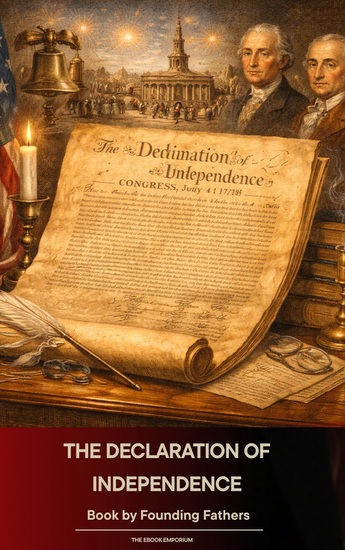
Declaration of Independence - cover

Declaration of Independence

James Madison, Benjamin Franklin, Thomas Jefferson, Jon Adams, George Washington, U.S. Government

Publisher: The Ebook Emporium

  • 0
  • 0
  • 0

Summary

What words changed the course of history forever?

The Declaration of Independence is the defining statement of American liberty and one of the most influential political documents ever written. Drafted primarily by Thomas Jefferson and shaped by leaders such as John Adams and Benjamin Franklin, this historic text announced the birth of a nation founded on the principles of freedom, equality, and self-government.

Adopted on July 4, 1776, the Declaration boldly asserted that all people are endowed with unalienable rights and that governments exist to secure those rights. Its powerful language and moral clarity inspired not only the American Revolution, but democratic movements around the world.

This Kindle Edition presents the Declaration in a clean, readable format, ideal for study, reference, and reflection. It is an essential text for understanding American history, constitutional principles, and the origins of modern democracy.

Inside this eBook, you'll explore:

The full text of the Declaration of Independence

The philosophical foundations of liberty and natural rights

The ideas that launched the American Revolution

One of the most important documents in world history

Read in classrooms, quoted in courts, and celebrated every Independence Day, the Declaration remains a living document whose message continues to resonate.

Return to the moment freedom was declared. Buy now and own the words that shaped a nation.
Available since: 01/21/2026.
Print length: 762 pages.

Other books that might interest you

  • What Is Property? - An Inquiry into the Principle of Right and of Government - cover

    What Is Property? - An Inquiry...

    Pierre-Joseph Proudhon

    • 0
    • 0
    • 0
    ‘Property is Theft’, a phrase which has passed into common parlance, was the rallying call of Pierre-Joseph Proudhon’s political treatise What Is Property? Proudhon (1809-1865) was both admired and excoriated. A political theorist of the first order, he was vilified in his native France by the Communists and the Monarchists alike, though admired by Karl Marx as well as many in the nation’s academia and judiciary who valued the clarity of his thought and analytical method.  
     
    He criticised both Right and Left (the very definition of French political thinking), describing them as two sides of the same coin. Their solutions to society’s ills, he said, were like Thesis and Antithesis, based on a common error and both inadequate to the task of healing society. He offered, instead, a third way, which he called his Synthesis. Regarded as the founder of modern Anarchism, his aim was not to engender chaos, as the word anarchy often connotes, but to suggest a workable, political, and economic foundation for society which would promote order and equity for all under the most unfettered conditions of individual liberty.  
     
    Proudhon grew up in poverty, and was home schooled as a child, but received a bursary in his youth sufficient to allow him to attend the City College in his home town (though not sufficient, it seems, to buy him shoes). There, he discovered the library which introduced him to a world, classical and contemporary, previously denied him. Lacking wealth or contacts, he worked variously as a printer, a compositor and proof-reader by day and an essayist by night, learning Latin along the way to assist in his work. In 1830, a friend, a scholar, invited Proudhon to join him in Paris to pursue his philosophical writings full time. When a cholera outbreak forced his return home, Proudhon spent the next few years juggling his two careers. In 1839, he applied for a pension (bursary) at the Academy of Besançon which obliged him to write works on its behalf.  
     
    What Is Property?, published in France in 1840, was his first. It was so controversial that little else followed. However, it established his reputation, and he was eventually able to pursue his philosophical work full time. What Is Property? (First Memoir) attempts to uncover the roots of poverty and associated social ills and examines different attitudes to poverty and wealth from the Greeks to the present day. Proudhon quickly identifies a common thread, property, which he distinguishes from possession, and argues that only a fundamental, though gradual, abandonment of property (as an asset) and all that flows from it, can rescue society from its current conflicts. The memoir seeks to illuminate the underlying causes of war, poverty, slavery, and oppression and points the way to a solution. In effect, it is a practical manual for the survival of mankind. The Second Memoir (1841), included on this recording, is Proudhon’s response to the criticisms of the First Memoir, initially uncomprehending and then self-assured by turns. What Is Property? is Proudhon’s masterwork. It divides opinion, but no one who hears it can come away with their view of their own world unchanged.  
     
    Translation: Benjamin R. Tucker.
    Show book
  • Imaginative Communities - Admired cities regions and countries - cover

    Imaginative Communities -...

    Robert Govers

    • 0
    • 0
    • 0
    Americans are loud. Amsterdam equals sex, drugs, and rock & roll. Mexicans are lazy and Germans are boring, but punctual. Paris is romantic, Wuhan infectious, Ukrainians heroic, and New Zealand untouched.  
    This is the way people around the world think about cities, regions and countries and the communities that live there; through cliches and stereotypes. It can be frustrating and hindering trade, diplomacy, investment, tourism, or talent attraction. Many believe that such image problems can be resolved with advertising campaigns, but the classic tourism promotion model is broken and insufficient. This book explains what works and what doesn’t when it comes to improving the reputation of cities, regions, and countries. It does so without the use of jargon and with reference to numerous case-studies. The book primarily aims to inspire readers and offer them a broad overview of an issue in modern society that is of interest and relevance to all of us: the reputation of our communities. 
    Tables and figures: download from www.imaginativecommunities.com/tables
    Show book
  • Understanding Hitler and the Germans - cover

    Understanding Hitler and the...

    François Roux

    • 0
    • 0
    • 0
    The internal logic of the Nazi movement and the Third Reich is intertwined with that of Hitler: one cannot be understood without first considering the other.
    
    How did an individual with little education or culture, whose life until the age of 30 had been a series of failures, manage to impose his will on a large modern country before leading it into a military and moral catastrophe unique in history?
    
    The answer to this question begs another: can what happened in Germany happen again?
    Show book
  • Dynamics of Security Management - Securing the future - cover

    Dynamics of Security Management...

    Taurai Makadho

    • 0
    • 0
    • 0
    This audiobook is narrated by an AI Voice.  
    "In today's rapidly evolving world, security management has become a critical component of organizational success. The Dynamics of Security Management aims to provide a comprehensive understanding of the complex and multifaceted nature of security in various contexts. This book explores the theoretical foundations, practical applications, and emerging trends in security management, offering insights and strategies for professionals, researchers, and students alike. By examining the dynamics of security management, we can better navigate the challenges and opportunities that arise in this field, ultimately contributing to a safer and more peaceful world.
    Show book
  • Recessional - The Death of Free Speech and the Cost of a Free Lunch - cover

    Recessional - The Death of Free...

    David Mamet

    • 0
    • 0
    • 0
    NEW YORK TIMES BESTSELLER! 
    “Savagery appeased can only grow. Once you give in to it, it must escalate, like a fire searching for air.” 
    The man who won the Pulitzer Prize for GLENGARRY GLEN ROSS, who wrote the classic films THE VERDICT and WAG THE DOG sounds his alarm about the Visigoths at our gates. 
    In RECESSIONAL he calls out, skewers, mocks, and, most importantly, dissects the virus of conformity which is now an existential threat to the West. 
    A broad-ranging journey through history, the Bible, and literature, RECESSIONAL examines how politics and cultural attitudes about rebellion have shifted in the United States in the last generation. By screaming down freedom of thought and expression, Mamet explains, we kill invention and democracy – the foundations of security and growth. 
    A wickedly funny, wistful and wry appeal to the free-thinking citizen, RECESSIONAL is a vital warning that if we don’t confront the cultural thuggery now, the commissars and their dupes will transform the Land of the Free into the dictatorship at which they aim.
    Show book
  • Sahel: 10 Years of Instability - Local Regional and International Dynamics - cover

    Sahel: 10 Years of Instability -...

    Giovanni Carbone, Camillo Casola

    • 0
    • 0
    • 0
    Ten years after the start of the Malian crisis, political and security instability in the Sahel have changed in scale and nature, and spilled over across national frontiers. The border region between Mali, Burkina Faso and Niger has become the new epicentre of insecurity.
    The comeback of military actors on the political scene, and the support provided by large parts of the population to post-coup military juntas is evidence of poor governance and a severe deterioration in the legitimacy of elected authorities. In this complex scenario, the initiatives of external partners affect regional balances, making the Sahel a major theatre for power competition.
    How did the crisis evolve over the past decade? What are the main drivers behind local, regional and international dynamics? What prospects for regional stability?
    Show book