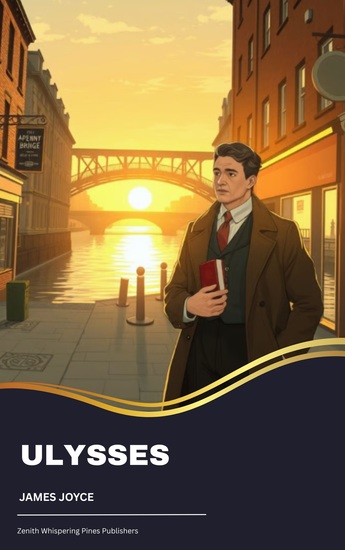
One ordinary day. One extraordinary city. One journey that changed modern literature forever.
Set over a single day in Dublin, Ulysses follows Leopold Bloom, Stephen Dedalus, and Molly Bloom as their paths cross through moments tender, comic, heartbreaking, and profoundly human. What seems like a simple day becomes an epic of thought, memory, desire, and self-discovery—told with daring style and emotional depth.
Celebrated as "the greatest novel of the twentieth century," Joyce's masterpiece captures the fullness of life: its chaos and beauty, its secrets and longings, its quiet battles and private triumphs. It remains a book that challenges, surprises, and rewards every reader who enters its world.
If you love ambitious storytelling, innovative language, and novels that reveal new wonders with every page, this landmark classic belongs in your library.
Open the book—and experience a single day that contains an entire universe.
The Kalevala is a 19th-century work of epic poetry compiled by Elias Lönnrot from Karelian and Finnish oral folklore and mythology. It is regarded as the national epic of Karelia and Finland and is one of the most significant works of Finnish literature. The Kalevala played an instrumental role in the development of the Finnish national identity, the intensification of Finland's language strife and the growing sense of nationality that ultimately led to Finland's independence from Russia in 1917. The first version of The Kalevala (called The Old Kalevala) was published in 1835. The version most commonly known today was first published in 1849 and consists of 22,795 verses, divided into fifty songs. The title can be interpreted as "The Land of Kaleva" or "Kalevia." If the rhythm of the poetry sounds familiar to American readers, it is probably because Henry Wadsworth Longfellow borrowed its trochaic tetrameter form for his famous "Song of Hiawatha." Of the five complete translations of the Kalevala into English, it is only the older translations by John Martin Crawford (1888) and William Forsell Kirby (1907) which attempt strictly to follow the original rhythm (Kalevala meter) of the poems. Modern writers influenced by the Kalevala include J. R. R. Tolkien, whose epic "Lord of the Rings" trilogy make use of both style and content from the Finnish work. - Summary by Wikipedia (edited and supplemented by Expatriate)
LibriVox volunteers offer you 12 different recordings of The Jabberwocky of Authors by Harry Persons Taber. This parody of Carroll's Jabberwocky consists almost entirely of authors' names. See how many you can spot! This was the weekly poetry project for the week of April 4th, 2010.
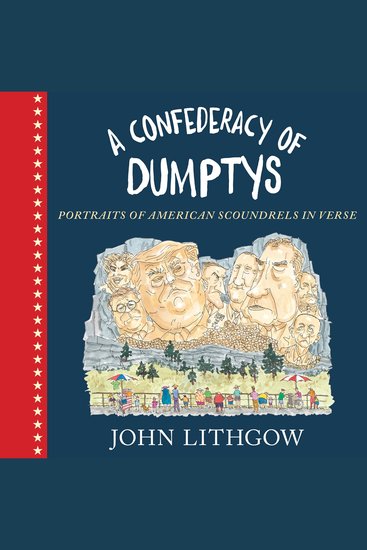
The next book in John Lithgow's New York Times bestselling seriesFollowing the success of New York Times bestsellers Dumpty and Trumpty Dumpty Wanted a Crown, award-winning actor, author, and illustrator John Lithgow presents the third book in his runaway hit series. A Confederacy of Dumptys takes us through a history of twenty-five "American Scoundrels" in this all-new collection of Lithgow's satirical poems and illustrations.While the Trump Era was rife with corruption and abuse of power, it was nothing new. Through Lithgow's cutting humor, you will read about a rogues' gallery of villains that came before Donald J. Trump, powerful men and women who were corrupt, venal, criminal, adulterous, racist, or just plain disgusting. With dark and lyrical stories from across American history, you will learn about long-forgotten figures and bad actors of today, including the first Grand Wizard of the Ku Klux Klan, the perpetrator of 19th century women's pyramid schemes, and participants in both the Watergate scandal and the Capitol insurrection. Trump and Nixon show up, of course, but also Leona Helmsley, Boss Tweed, Typhoid Mary, Newt Gingrich, Ted Cruz, and many more. Skipping through time, and delivered with classic Lithgow wit and style, A Confederacy of Dumptys is an exuberant reminder of how not to repeat history.Digital audio edition read by the author.The perfect book for:• Political satire fans—viewers of The Daily Show with Trevor Noah, Last Week Tonight with John Oliver, and The Late Show with Stephen Colbert.• American history buffs and trivia enthusiasts—readers of Jon's Stewart's America (The Book): A Citizen's Guide to Democracy Inaction and Josh Clark's Stuff You Should Know: An Incomplete Compendium of Mostly Interesting Things.• Poetry, art, and illustration aficionados.
Winner of the Max Ritvo Poetry Prize, Jackson Holbert’s Winter Stranger is a solemn record of addiction and the divided affections we hold for the landscapes that shape us.In the cold, seminal countryside of eastern Washington, a boy puts a bullet through his skull in a high school parking lot. An uncle crushes oxycodone into “a thousand red granules.” Hawks wheel above a dark, indifferent river. “I left that town / forever,” Holbert writes, but its bruises appear everywhere, in dreams of violent men and small stars, the ghosts of friends and pills. These poems incite a complex emotional discourse on what it means to leave—if it’s ever actually possible, or if our roots only grow longer to accommodate the distance.Punctuated by recollections of loved ones consumed by their addictions, Winter Stranger also questions the capricious nature of memory, and poetry’s power to tame it. “I can make it all sound so beautiful. / You’ll barely notice that underneath / this poem there is a body / decaying into the American ground.” Meanwhile, the precious realities vanish—“your hair, your ears, your hands.”—leaving behind “the fucked up / trees,” the “long, cold river.” In verse both bleak and wishful, Holbert strikes a fine balance between his poetic sensibilities and the endemic cynicism of modern life.“It is clear now that there are no ends,” Holbert writes, “Just winters.” Though his poems bloom from hills heavy with springtime snow, his voice cuts through the cold, rich with dearly familiar longings: to not be alone, to honor our origins, to survive them.
Writing poetry always seems to be something we learn at school, usually beginning with a couplet of child-like rhyme that brings gales of laughter. Later it may be agonising over a verse or two attempting to rhapsodise on love and then the years roll on with only an occasional desire to return.
In this volume we put together wordsmiths of the highest caliber as they write on Poets themselves. Many of the poems provide valuable insights on how other poets are seen by their peers. Some are deeply personal others are abstract. Whether they speak at the celebration of a birth or the knowing tragedy of entering a slaughterous battle these poets take us into new uncharted territories revealing their inner selves in raw and tender ways.
Yeats, Flecker, Benet, Yeats, Dickinson, Coleridge, Millay, Levy, Gurney are but a few of their number who speak with the clarity, the eloquence and the truth that only a poet can know….but all can share.
01 - Poets on Poets - An Introduction
02 - A Caution to Poets by Matthew Arnold
03 - To a Poet by Emily Hickey
04 - To a Poet by Alice Meynell
05 - To a Poet by Claude McKay
06 - To Poets by Charles Sorley
07 - The Poet by Aleksandr Pushkin
08 - The Poet by Radclyffe Hall
09 - The Poet by Paul Laurence Dunbar
10 - The Poet to Nature by Alice Meynell
11 - Sonnet VII - Sweet Poet of the Woods by Charlotte Smith
12 - To John Keats, Poet, At Spring Time by Countee Cullen
13 - False Poets and True (To Wordsworth) by Thomas Hood
14 - On Dryden by Christopher Caudwell
15 - On Poet-Ape by Ben Jonson
16 - On the Morals of Poets by Richard Le Gallienne
17 - The Poets by Henry Wadsworth Longfellow
18 - The Toast by Ernest Rhys
19 - A Minor Poet by Stephen Vincent Benet
20 - To Alex Smith, the Glasgow Poet by George Meredith
21 - The Peasant Poet by John Clare
22 - London Poets by Amy Levy
23 - Negro Poets by Charles Bertram Johnson
24 - A Poet's Hope by Ambrose Bierce
25 - The Poet's Portion by Thomas Hood
26 - Poets by Khalil Gibran
27 - The Poet's Apology by Aristophanes
28 - A Tale of the Miser and His Poet by Anne Kingsmill Finch
29 - The Poet, the Oyster and Sensitive Plant by William Cowper
30 - The Bad Season Makes the Poet Sad by Robert Herrick
31 - Besides The Autumn Poets Sing by Emily Dickinson
32 - A Poet of One Mood by Alice Meynell
33 - Fancy in Nubibus or The Poet in the Clouds by Samuel Taylor Coleridge
34 - The Poet Pleads with the Elemental Powers by W B Yeats
35 - Singers To Come by Alice Meynell
36 - To a Poet a Thousand Years Hence by James Elroy Flecker
37 - The Young Poet by James Elroy Flecker
38 - Portrait of the Author by William Carlos Williams
39 - The Modern Poet - A Song of Derivations by Alice Meynell
40 - The Poet to His Childhood by Alice Meynell
37 - A Poet's Father by Ambrose Bierce
42 - A Poet's Welcome To His Love Begotten Daughter by Robert Burns
43 - A Poet to His Baby Son by James Weldon Johnson
44 - Mother and Poet by Elizabeth Barrett Browning
45 - The Martyr Poets - Did Not Tell by Emily Dickinson
46 - Trench Poets by Edgell Rickword
47 - England's Poet by Laurence Binyon
48 - A Poet Unknown by Ernest Rhys
49 - To the Poet Before Battle by Ivor Gurney
50 - The Poets Are Waiting by Harold Munro
51 - Lament for the Poets, 1916 by Francis Ledwidge
52 - The Poet's Knowledge by Raymond Chandler
53 - These Things That Poets Said by Edward Thomas
54 - This Was A Poet - It Is That by Emily Dickinson
55 - The Old Poet by Amy Levy
56 - The Old Poet by James Elroy Flecker
57 - The
LibriVox volunteers bring you 15 different recordings of Ode to Autumn by John Keats. This was the weekly poetry project for the week of November 11th, 2007.
Ihr Account wird momentan auf einem anderen Gerät benutzt.
Es ist bereits eine Sitzung auf einem anderen Gerät geöffnet.
Abmelden
Erneut verbinden
Ihr Account wird momentan auf einem anderen Gerät benutzt.
Um darauf zugreifen zu können, müssen die Berechtigungen und obligatorischen Richtlinien (markiert mit *) überprüft und akzeptiert werden.
Wenn Sie Hilfe oder weitere Informationen benötigen, schreiben Sie an support@24symbols.com
Akzeptieren
Ihr Account wird momentan auf einem anderen Gerät benutzt.
OK
Bestätigungs-E-Mail noch einmal schicken
Ihr Account wird momentan auf einem anderen Gerät benutzt.
Wir haben versucht, Ihr Abo abzubuchen, aber es ist uns nicht gelungen. Das teilt uns Ihre Bank/Karte mit:
Wenn Sie weiterlesen möchten, müssen Sie sich möglicherweise an Ihre Bank wenden oder Ihre Zahlungsinformationen hier ändern:
Ich möchte meine Karte aktualisieren!
Haben Sie Fragen? Schreiben Sie uns an support@24symbols.com und wir werden Ihnen weiterhelfen.
Cookies helfen uns bei der Bereitstellung unserer Dienste. Durch die Nutzung unserer Dienste erklären Sie sich damit einverstanden, dass wir Cookies setzen.Mehr erfahren