Begleiten Sie uns auf eine literarische Weltreise!
Buch zum Bücherregal hinzufügen
Grey
Einen neuen Kommentar schreiben Default profile 50px
Grey
Jetzt das ganze Buch im Abo oder die ersten Seiten gratis lesen!
All characters reduced
Cultural Face Dynamics - cover

Cultural Face Dynamics

Jade Earing

Übersetzer A AI

Verlag: Publifye

  • 0
  • 0
  • 0

Beschreibung

Cultural Face Dynamics explores the crucial role of “face”—the public image people try to project—in shaping social interactions across cultures. Understanding cultural face dynamics is essential, as it reveals the often-unspoken rules that govern our behavior and influence our relationships, particularly in intercultural communication. The book challenges the idea that face is a universal concept, instead arguing that its expression and interpretation vary significantly based on cultural values, drawing on classic sociological and anthropological studies.

 
The book progresses systematically, first introducing core concepts like positive and negative face, representing the desire to be liked and the desire for autonomy, respectively. It then examines case studies from diverse regions like East Asia and Latin America, illustrating how face concerns manifest in different social settings. Finally, it explores practical applications in international relations and business, emphasizing cultural sensitivity.

 
What makes this book unique is its interdisciplinary approach, integrating insights from psychology, sociology, anthropology, and communication studies to provide a holistic understanding of face.
Verfügbar seit: 21.02.2025.
Drucklänge: 82 Seiten.

Weitere Bücher, die Sie mögen werden

  • 20 First Legislative Acts of the Russian Bolshevik Revolution - cover

    20 First Legislative Acts of the...

    Vladimir Lenin

    • 0
    • 0
    • 0
    Decrees were legislative acts of the highest Soviet institutions, primarily of the Council of People's Commissars (the highest executive body — Sovnarkom) and of VTsIK (the highest legislative body between sessions of the Congress of Soviets).
    The Bolshevik Initial Decrees were announced as soon as the Bolsheviks declared their success in the October Revolution (October 26, 1917). The Decrees seemed to conform to the popular Bolshevik slogan "Peace, Land and Bread". The slogan succinctly articulated the grievances of the Russian peasantry, armed forces and proletariat.
    The Bolsheviks were not opportunists but benevolent idealists; the point of the Decrees was to bring about a better quality of life for the Russian people. Regardless of which view is the more accurate account, it is clear from these opposing perspectives that the history of the Initial Decrees is a politically charged issue. This is perhaps because historians use the Decrees to try to discern whether the implementation of Marxist thought has totalitarian tendencies.
    Zum Buch
  • Soap Magic Part 4 - Old Bullies New Lovers - cover

    Soap Magic Part 4 - Old Bullies...

    Kathrin Pissinger

    • 0
    • 0
    • 0
    Magic. Mayhem. Soap. 
    Fine, then. Let's put this soap to good use. And what better use than to re-visit my old schoolmates and see what they've been up to. And maybe some will be up for some soapy, soapy lesbian love. I'll provide the toys, of course. Not gonna show up empty handed, right?  
    And so in the fourth part of Soap Magic, this trip down memory lane is paved with sweet, sticky lesbian juices, less sweet, but still sticky anal probing and quite possibly more than two lesbians at one time, if I was counting correctly. Which I may not have. Look, things got heated, is all I'm sayin'.
    Zum Buch
  • Emergency - cover

    Emergency

    Neil Strauss

    • 0
    • 0
    • 0
    Terrorist attacks. Natural disasters. Domestic crackdowns. Economic collapse. Riots. Wars. Disease. Starvation.  
    What can you do when it all hits the fan?  
    You can learn to be self-sufficient and survive without the system.  
    ""I've started to look at the world through apocalypse eyes."" So begins Neil Strauss's harrowing new book: his first full-length work since the international bestseller The Game, and one of the most original-and provocative-narratives of the year.  
    After the last few years of violence and terror, of ethnic and religious hatred, of tsunamis and hurricanes–and now of world financial meltdown–Strauss, like most of his generation, came to the sobering realization that, even in America, anything can happen. But rather than watch helplessly, he decided to do something about it. And so he spent three years traveling through a country that's lost its sense of safety, equipping himself with the tools necessary to save himself and his loved ones from an uncertain future.  
    With the same quick wit and eye for cultural trends that marked The Game, The Dirt, and How to Make Love Like a Porn Star, Emergency traces Neil's white-knuckled journey through today's heart of darkness, as he sets out to move his life offshore, test his skills in the wild, and remake himself as a gun-toting, plane-flying, government-defying survivor. It's a tale of paranoid fantasies and crippling doubts, of shady lawyers and dangerous cult leaders, of billionaire gun nuts and survivalist superheroes, of weirdos, heroes, and ordinary citizens going off the grid.  
    It's one man's story of a dangerous world–and how to stay alive in it.  
    Before the next disaster strikes, you're going to want to read this book. And you'll want to do everything it suggests. Because tomorrow doesn't come with a guarantee...
    Zum Buch
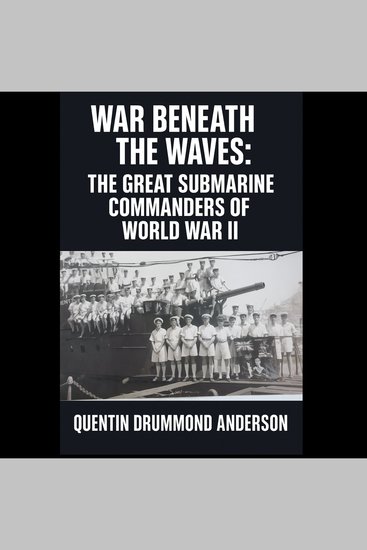
  • “War Beneath the Waves: The Great Submarine Commanders of World War II” - cover

    “War Beneath the Waves: The...

    Quentin Drummond Anderson

    • 0
    • 0
    • 0
    War Beneath the Waves: The Great Submarine Commanders of World War II 
    From the acclaimed author of "Righteous Renegades" and "The Few Against The Many"The Underwater War That Decided Everything 
    In the ocean's depths, a different war determined nations' fates. War Beneath the Waves reveals the extraordinary true stories of submarine commanders who wielded steel sharks with deadly precision and unbreakable courage. 
    Drawing from family archives, international military records, and untold personal accounts, Anderson brings readers into cramped control rooms where split-second decisions meant victory or death in crushing depths.Meet History's Greatest Underwater Warriors 
    OTTO KRETSCHMER - Germany's "Tonnage King," the most successful U-boat commander. 
    DUDLEY "MUSH" MORTON - Revolutionary American submarine commander who led USS Wahoo into Japan's defended waters. 
    MALCOLM WANKLYN - Scottish perfectionist whose Victoria Cross and HMS Upholder made him the Mediterranean's most feared commander. 
    ALEKSANDR MARINESKO - Soviet commander whose Wilhelm Gustloff sinking created history's deadliest maritime disaster. 
    RICHARD O'KANE - America's deadliest submarine ace and most successful commander. 
    GEORGE "SHRIMP" SIMPSON - Mastermind who orchestrated Axis supply destruction from Malta.Four Nations, One Deadly Art 
    From North Atlantic to tropical Pacific, these commanders fought across every ocean. German wolf packs terrorized shipping. American submarines strangled Japanese supply lines. British submarines destroyed Rommel's lifelines.
    Zum Buch
  • What to the Slave is the Fourth of July? - cover

    What to the Slave is the Fourth...

    Frederic Douglass

    • 0
    • 0
    • 0
    In 1852, Frederick Douglass, former slave and, by then, a leading figure in the abolitionist movement was asked by the Rochester Ladies' Anti-Slavery Association to address the group for their July 4th celebration at Corinthian Hall in Rochester, New York.Delivered, in fact, on the 5th of July, the speech caused an immediate sensation and swiftly became a seminal rallying cry of the abolitionist movement in America. The audience in Rochester included none other than President Millard Fillmore (along with a group of politicians from Washington) as well as some of the most important leaders of the abolitionist movement at the time.Through the years, Douglass' powerful words have only grown in stature, resonance and importance. His timeless message and elegant prose have made this speech - here presented in its unabridged, original format - one of the greatest orations in history.
    Zum Buch
  • Captive Gods - Religion and the Rise of Social Science - cover

    Captive Gods - Religion and the...

    Kwame Anthony Appiah

    • 0
    • 0
    • 0
    Philosopher Kwame Anthony Appiah explores how early social scientists developed our modern understandings of society through their theories of religion The foundations of modern social science were built on the study of religion, the acclaimed thinker Kwame Anthony Appiah argues. Delving into the intellectual currents of the nineteenth and early twentieth centuries, he investigates how formative thinkers—notably Edward Burnett Tylor, Émile Durkheim, Georg Simmel, and Max Weber—grappled with the concepts of society and religion as interdependent categories. Appiah shows how their efforts to define religion, or evade the task, mark the power and limitations of social thought in ways that persist among theorists today. Religion was not an object of study but a framework through which early social scientists established sociology as a discipline. Appiah also examines recent work in both interpretive sociology and evolutionary and cognitive psychology about the mechanisms through which communities form beliefs and values—while underscoring the enduring significance of these earlier debates for contemporary social thought. Throughout, he intertwines storytelling, historical analysis, and philosophical reflection to show how our ideas about society and culture have been, and continue to be, forged in dialogue with religious questions.
    Zum Buch