Begleiten Sie uns auf eine literarische Weltreise!
Buch zum Bücherregal hinzufügen
Grey
Einen neuen Kommentar schreiben Default profile 50px
Grey
Jetzt das ganze Buch im Abo oder die ersten Seiten gratis lesen!
All characters reduced
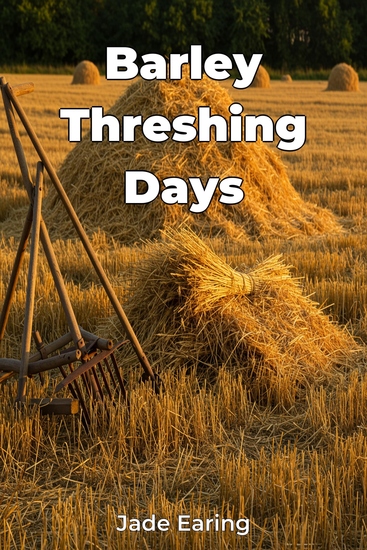
Barley Threshing Days - cover

Barley Threshing Days

Jade Earing

Übersetzer A AI

Verlag: Publifye

  • 0
  • 0
  • 0

Beschreibung

Barley Threshing Days explores the world of traditional barley harvesting and its deep roots in rural society. More than a simple agricultural task, barley harvesting shaped economic structures, social hierarchies, and cultural traditions within village life. The book reveals that traditional methods were not just about crop yields, but also about fostering communal identity, where harvest festivals and rituals reinforced social bonds.

 
The book traces the evolution of harvesting methods, from hand-pulling to the adoption of threshing machines, examining the impact on labor practices and social relationships. For example, the introduction of new agricultural technology significantly altered traditional labor practices, changing how rural communities functioned.

 
Beginning with an introduction to barley cultivation, the book progresses to explore social structures, labor practices, cultural traditions, and the impact of mechanization, offering a comprehensive view of this vital aspect of agricultural history. Drawing on historical manuals, oral histories, and archival photographs, Barley Threshing Days adopts a narrative non-fiction approach, blending rigorous research with engaging storytelling.

 
It is intended for those interested in understanding the complex relationship between human labor, agricultural technology, and the evolving social fabric of rural communities, making it valuable for anyone seeking to understand the cultural traditions of rural communities.
Verfügbar seit: 27.02.2025.
Drucklänge: 63 Seiten.

Weitere Bücher, die Sie mögen werden

  • Nothing but Wickedness - The Delusions of Our Culture - cover

    Nothing but Wickedness - The...

    Theodore Dalrymple

    • 0
    • 0
    • 0
    Nothing But Wickedness delves into society's subtle—and some not so subtle—transgressions that contribute to the decline of our culture. Theodore Dalrymple, drawing on his extensive experience as an inner-city GP and prison psychiatrist, examines the underlying factors that drive societal behaviours and self-deception. The book covers a range of thought-provoking topics, including what drives doctors to work for dictators, the benefits of idleness, understanding the mindset of Hitler, why doctors collect body parts, the true meaning of illness, and how war can paradoxically advance medicine. This wide-ranging exploration is a compelling read for the intelligent reader and the Theodore Dalrymple fan. Dalrymple's insights offer a unique perspective on the complexities of human behaviour and cultural decline. Whether you are intrigued by the benefits of idleness, fascinated by the darker side of human nature, or interested in historical and psychological analyses, Nothing But Wickedness promises to be an enlightening and engaging read ranging across many genres.
    Zum Buch
  • Healing From Infidelity - cover

    Healing From Infidelity

    Sylvia Loach

    • 0
    • 0
    • 0
    Infidelity is breaking a promise to remain faithful to a romantic partner, whether that promise was a part of marriage vows, a privately uttered agreement between lovers, or an unspoken assumption. As unthinkable as the notion of breaking such promises may be at the time they are made, infidelity is common, and when it happens, it raises thorny questions: Should you stay? Can trust be rebuilt? Or is there no choice but to pack up and move on?For the adulterer, infidelity can be exciting and seductive, conferring feelings of renewal, rejuvenation, and joy. Infidelity is a betrayal, but it isn’t necessarily the end of love; cheating occurs even in happy relationships. The partner being betrayed may feel confusion, anger, doubt, pain, and heartbreak.Most people know the costs of cheating in a relationship, particularly in a marriage. Betrayal can lead to divorce and parental disruption, and infidelity is a predictor of depression, anxiety, and domestic violence. Yet many stray anyway, prompting the question: Why? In surveys of individuals who have cheated, falling out of love, seeking variety, and feeling neglected were the most commonly cited reasons, followed by situational forces, a desire to raise self-esteem, and anger with a partner.Men have always been more likely than women to cheat, or at least to report having done so, but researchers have noticed a shift in recent years: 16% of adults, about 20% of men, and 13% of women report that they’ve had sex with someone other than their spouse while married. But among adults under 30 who have been married, 11% of women say having committed infidelity, as opposed to 10% of men.The line between innocent flirtation and romantic betrayal is often elastic, and many couples face conflict because partners do not share the same definition of cheating. For some, anything short of sexual contact with someone else is acceptable; for others, any attention to a potential rival is unforgivable.The term “micro-cheating” refers
    Zum Buch
  • The Life and Miracles of St Cuthbert - cover

    The Life and Miracles of St...

    The Venerable Bede

    • 0
    • 0
    • 0
    For centuries, St Cuthbert (c. 634-687) was the most worshipped saint in England, revered for his virtuous life and his miracles. Even centuries after his death, stories were told of his body remaining ‘incorrupt’ in his tomb. What we know about his work and character comes from the records and significantly from the writings of the Venerable Bede (673-735). His Life of St Cuthbert (published in 721) was part of the tradition of hagiography, a reverential biography of a saint. Bede diligently collected accounts, both written and word of mouth, to compile his work.   
     
    Probably born in Northumberland and educated by monks - initially at Melrose Abbey - Cuthbert’s religious practice, unusually, encompassed activities as monk, bishop and finally hermit. The numerous reports of his piety, his virtue, his ascetism and a reputation for healing made him a respected figure in his lifetime. These were difficult political times, and he clearly had diplomatic and administrative skills as well, which led to his appointment as bishop of Lindisfarne. However, his personal monastic leanings made him unhappy to occupy such a worldly position, and after a short time he resigned. Feeling his death was imminent he retired to his cell on Inner Farne island where, after a period of illness, he died. Bede’s endearing Life, written within living memory of its subject, presents an untarnished view of St Cuthbert, whose shrine in Durham Cathedral, nearly 1,400 years on, continues to attract visitors and pilgrims.  
     
    Translated by J. A. Giles.
    Zum Buch
  • Francisco de Orellana: A short biography - 5 Minutes: Short on time – long on info! - cover

    Francisco de Orellana: A short...

    5 Minutes, 5 Minute Biographies,...

    • 0
    • 0
    • 0
    Francisco de Orellana, Spanish explorer and discoverer of the Amazon river: Life and work in a short biography! Everything you need to know, brief and concise. Infotainment, education and entertainment at its best!
    Zum Buch
  • Emancipation of the Mind An - Radical Philosophy the War Over Slavery and the Refounding of America - cover

    Emancipation of the Mind An -...

    Matthew Stewart

    • 0
    • 0
    • 0
    How a band of antislavery leaders recovered the radical philosophical inspirations of the first American Revolution to defeat the slaveholders' oligarchy in the Civil War. 


    In their struggle against the slaveholding oligarchy of their time, America's antislavery leaders found their way back to the rationalist, secularist, and essentially atheist inspiration for the first American Revolution. Frederick Douglass's unusual interest in radical German philosophers and Abraham Lincoln's buried allusions to the same thinkers are but a few of the clues that underlie this propulsive philosophical detective story. With fresh takes on forgotten thinkers like Theodore Parker, the excommunicated Unitarian minister who is the original source of some of Lincoln's most famous lines, Matthew Stewart tells the story of the battle between America's philosophical radicals and the conservative counterrevolution that swept the American republic in the first decades of its existence and persists in new forms up to the present day. In exposing the role of Christian nationalism and the collusion between northern economic elites and slaveholding oligarchs, An Emancipation of the Mind demands a significant revision in our understanding of the origins and meaning of the struggle over slavery in America—and offers a fresh perspective on struggles between democracy and elite power today.
    Zum Buch
  • The Language of the Night - Essays on Writing Science Fiction and Fantasy - cover

    The Language of the Night -...

    Ursula K. Le Guin

    • 0
    • 0
    • 0
    Featuring a new introduction by Ken Liu, this revised edition of Ursula K. Le Guin’s first full-length collection of essays covers her background as a writer and educator, her thoughts on writing, and her commentary on literary science fiction and fantasy and their future. 
     
    “We like to think we live in daylight, but half the world is always dark; and fantasy, like poetry, speaks the language of the night.”—URSULA K. Le GUIN 
     
    Le Guin’s sharp and witty voice is on full display in this collection of twenty-four essays, revised by the author a decade after its initial publication in 1979. The collection covers a wide range of topics and Le Guin’s origins as a writer, her advocacy for science fiction and fantasy as mediums for true literary exploration, the writing of her own major works such as A Wizard of Earthsea and The Left Hand of Darkness, and her role as a public intellectual and educator. The book and each thematic section are brilliantly introduced and contextualized by Susan Wood, a professor at the University of British Columbia and a literary editor and feminist activist during the 1960s and ’70s. 
     
    A fascinating, intimate look into the exceptional mind of Le Guin, whose insights remain as relevant and resonant today as when they were first published.
    Zum Buch