

Rejoignez-nous pour un voyage dans le monde des livres!
Ajouter ce livre à l'électronique
Grey
Ecrivez un nouveau commentaire Default profile 50px
Grey
Abonnez-vous pour lire le livre complet ou lisez les premières pages gratuitement!
All characters reduced
Hannibal the Carthaginian - cover

Hannibal the Carthaginian

Jacob Abbott

Maison d'édition: BookRix

  • 0
  • 0
  • 0

Synopsis

Hannibal was a Punic Carthaginian military commander, generally considered one of the greatest military commanders in history. His father, Hamilcar Barca, was the leading Carthaginian commander during the First Punic War, his younger brothers were Mago and Hasdrubal, and he was brother-in-law to Hasdrubal the Fair.

Hannibal lived during a period of great tension in the Mediterranean, when the Roman Republic established its supremacy over other great powers such as Carthage, the Hellenistic kingdoms of Macedon, Syracuse, and the Seleucid empire. One of his most famous achievements was at the outbreak of the Second Punic War, when he marched an army, which included war elephants, from Iberia over the Pyrenees and the Alps into northern Italy. In his first few years in Italy, he won three dramatic victories—Trebia, Trasimene, and Cannae, in which he distinguished himself for his ability to determine his and his opponent's strengths and weaknesses, and to play the battle to his strengths and the enemy's weaknesses—and won over many allies of Rome. Hannibal occupied much of Italy for 15 years, but a Roman counter-invasion of North Africa forced him to return to Carthage, where he was decisively defeated by Scipio Africanus at the Battle of Zama. Scipio had studied Hannibal's tactics and brilliantly devised some of his own, and finally defeated Rome's nemesis at Zama, having previously driven Hasdrubal, Hannibal's brother, out of the Iberian Peninsula.

Often regarded as one of the greatest military strategists in history, Hannibal would later be considered one of the greatest generals of antiquity, together with Alexander the Great, Julius Caesar, Scipio, and Pyrrhus of Epirus. Plutarch states that, when questioned by Scipio as to who was the greatest general, Hannibal is said to have replied either Alexander or Pyrrhus, then himself, or, according to another version of the event, Pyrrhus, Scipio, then himself. Military historian Theodore Ayrault Dodge once famously called Hannibal the "father of strategy", because his greatest enemy, Rome, came to adopt elements of his military tactics in its own strategic arsenal. This praise has earned him a strong reputation in the modern world, and he was regarded as a great strategist by men like Napoleon Bonaparte.
Disponible depuis: 19/12/2023.
Longueur d'impression: 223 pages.

D'autres livres qui pourraient vous intéresser

  • A Jane Austen Year - Celebrating 250 years of Jane Austen - cover

    A Jane Austen Year - Celebrating...

    House Jane Austen's

    • 1
    • 2
    • 0
    This beautifully illustrated book charts the life, works and legacy of one of the world's most beloved authors, offering a seasonal guide to Jane Austen's life through the objects that surrounded her, the personal letters and manuscripts that she created, and the events that shaped her life and understanding.
    It is created by Jane Austen's House - the enchanting Hampshire cottage where her genius flourished, now a museum that attracts tens of thousands of visitors every year - and reveals highlights from the museum's collection.
    Arranged over the course of a calendar year, from snowy scenes in January to festive recipes in December, specially commissioned photography of Austen's home and possessions are brought together with extracts from her books, reproductions of her letters, and stories of her life throughout the seasons. Highlights include affectionate letters to her sister Cassandra, the story of the publication of the first edition of Pride and Prejudice, and the 'topaze crosses' that inspired Mansfield Park.
    Read this book for a unique and intimate insight into Jane Austen's world. Dip into it as you will, or visit each month, and enjoy a full year of Austen – her life, works and letters, people and objects she knew, and of course her idyllic, inspiring home.
    Voir livre
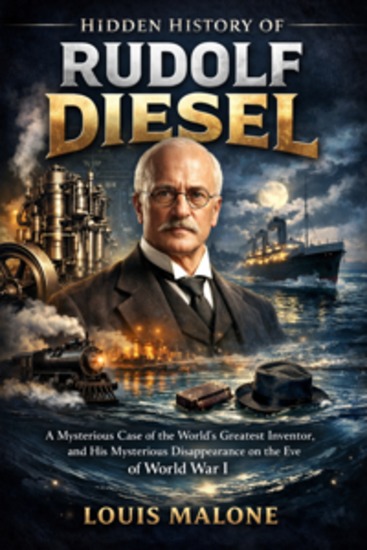
  • Hidden History of Rudolf Diesel - A Mysterious Case of the World’s Greatest Inventor and His Mysterious Disappearance on the Eve of World War I - cover

    Hidden History of Rudolf Diesel...

    Louis Malone

    • 0
    • 1
    • 0
    Rudolf Diesel is a name known across the world, stamped onto engines that power ships, trains, factories, and entire economies. Yet the man behind that name has largely vanished from history, reduced to a technical footnote or a single unresolved mystery. This book restores Rudolf Diesel to the center of his own story.More than a biography, The Hidden History of Rudolf Diesel is a deeply researched narrative that uncovers the inventor, the thinker, and the idealist behind one of the most influential technologies ever created. It traces Diesel’s journey from his early intellectual formation and revolutionary ideas about efficiency and energy, through the brutal realities of industrial power, legal conflict, and personal exhaustion, to his unexplained disappearance aboard a ship in 1913, just months before Europe plunged into World War I.At the heart of this story is Rudolf Diesel’s forgotten vision. Diesel did not design his engine merely to improve machinery. He believed efficiency was a moral principle. He envisioned decentralized energy, renewable fuels, and technological systems that empowered communities rather than concentrating control in the hands of governments and corporations. History would take his invention in a very different direction.The book examines the competing theories surrounding Diesel’s disappearance, including suicide, accident, and assassination, with clarity and restraint. Instead of chasing sensational conclusions, it reveals why the mystery has never been fully resolved and what that uncertainty tells us about power, innovation, and silence. It also follows what happened after Diesel was gone, as his engine became militarized, absorbed into global conflict, and transformed into a tool of industrial war, while his ideas were quietly discarded.Drawing powerful parallels between Diesel’s era and our own, this book speaks directly to modern readers living in a world shaped by rapid technological change, corporate dominance, and unresolved ethical questions. It asks who controls innovation, what happens to inventors who challenge existing systems, and how progress can lose its moral compass when efficiency is separated from responsibility.The Hidden History of Rudolf Diesel is for readers who enjoy intellectual history, investigative biography, and stories that challenge simple explanations. It is a portrait of a man ahead of his time, a mystery that refuses easy answers, and a warning that still matters today.This is not just the story of how Rudolf Diesel disappeared.It is the story of what happened when his ideas did.
    Voir livre
