Rejoignez-nous pour un voyage dans le monde des livres!
Ajouter ce livre à l'électronique
Grey
Ecrivez un nouveau commentaire Default profile 50px
Grey
Abonnez-vous pour lire le livre complet ou lisez les premières pages gratuitement!
All characters reduced
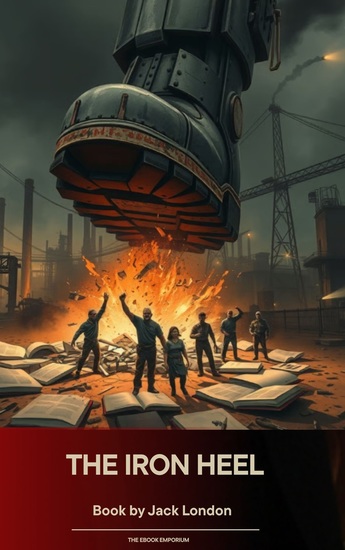
The Iron Heel - cover

The Iron Heel

Jack London

Maison d'édition: The Ebook Emporium

  • 0
  • 0
  • 0

Synopsis

"The Iron Heel will walk upon our faces... and yet we must dream of the Brotherhood of Man."

Presented as the "Everhard Manuscript," a document discovered seven centuries in the future, The Iron Heel tells the story of the 20th-century collapse of democracy. The narrative follows Ernest Everhard, a charismatic labor leader, as he challenges the "Oligarchy"—a ruthless cabal of industrial titans who seize control of the United States. As the Oligarchy (the "Iron Heel") crushes dissent with private armies and secret police, Everhard and his wife Avis are driven into a violent underground resistance. This is a visceral, high-stakes exploration of class warfare, revolutionary fervor, and the terrifying resilience of absolute power.

A Blueprint for Dystopia: London's vision is unique because it doesn't just show the fall; it explains the mechanics of how a superpower turns into a police state. From the manipulation of the press to the creation of "Labor Castes" designed to divide the working class, London's political insights remain startlingly relevant to the modern age.

The "People of the Abyss": The novel's climax, featuring the "Chicago Commune," is one of the most intense sequences in political fiction. London portrays the raw, desperate fury of the downtrodden as they face the high-tech weaponry of the state. It is a sobering reminder of the human cost of systemic inequality and the enduring hope for a more just world.

Read the book that inspired the masters of dystopia. Purchase "The Iron Heel" today.
Disponible depuis: 09/01/2026.
Longueur d'impression: 218 pages.

D'autres livres qui pourraient vous intéresser

  • End of the Young Family Feud The (Unabridged) - cover

    End of the Young Family Feud The...

    L. M. Montgomery

    • 0
    • 0
    • 0
    Lucy Maud Montgomery (November 30, 1874 - April 24, 1942), published as L. M. Montgomery, was a Canadian author best known for a series of novels beginning in 1908 with Anne of Green Gables. The book was an immediate success. The title character, orphan Anne Shirley, made Montgomery famous in her lifetime and gave her an international following.
    The End of the Young Family Feud: A week before Christmas, Aunt Jean wrote to Elizabeth, inviting her and Alberta and me to eat our Christmas dinner at Monkshead. We accepted with delight. Aunt Jean and Uncle Norman were delightful people, and we knew we should have a jolly time at their house.
    Voir livre
  • The Eyes Have It - A seemingly paranoid man tells us of an alien invasion - cover

    The Eyes Have It - A seemingly...

    Philip K. Dick

    • 0
    • 0
    • 0
    Philip Kindred Dick was born in 1928.  Widely considered one of the greatest science fiction writers, his talents were immense but he lived almost his whole life on the edge of poverty. Born prematurely on December 16, 1928 his twin sister died which caused a shadow over the rest of his life.  Many of his works would refer to the ‘phantom twin’.  Bizarrely her tiny body was buried in Colorado where her parents also had Phillips name inscribed on the tombstone. Eventually upon his death in 1982 he too was interred in the same plot. Phillip sold his first short story in 1951 and then became a full time writer selling his first novel in 1955.  He wrote continually and whilst considered a genius of the science fiction genre he was ignored by the mainstream.  Now of course much of his work is turned into films and he is rightly lauded.  All his work is at times visionary, and haunting dealing with many themes. Dick wrote of his work. "In my writing I even question the universe; I wonder out loud if it is real, and I wonder out loud if all of us are real."
    Voir livre
  • The First Men in The Moon - cover

    The First Men in The Moon

    H. G. Wells

    • 0
    • 0
    • 0
    Britain won the Moon Race! Decades before Neal Armstrong took his "giant leap for mankind" two intrepid adventurers from Lympne, England, journeyed there using not a rocket, but an antigravity coating. Mr. Bedford, who narrates the tale, tells of how he fell in with eccentric inventor Mr. Cavor, grew to believe in his research, helped him build a sphere for traveling in space, and then partnered with him in an expedition to the Moon. What they found was fantastic! There was not only air and water but the Moon was honeycombed with caverns and tunnels in which lived an advanced civilization of insect-like beings. While Bedford is frightened by them and bolts home, Cavor stays and is treated with great respect. So why didn't Armstrong and later astronauts find the evidence of all this? Well, according to broadcasts by Cavor over the newly-discovered radio technology, he told the Selenites too much about mankind, and apparently, they removed the welcome mat! Herbert George Wells was an English writer. Prolific in many genres, he wrote more than fifty novels and dozens of short stories. His non-fiction output included works of social commentary, politics, history, popular science, satire, biography, and autobiography.
    Voir livre
  • Her Turn - From their pens to your ears genius in every story - cover

    Her Turn - From their pens to...

    D H Lawrence

    • 0
    • 0
    • 0
    David Herbert Lawrence was born on the 11th September 1885 in Eastwood, Nottinghamshire, a coal mining town where the reality of a harsh life was only useful as experiences for future literary works. 
    He was educated at Beauvale Board School and became the first local boy to receive a scholarship to attend Nottingham High School. After 3 years he became a junior clerk in Haywood’s surgical appliances factory. He was also attempting a literary career which, in the short term, led to a teacher training position in Eastwood and later a teaching qualification from University College, Nottingham.  
    Lawrence’s first efforts were poems, short stories and a draft of ‘The White Peacock’. Moving to London and a teaching position in Croydon his writing attracted the attention of Ford Madox Ford, editor of The English Review, and he commissioned him to write ‘Odour of Chrysanthemums’.  
    Wanting to write full-time he now began work on what would become ‘Sons and Lovers.   
    In 1912 he met the older and married mother-of-three Frieda Weekley. They eloped to Germany and here Lawrence could see for himself the growing tensions with France.  So keen was his interest that he was arrested and accused of being a British spy.  
    In early 1914 Frieda obtained her divorce and they returned to Britain to be married just days before the outbreak of war. Owing to her German parentage, and his own public dislike of militarism and violence, the couple were treated with contempt and suspicion throughout the war years.  
    Despite this he continued to write but his reputation in England was so tarnished and, mirrored by his own disdain for the country, he and Frieda left England in November 1919, first for Europe and then America via Ceylon and Australia. 
    They bought a ranch in Taos, New Mexico and visited Mexico several times. The third visit in March 1925 caused a near fatal attack of malaria. To convalesce they moved to Florence. Here he continued work on ‘Lady Chatterley’s Lover’ which for many years would cause controversy. A renewed interest in oil painting resulted in an exhibition in 1929 which was raided by the police and several works were confiscated.  
    D H Lawrence died of complications arising from a bout of tuberculosis on the 2nd of March 1930 in Vence, France.  He was 44.
    Voir livre
  • Temptation of Harringay The (Unabridged) - cover

    Temptation of Harringay The...

    H. G. Wells

    • 0
    • 0
    • 0
    Herbert George Wells (21 September 1866 - 13 August 1946) was an English writer. Prolific in many genres, he wrote dozens of novels, short stories, and works of social commentary, history, satire, biography and autobiography. His work also included two books on recreational war games. Wells is now best remembered for his science fiction novels and is often called the "father of science fiction", along with Jules Verne and the publisher Hugo Gernsback.
    THE TEMPTATION OF HARRINGAY: It is quite impossible to say whether this thing really happened. It depends entirely on the word of R.M. Harringay, who is an artist.
    Voir livre
  • The Adventures of Huckleberry Finn - cover

    The Adventures of Huckleberry Finn

    Mark Twain

    • 0
    • 0
    • 0
    Set along the mighty Mississippi River, The Adventures of Huckleberry Finn is Mark Twain's timeless tale of freedom, friendship, and the search for identity. Huck Finn, a spirited boy escaping the confines of his small-town life, joins forces with Jim, an enslaved man fleeing for his freedom. Together, they embark on a daring journey aboard a raft, navigating treacherous waters and encountering a vivid cast of characters, from crafty conmen to feuding families.Through Huck's eyes, Twain explores themes of race, morality, and the bonds that transcend societal divisions. Huck wrestles with his conscience and challenges the prejudices of his world, making this story as relevant today as it was in its time. A thrilling adventure and a profound exploration of human nature, The Adventures of Huckleberry Finn is a cornerstone of American literature that will captivate readers of all ages.
    Voir livre