Begleiten Sie uns auf eine literarische Weltreise!
Buch zum Bücherregal hinzufügen
Grey
Einen neuen Kommentar schreiben Default profile 50px
Grey
Jetzt das ganze Buch im Abo oder die ersten Seiten gratis lesen!
All characters reduced
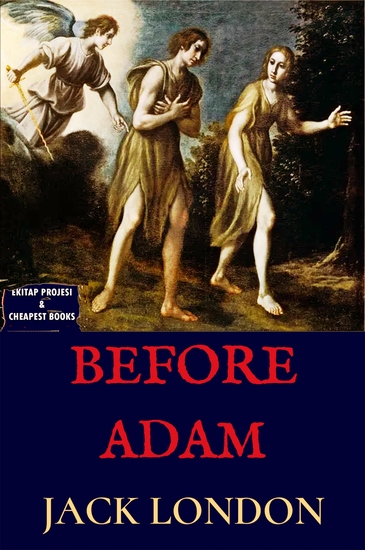
Before Adam - cover

Before Adam

Jack London

Verlag: E-Kitap Projesi & Cheapest Books

  • 0
  • 0
  • 0

Beschreibung

Before Adam is a historical novel by Jack London, serialized in 1906 and 1907 in Everybody's Magazine. It is the story of a man who dreams he lives the life of an early hominid Australopithecine.

The story offers an early view of human evolution. The majority of the story is told through the eyes of the man's hominid alter ego, one of the Cave People. In addition to the Cave People, there are the more advanced Fire People, and the more animal-like Tree People.

Other characters include the hominid's father, a love interest, and Red-Eye, a fierce "atavism" that perpetually terrorizes the Cave People. A sabre-cat also plays a role in the story.

* * *

Pictures! Pictures! Pictures! Often, before I learned, did I wonder whence came the multitudes of pictures that thronged my dreams; for they were pictures the like of which I had never seen in real wake-a-day life. They tormented my childhood, making of my dreams a procession of nightmares and a little later convincing me that I was different from my kind, a creature unnatural and accursed.

In my days only did I attain any measure of happiness. My nights marked the reign of fear—and such fear! I make bold to state that no man of all the men who walk the earth with me ever suffer fear of like kind and degree. For my fear is the fear of long ago, the fear that was rampant in the Younger World, and in the youth of the Younger World. In short, the fear that reigned supreme in that period known as the Mid-Pleistocene.

What do I mean? I see explanation is necessary before I can tell you of the substance of my dreams. Otherwise, little could you know of the meaning of the things I know so well. As I write this, all the beings and happenings of that other world rise up before me in vast phantasmagoria, and I know that to you they would be rhymeless and reasonless.
Verfügbar seit: 05.12.2023.
Drucklänge: 350 Seiten.

Weitere Bücher, die Sie mögen werden

  • Candide - cover

    Candide

    Voltaire

    • 0
    • 0
    • 0
    Candide is characterised by its sarcastic tone, as well as by its erratic, fantastical and fast-moving plot. A picaresque novel with a story similar to that of a more serious bildungsroman, it parodies many adventure and romance clichés, the struggles of which are caricatured in a tone that is mordantly matter-of-fact. Still, the events discussed are often based on historical happenings, such as the Seven Years' War and the 1755 Lisbon earthquake. As philosophers of Voltaire's day contended with the problem of evil, so too does Candide in this short novel, albeit more directly and humorously.    Voltaire ridicules religion, theologians, governments, armies, philosophies, and philosophers through allegory; most conspicuously, he assaults Leibniz and his optimism. Voltaire's men and women point his case against optimism by starting high and falling low. A modern could not go about it after this fashion. He would not plunge his people into an unfamiliar misery. He would just keep them in the misery they were born to. But such an account of Voltaire's procedure is as misleading as the plaster cast of a dance.    Look at his procedure again. Mademoiselle Cunégonde, the illustrious Westphalian, sprung from a family that could prove seventy-one quarterings, descends and descends until we find her earning her keep by washing dishes in the Propontis. The aged faithful attendant, victim of a hundred acts of rape by negro pirates, remembers that she is the daughter of a pope, and that in honor of her approaching marriage with a Prince of Massa-Carrara all Italy wrote sonnets of which not one was passable. We do not need to know French literature before Voltaire in order to feel, although the lurking parody may escape us, that he is poking fun at us and at himself. His laughter at his own methods grows more unmistakable at the last, when he caricatures them by casually assembling six fallen monarchs in an inn at Venice.    A modern assailant of optimism would arm himself with social pity. There is no social pity in "Candide." Voltaire, whose light touch on familiar institutions opens them and reveals their absurdity, likes to remind us that the slaughter and pillage and murder which Candide witnessed among the Bulgarians was perfectly regular, having been conducted according to the laws and usages of war. Had Voltaire lived today he would have done to poverty what he did to war. Pitying the poor, he would have shown us poverty as a ridiculous anachronism, and both the ridicule and the pity would have expressed his indignation.
    Zum Buch
  • Hunted Down - The Detective Stories of Charles Dickens - cover

    Hunted Down - The Detective...

    Charles Dickens

    • 0
    • 0
    • 0
    Immerse yourself in the thrilling world of Victorian crime with Hunted Down: The Detective Stories of Charles Dickens. This captivating audiobook brings to life Dickens’ masterful detective tales, filled with intrigue, deception, and sharp-witted investigators. Experience the suspense and rich storytelling of one of history’s greatest authors as he delves into the dark corners of justice and mystery. Perfect for fans of classic literature and detective fiction, this audiobook will keep you on the edge of your seat. Listen now and uncover the secrets hidden within Dickens’ most gripping crime stories!
    Zum Buch
  • Ancient Greek Tragedies Classic collection - Euripides Medea; Sophocles Antigone; Aeschylus The Oresteia - cover

    Ancient Greek Tragedies Classic...

    Eurípides, Sophocles, Aeschylus

    • 0
    • 0
    • 0
    This collection presents the works of the three fathers of ancient Greek tragedies: Aeschylus, Sophocles, and Euripides.The reader of this collection will be able to comprehend how the plots and conflicts populating classical tragedy developed.The principle theme of Aeschylus' tragedies is the idea of fate being omnipotent and the futility in struggling against it.The tragedies of Sophocles reflect the era of the Greeks' victorious war against the Persians, which opened up commercial prosperity through trade.Euripides propels his dramas by incorporating conflicts from within the human psyche.Contents:Euripides: MedeaSophocles: AntigoneAeschylus: The OresteiaAgamemnonEumenidesThe Choephori
    Zum Buch
  • Jo's Boys - cover

    Jo's Boys

    Louisa May Alcott

    • 0
    • 0
    • 0
    "Life is a hard fight for many of us, but we can turn it into a glorious victory if we choose."
    
    Ten years have passed since the events of Little Men, and the "boys" of Plumfield have grown into young men facing the challenges of the adult world. At the center of it all is Jo Bhaer (née March), the matriarch and mentor who watches over her flock with the same wit and wisdom that made her a literary icon. From the halls of college to the rugged frontier, follow the diverse paths of Tommy, Demi, Nat, and the rebellious Dan as they navigate love, career, and the enduring legacy of the March family.
    
    The Evolution of a Legacy: Jo's Boys is more than a sequel; it is a reflection on the maturity of a generation. Jo, now a successful author, grapples with the trials of fame and the bittersweet reality of her "nest" emptying. The novel explores progressive themes of the era, including women's higher education, the pursuit of unconventional careers, and the moral complexities of a changing America.
    
    A Story of Redemption and Growth: While the novel provides the "happy endings" readers crave, it doesn't shy away from the shadows. The journey of Dan Kean—the "wild boy" of Plumfield—provides a gritty, emotional counterpoint to the domestic comforts of the March household. It is a story about the strength of roots and the courage required to forge one's own identity in a world that often demands conformity.
    
    Return to the warmth of the March family. Purchase "Jo's Boys" today and complete the journey that began with "Little Women."
    Zum Buch
  • A Tale of Two Cities - cover

    A Tale of Two Cities

    Charles Dickens

    • 0
    • 0
    • 0
    A Tale of Two Cities is an 1859 historical novel by Charles Dickens, set in London and Paris before and during the French Revolution. The novel tells the story of the French Doctor Manette, his 18-year-long imprisonment in the Bastille in Paris, and his release to live in London with his daughter Lucie whom he had never met. The story is set against the conditions that led up to the French Revolution and the Reign of Terror. In the Introduction to the Encyclopedia of Adventure Fiction, critic Don D'Ammassa argues that it is an adventure novel because the protagonists are in constant danger of being imprisoned or killed.
    As Dickens's best-known work of historical fiction, A Tale of Two Cities is claimed to be one of the best-selling novels of all time. In 2003, the novel was ranked 63rd on the BBC's The Big Read poll. The novel has been adapted for film, television, radio, and the stage, and has continued to influence popular culture.
    Zum Buch
  • Bellerophon To Anteia - From their pens to your ears genius in every story - cover

    Bellerophon To Anteia - From...

    Mary Butts

    • 0
    • 0
    • 0
    Mary Frances Butts was born on 13th December 1890 in Poole, Dorset. 
    Her early years were spent at Salterns, an 18th-century house overlooking Poole Harbour.  Sadly in 1905 her father died, and she was sent for boarding at St Leonard's school for girls in St Andrews. 
    Her mother remarried and, from 1909, Mary studied at Westfield College in London, and here, first became aware of her bisexual feelings.  She was sent down for organising a trip to Epsom races and only completed her degree in 1914 when she graduated from the London School of Economics.  By then Mary had become an admirer of the occultist Aleister Crowley and she was given a co-authorship credit on his ‘Magick (Book 4)’. 
    In 1916, she began the diary which would now detail her future life and be a constant reference point for her observations and her absorbing experiences. 
    During World War I, she was doing social work for the London County Council in Hackney Wick, and involved in a lesbian relationship.  Life changed after meeting the modernist poet, John Rodker and they married in 1918. 
    In 1921 she spent 3 months at Aleister Crowley's Abbey of Thelema in Sicily; she found the practices dreadful and also acquired a drug habit.  Mary now spent time writing in Dorset, including her celebrated book of short stories ‘Speed the Plough’ which saw fully develop her unique Modernist prose style. 
    Europe now beckoned and several years were spent in Paris befriending many artists and writing further extraordinary stories.   
    She was continually sought after by literary magazines and also published several short story collections as books. Although a Modernist writer she worked in other genres but is essentially only known for her short stories.  Mary was deeply committed to nature conservation and wrote several pamphlets attacking the growing pollution of the countryside. 
    In 1927, she divorced and the following year her novel ‘Armed with Madness’ was published.  A further marriage followed in 1930 and time was spent attempting to settle in London and Newcastle before setting up home on the western tip of Cornwall.  By 1934 the marriage had failed. 
    Mary Butts died on 5th March 1937, at the West Cornwall Hospital, Penzance, after an operation for a perforated gastric ulcer. She was 46.
    Zum Buch