Begleiten Sie uns auf eine literarische Weltreise!
Buch zum Bücherregal hinzufügen
Grey
Einen neuen Kommentar schreiben Default profile 50px
Grey
Jetzt das ganze Buch im Abo oder die ersten Seiten gratis lesen!
All characters reduced
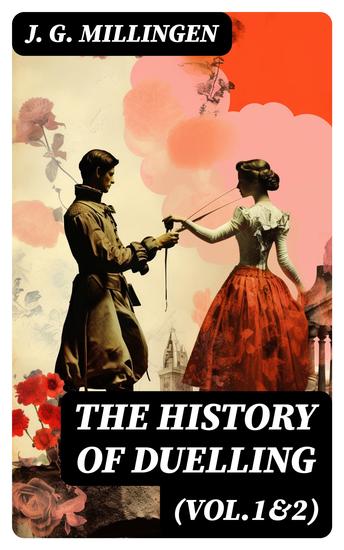
The History of Duelling (Vol1&2) - Enriched edition Complete Edition - cover

The History of Duelling (Vol1&2) - Enriched edition Complete Edition

J. G. Millingen

Verlag: DigiCat

  • 0
  • 0
  • 0

Beschreibung

In "The History of Duelling (Vol. 1 & 2)," J. G. Millingen provides a comprehensive and meticulously researched account of the practice and cultural significance of duelling across various societies and historical periods. With an engaging narrative style, Millingen deftly intertwines anecdotes, legal perspectives, and philosophical musings, revealing duelling as not merely a violent pastime, but as a complex ritual steeped in notions of honor, social status, and morality. The work reflects the Enlightenment's fascination with human behavior and societal norms, calling attention to the psychological and ethical dimensions that have historically governed the practice of duelling. J. G. Millingen, an accomplished physician and author, presents this work drawing on his extensive knowledge of human nature and societal constructs. His background in medicine and psychology, coupled with his acute awareness of the social mores of his time, informs his critical exploration of the motivations behind duelling. By situating the practice within a broader discourse of honor and ethical conduct, Millingen highlights the intersection of personal and societal dynamics that contributed to the prevalence of duelling in his era. For scholars of social history, literature, or ethics, Millingen's "The History of Duelling" is an invaluable resource that illuminates the intricate relationship between individual agency and societal expectations. As an essential reference for understanding the evolution of honor culture, this text invites readers to reflect on the implications of duelling in contemporary discussions of conflict resolution and personal integrity.

In this enriched edition, we have carefully created added value for your reading experience:
- Hand‐picked Memorable Quotes shine a spotlight on moments of literary brilliance.
- Interactive footnotes clarify unusual references, historical allusions, and archaic phrases for an effortless, more informed read.
Verfügbar seit: 12.11.2023.
Drucklänge: 496 Seiten.

Weitere Bücher, die Sie mögen werden

  • The Power to Destroy - How the Antitax Movement Hijacked America - cover

    The Power to Destroy - How the...

    Michael J. Graetz

    • 0
    • 0
    • 0
    The postwar United States enjoyed large, widely distributed economic rewards—and most Americans accepted that taxes were a reasonable price to pay for living in a society of shared prosperity. Then in 1978 California enacted Proposition 13, a property tax cap that Ronald Reagan hailed as a "second American Revolution," setting off an antitax, antigovernment wave that has transformed American politics and economic policy. In The Power to Destroy, Michael Graetz tells the story of the antitax movement and how it holds America hostage—undermining the nation's ability to meet basic needs and fix critical problems. 


    In 1819, Chief Justice John Marshall declared that the power to tax entails "the power to destroy." But The Power to Destroy argues that tax opponents now wield this destructive power. Attacking the IRS, protecting tax loopholes, and pushing tax cuts from Reagan to Donald Trump, the antitax movement is threatening the nation's social safety net, increasing inequality, ballooning the national debt, and sapping America's financial strength. The book chronicles how the movement originated as a fringe enterprise promoted by zealous outsiders using false economic claims and thinly veiled racist rhetoric, and how—abetted by conservative media and Grover Norquist's "taxpayer protection pledge"—it evolved into a mainstream political force.
    Zum Buch
  • The Frightened Fairie - cover

    The Frightened Fairie

    Kay Brophy

    • 0
    • 0
    • 0
    Fear is one of the six core human emotions and can occur in a number of situations. The Frightened Fairie is scared of the dark. She struggles to sleep and worries during the day. She turns to her friend who helps her cope with the situation using imaginative ways and realises she's able to deal with 'big feelings' which can go away. This is a book for younger readers to help them learn about their emotions and how to deal with them. Comes complete with reading aids for adults. Beautifully illustrated and written in easy-to-understand rhyme.
    Zum Buch
  • A Rare Recording of Mr Fred Rogers - cover

    A Rare Recording of Mr Fred Rogers

    Fred Rogers

    • 0
    • 0
    • 0
    On May 1, 1969, Fred Rogers, host of the (then) recently nationally syndicated children's television series, Mister Rogers' Neighborhood, testified before the Senate Committee on Commerce Subcommittee on Communications to defend $20 million in federal funding proposed for the newly formed non-profit Corporation for Public Broadcasting, which was at risk of being reduced to $10 million. Subcommittee chairman, Senator John Pastore (D-RI), unfamiliar with Fred Rogers, is initially indifferent towards him. Over the course of Rogers' 6 minutes of testimony, Pastore's demeanor gradually transitions to one of awe and admiration as Rogers speaks. 
     
    Fred McFeely Rogers (March 20, 1928 - February 27, 2003), better known as Mister Rogers, was an American television host, author, producer, and Presbyterian minister. He was the creator, showrunner, and host of the preschool television series Mister Rogers' Neighborhood, which ran from 1968 to 2001.
    Zum Buch
  • The Greatest Cities of Ancient Mesopotamia - cover

    The Greatest Cities of Ancient...

    Editors Charles River

    • 0
    • 0
    • 0
    Long before Alexandria was a city and even before Memphis and Babylon had attained greatness, the ancient Mesopotamian city of Ur stood foremost among ancient Near Eastern cities. Today, the greatness and cultural influence of Ur has been largely forgotten by most people, partially because its monuments have not stood the test of time the way other ancient culture’s monuments have. For instance, the monuments of Egypt were made of stone while those of Ur and most other Mesopotamian cities were made of mud brick and as will be discussed in this report, mud-brick may be an easier material to work with than stone but it also decays much quicker. The same is true to a certain extent for the written documents that were produced at Ur. Likewise, no site better represents the importance of the Sumerians than the city of Uruk. Between the fourth and the third millennium BCE, Uruk was one of several city-states in the land of Sumer, located in the southern end of the Fertile Crescent, between the two great rivers of the Tigris and the Euphrates. 
    As Hittite power grew during the Old Kingdom, the royal city of Hattusa became more important and even wealthier. From his citadel overlooking Hattusa, Hattusili I launched the first major Hittite attacks into the Near East, first conquering the cities between Hattusa and the Mediterranean (Macqueen 2003, 36). Although the Biblical accounts of the Assyrians are among the most interesting and are often corroborated with other historical sources, the Assyrians were much more than just the enemies of the Israelites and brutal thugs. Among all the cities that thrived in the ancient Near East, few can match the opulence and ostentatiousness of Nineveh, the capital of the Assyrian Empire for much of the seventh century BCE. 
    Zum Buch
  • Samoan Crisis The: The History of the Military Standoff Between the United States Germany and Great Britain over the Samoan Islands - cover

    Samoan Crisis The: The History...

    Editors Charles River

    • 0
    • 0
    • 0
    Samoa is a group of about 20 islands in the South Pacific Ocean, totaling slightly over 1,100 square miles, about a fifth the size of Hawai’i. The ancestors of the Samoans arrived there many centuries ago. Archaeological artifacts suggest Polynesians arrived perhaps three thousand years before the present, or perhaps even earlier (O’Connor, 2017). 
    Samoans remained part of an isolated Pacific Ocean region for a very long time, with trade and social links with the people of the Fiji and Tonga islands. That inter-island world was not “discovered” by European explorers until 1722, when a Dutch ship, captained by Joseph Roggeveen, visited. The next European view of the Samoan islands was in 1778 by a French expedition, commanded by Louis-Antoine de Bougainville. A later French expedition under La Perouse found the islands far from congenial; a fight erupted and the French lost 12 men (O’Connor, 2017). 
    The pace of contact with the outside world quickened by the end of the 1700s. Explorers visited, naval expeditions checked out Samoa and other islands, a few European beachcombers arrived, and so did missionaries. Samoa, like many other Pacific Island groups, attracted outside interest for several reasons. Missionaries found souls to save. Whaling ships found places to resupply themselves with food, water, sometimes crew, and for rest and recreation. As navies converted to steam, islands became useful as coaling stations, and as the Industrial Revolution spread, islands offered raw materials and goods for potential profit. The Pacific Islands also became pawns in what is best described as a global imperial competition.
    Zum Buch
  • The Weimar Republic - Inflation Degeneration and Historicity - cover

    The Weimar Republic - Inflation...

    Kelly Mass

    • 0
    • 0
    • 0
    To summarize everything about this topic, the Weimar Republic was a disaster. Perhaps the setup of the republic wasn’t as much as fault as just the world events that led to the Great Depression, the eventual surrender of Germany to France, Russia, and England in World War I before that, and other significant changes in the economy at the time. 
    The Weimar Republic was a federal constitutional republic that lasted in Germany from 1918 to 1933. The German Reich (Deutsches Reich) was the main name of the state, which was also referred to as the German Republic (Deutsche Republik). The first word associates with the city of Weimar, which hosted the republic's first constituent assembly. The nation was typically described as "Germany" in English; the title "Weimar Republic" didn't become well-known till the 1930s. 
    Do you want to buy a few eggs with thousands of marks? How about a loaf of bread for ten thousand dollars? The inflation in the Weimar Republic led to a severe economic downturn, one that had probably never been there ever before. This led to other problems, which also explained the rise of Nazi Germany somewhat later. 
    If you want to understand all these things, then go ahead and get started.
    Zum Buch