Begleiten Sie uns auf eine literarische Weltreise!
Buch zum Bücherregal hinzufügen
Grey
Einen neuen Kommentar schreiben Default profile 50px
Grey
Jetzt das ganze Buch im Abo oder die ersten Seiten gratis lesen!
All characters reduced
A History of Freedom of Thought - cover

A History of Freedom of Thought

J. B. Bury

Verlag: DigiCat

  • 0
  • 0
  • 0

Beschreibung

In "A History of Freedom of Thought," J. B. Bury meticulously explores the evolution of intellectual liberty from ancient to contemporary times, detailing its philosophical underpinnings and societal implications. Bury's prose is both erudite and accessible, presenting a comprehensive narrative that deftly interweaves historical events with the progression of ideas. The book is situated within the broader discourse on the importance of freedom of thought as a cornerstone of modern democratic societies, unearthing how various epochs have shaped and been shaped by this fundamental concept. J. B. Bury, a distinguished historian and philosopher, was deeply influenced by the intellectual currents of the late 19th and early 20th centuries. His rigorous academic background, coupled with his advocacy for rationalism and secularism, informed his analysis of freedom's historical trajectory. Bury's commitment to understanding the interplay between thought and society is evident in his inquiry into the obstacles and triumphs faced by thinkers throughout history, offering invaluable insights into the struggles for intellectual independence. Readers are encouraged to engage with this profound work, as it not only illuminates the past but also provokes critical reflection on the present state of freedom of thought. Bury's synthesis of history and philosophy serves as an essential guide for scholars, students, and anyone interested in the ongoing quest for intellectual autonomy in a world often fraught with dogma.
Verfügbar seit: 04.09.2022.
Drucklänge: 141 Seiten.

Weitere Bücher, die Sie mögen werden

  • Open Society and Its Enemies The: Book Summary & Analysis - cover

    Open Society and Its Enemies...

    Briefly Summaries

    • 0
    • 0
    • 0
    This is a concise summary and analysis of The Open Society and Its Enemies, by 
    Karl Popper.
    It is not the original book and is not affiliated with or endorsed by 
    Karl Popper.
    Ideal those seeking a quick and insightful overview.
     
    The Open Society and Its Enemies is a groundbreaking exploration of the philosophical underpinnings of totalitarianism and the defense of liberal democracy. This seminal work challenges the ideas of influential thinkers such as Plato, Hegel, and Marx, critiquing their roles in shaping authoritarian ideologies. With incisive logic and clarity, it argues for the necessity of open societies, where individual freedoms, critical thinking, and scientific inquiry thrive. A profound study of the conflict between tyranny and freedom, this book remains a cornerstone in political philosophy and an enduring guide for safeguarding democratic principles.
    Zum Buch
  • Willy Brandt: A short biography - 5 Minutes: Short on time – long on info! - cover

    Willy Brandt: A short biography...

    5 Minutes, 5 Minute Biographies,...

    • 0
    • 0
    • 0
    Willy Brandt, German chancellor and Nobel Peace Prize laureate: Life and work in a short biography! Everything you need to know, brief and concise. Infotainment, education and entertainment at its best!
    Zum Buch
  • Adam Smith - The Father of Modern Economics - cover

    Adam Smith - The Father of...

    Hector Davidson

    • 0
    • 0
    • 0
    Adam Smith, often hailed as the father of modern economics, revolutionized the field with his pioneering ideas in the 18th century. His significance lies in his formulation of the foundational principles of classical economics, particularly through his seminal works, The Theory of Moral Sentiments and An Inquiry into the Nature and Causes of the Wealth of Nations. 
    In The Wealth of Nations, Smith introduced the concept of the "invisible hand," a metaphor for the self-regulating nature of free markets. He argued that individuals pursuing their self-interest unintentionally contribute to the economic well-being of society, as if guided by an invisible hand. This idea challenged the prevailing mercantilist views of the time, advocating instead for free trade and minimal government intervention in economic affairs. 
    Smith's exploration of the division of labor highlighted how productivity and efficiency could be vastly improved when tasks are specialized. This principle not only influenced economic theory but also had a profound impact on industrial practices and economic policy.
    Zum Buch
  • The Art of War - cover

    The Art of War

    Sun Tzu

    • 0
    • 0
    • 0
    The Art of War (Chinese: 孫子兵法; lit. 'Sun Tzu's Military Method') is an ancient Chinese military treatise dating from the Late Spring and Autumn Period (roughly 5th century BC). The work, which is attributed to the ancient Chinese military strategist Sun Tzu ("Master Sun"), is composed of 13 chapters. Each one is devoted to a different set of skills (or "art") related to warfare and how it applies to military strategy and tactics. For almost 1,500 years it was the lead text in an anthology that was formalized as the Seven Military Classics by Emperor Shenzong of Song in 1080. The Art of War remains the most influential strategy text in East Asian warfare and has influenced both Far Eastern and Western military thinking, business tactics, legal strategy, lifestyles and beyond.
    The book contains a detailed explanation and analysis of the 5th-century BC Chinese military, from weapons and strategy to rank and discipline. Sun also stressed the importance of intelligence operatives and espionage to the war effort. Considered one of history's finest military tacticians and analysts, his teachings and strategies formed the basis of advanced military training for millennia to come.
    The book was translated into French and published in 1772 (re-published in 1782) by the French Jesuit Jean Joseph Marie Amiot. A partial translation into English was attempted by British officer Everard Ferguson Calthrop in 1905 under the title The Book of War. The first annotated English translation was completed and published by Lionel Giles in 1910. Military and political leaders such as the Chinese communist revolutionary Mao Zedong, Japanese daimyō Takeda Shingen, Vietnamese general Võ Nguyên Giáp, and American military general Norman Schwarzkopf Jr. are all cited as having drawn inspiration from the book.
    Zum Buch
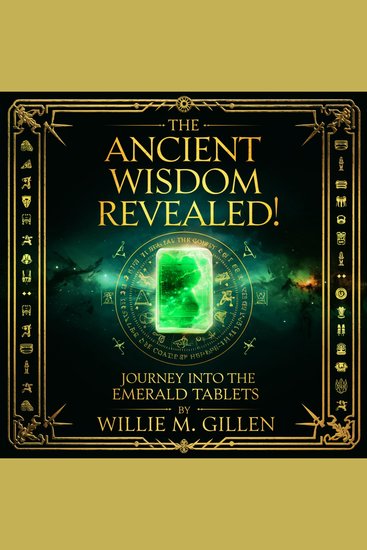
  • Ancient Wisdom Revealed The: Journey into the Emerald Tablets - cover

    Ancient Wisdom Revealed The:...

    Willie M. Gillen

    • 0
    • 0
    • 0
    "The Ancient Wisdom Revealed: Journey into the Emerald Tablets" takes you on a fascinating exploration of the emerald tablet and its profound wisdom. This emerald tablets book delves into the hidden knowledge of ancient tablets, revealing esoteric teachings passed down through the ages. Whether you are searching for an emerald tablet book to deepen your understanding of alchemy, metaphysics, or cosmic laws, or are simply intrigued by the mysteries of the emerald tablets, this audiobook offers an engaging and enlightening experience. From the mystical origins of the emerald tablets to their impact on spiritual traditions, this book is your guide to unlocking the timeless truths encoded within these sacred texts.
    Zum Buch
  • Northern Chinese Powers - Rivals and Conquerors (3 in 1) - cover

    Northern Chinese Powers - Rivals...

    Rolf Hedger

    • 0
    • 0
    • 0
    **Northern Chinese Powers: Rivals and Conquerors (3 in 1)** explores the rise and dominance of three formidable northern dynasties that shaped China’s history through conquest, diplomacy, and cultural exchange. From the enigmatic Tangut Kingdom to the powerful Liao Dynasty and the world-altering Yuan Dynasty, these states challenged traditional Chinese rule and left lasting legacies in governance, warfare, and trade.   
    Discover the Tangut Kingdom, founders of the Western Xia Dynasty, who developed their own script, built fortified cities, and played a crucial role in Silk Road commerce. Learn about the Liao Dynasty, a Khitan-led empire that rivaled the Song Dynasty and mastered the art of steppe warfare. Finally, delve into the Yuan Dynasty, the Mongol-led empire established by Kublai Khan, which expanded across Asia, redefined China’s political landscape, and connected East and West through trade and cultural exchange.   
    From nomadic warriors to imperial rulers, these northern powers shaped China’s destiny through both conflict and cooperation. This book is perfect for history enthusiasts eager to explore the complex and dynamic forces that ruled beyond the Great Wall.
    Zum Buch