Begleiten Sie uns auf eine literarische Weltreise!
Buch zum Bücherregal hinzufügen
Grey
Einen neuen Kommentar schreiben Default profile 50px
Grey
Jetzt das ganze Buch im Abo oder die ersten Seiten gratis lesen!
All characters reduced
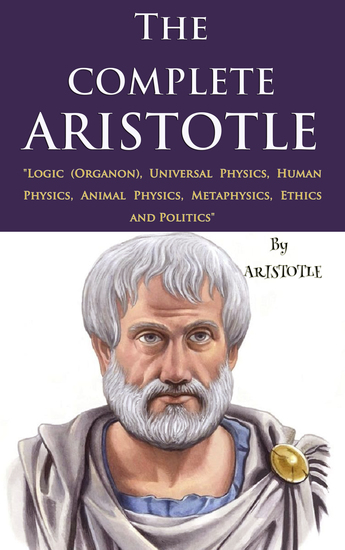
The Complete Aristotle - "Logic (Organon) Universal Physics Human Physics Animal Physics Metaphysics Ethics and Politics" - cover

The Complete Aristotle - "Logic (Organon) Universal Physics Human Physics Animal Physics Metaphysics Ethics and Politics"

J. A. Smith, W. D. Ross, E. M. Edghill, D'Arcy Wentworth Thompson, W. Rhys Roberts, Aristotle, R. P. Hardie, R. K. Gaye

Verlag: E-Kitap Projesi & Cheapest Books

  • 0
  • 0
  • 0

Beschreibung

The Corpus Aristotelicum (The Complete Aristotle) is the collection of Aristotle's works that have survived from antiquity through Medieval manuscript transmission. These texts, as opposed to Aristotle's lost works, are technical philosophical treatises from within Aristotle's school. Reference to them is made according to the original texts of Aristotle, which in turn is based on ancient classifications of these works.

This complete Book consist of (Contents):

Biography (About Aristotle)
Part 1: Logic (Organon)
Part 2. Universal Physics
Part 3: Human Physics
Part 4: Animal Physics
Part 5: Metaphysics
Part 6: Ethics and Politics
Part 7: Aesthetic Writings
Aristotle, Greek Aristoteles, (born 384 BCE, Stagira, Chalcidice, Greece—died 322, Chalcis, Euboea), ancient Greek philosopher and scientist, one of the greatest intellectual figures of Western history. He was the author of a philosophical and scientific system that became the framework and vehicle for both Christian Scholasticism and medieval Islamic philosophy. Even after the intellectual revolutions of the Renaissance, the Reformation, and the Enlightenment, Aristotelian concepts remained embedded in Western thinking.

Aristotle's intellectual range was vast, covering most of the sciences and many of the arts, including biology, botany, chemistry, ethics, history, logic, metaphysics, rhetoric, philosophy of mind, philosophy of science, physics, poetics, political theory, psychology, and zoology. He was the founder of formal logic, devising for it a finished system that for centuries was regarded as the sum of the discipline; and he pioneered the study of zoology, both observational and theoretical, in which some of his work remained unsurpassed until the 19th century. But he is, of course, most outstanding as a philosopher. His writings in ethics and political theory as well as in metaphysics and the philosophy of science continue to be studied, and his work remains a powerful current in contemporary philosophical debate.
Verfügbar seit: 06.12.2023.
Drucklänge: 2000 Seiten.

Weitere Bücher, die Sie mögen werden

  • Moors’ Most Famous Sites in Spain The: The History of Moorish Architecture in al-Andalus - cover

    Moors’ Most Famous Sites in...

    Charles River Editors

    • 0
    • 0
    • 0
    Tucked away on the crest of the Al-Sabika Hill in Granada of Andalusia, Spain, just left of the babbling stream of the Darro River, sits a majestic structure overlooking the charming city and mystical meadows of La Vega. This palatial fortress and the fabled Alhambra are one and the same. To those that have seen it in its full glory, this was heaven on earth itself. Many were quick to fall under the spell of its breathtaking beauty, with its admirers lovingly dubbing it “a pearl set in emeralds.”  
    	Even if one were to discount security and the Spanish royals who reside here seasonally, legend has it that the Alcázar is never truly uninhabited. Take a post-midnight stroll through the colonnades or the baths, and listen closely, insist mystics, and one will hear the spine-tingling sniffling, harrowing whimpers, and wretched weeping of the hapless souls who met their demise at the hands of Pedro the Cruel, Peter I of Castile, one of the many builders and tenants of this bewitching place. The vicious and volatile wrath of the cruel monarch knew no bounds, and his victims, no numbers. Some say these cries belong to the young maidens who were burnt at the stake for no other reason than rejecting Pedro's romantic advances. Others say they come from the spirit of Eleanor of Guzman, the mistress of Pedro's father, Alfonso XI of Castile, and one of Pedro's first kills. Or perhaps they come from all of Pedro's victims, cursed by their violent deaths to roam the Alcázar in perpetuity. 
    	The Calle Cardenal Herrero in Córdoba is an iconic cobbled street impossible to overlook, for it is home to the Andalusian city's spectacular Mosque-Cathedral. Also known as “La Mezquita,” this one-of-a-kind Moorish and Christian place of worship reels in about 1.5 million visitors each year, most of whom find themselves spellbound by its hypnotic architectural features and riveting history.
    Zum Buch
  • Dragonslayers - Six Presidents and Their War with the Swamp - cover

    Dragonslayers - Six Presidents...

    Larry Schweikart

    • 0
    • 0
    • 0
    The Swamp has been around for over 150 years, and six major presidents have tried to drain it with varying degrees of success. 
     
    Donald Trump promised to “Drain the Swamp,” by which he originally meant lobbyists. When he got in, he found an entirely different Swamp—a Deep State that had grown, layer upon layer, within the government. But he wasn’t the first to encounter entrenched Swamp opposition. Abraham Lincoln had to battle the  
    “Slave Power Conspiracy”; Grover Cleveland was the most successful of three presidents to fight the spoils Swamp. Theodore Roosevelt found a new iteration of the Swamp awaiting him: Trusts. After World War II, John F. Kennedy discovered that he had little control over the Central Intelligence Agency, and even found he  
    needed the CIA for his own purposes. Despite promising to shrink the bureaucracy Swamp, Ronald Reagan found himself helpless to even make a dent in it. And Trump soon learned that the Deep State could ensure no one ever brought any of its own to justice. Dragonslayers explains why these Swamps exist, and why they were—and remain—so hard to defeat.
    Zum Buch
  • Pocahontas - The Real History of the Native American Peacemaker - cover

    Pocahontas - The Real History of...

    Kelly Mass

    • 0
    • 0
    • 0
    Pocahontas was a Native American woman from the Powhatan-speaking tribe, most famous for her connection to the colonial settlement at Jamestown, Virginia. She was the daughter of Powhatan, the powerful chief of Tsenacommacah, a confederation of about 30 Algonquian-speaking tribes in the Tidewater region of Virginia. Powhatan held dominion over a vast territory, which made Pocahontas a figure of significant influence within her own people’s complex political and social systems. 
    In 1613, during a conflict between the Powhatan Confederacy and the English settlers, Pocahontas was captured by the English. She was held hostage for ransom in an effort to leverage peace negotiations with her father. During her captivity, Pocahontas experienced a profound transformation, converting to Christianity and being baptized with the name Rebecca. Her conversion was seen as an opportunity by the English to showcase their success in "civilizing" the native population.
    Zum Buch
  • Why Not Better and Cheaper? - Healthcare and Innovation - cover

    Why Not Better and Cheaper? -...

    James B. Rebitzer, Robert S....

    • 0
    • 0
    • 0
    An engaging account of innovation in healthcare and why the results fall short for patients and society. 


    The evolution of the cell phones we carry in our pockets demonstrates that quality can increase while prices fall. Why doesn't healthcare also get better and cheaper? 


    In Why Not Better and Cheaper?, James B. Rebitzer and Robert S. Rebitzer offer an answer to this question. Bringing together research on incentives, social norms, and market competition, they argue that the healthcare system generates the wrong kinds of innovation. It is too easy to profit from low-value innovations and too hard to profit from innovations that reduce the costs of care. The result is a healthcare system that is profusely innovative yet remarkably ineffective in discovering ways to deliver increased value at lower cost. 


    Why Not Better and Cheaper? sheds new light on the trajectory of innovation in healthcare, and how to point innovation in a better direction.
    Zum Buch
  • The Social Justice Investor - Advance Your Values While Building Wealth Whether a Few Dollars or Millions - cover

    The Social Justice Investor -...

    Andrea Longton

    • 0
    • 0
    • 0
    Having lived through recessions and pandemics, we all recognize the importance of financial well-being. But we are also living in a time of uncertainty, marked by injustice, climate crisis, and social change. How do we reconcile these two things—our financial well-being and our desire to advocate for a more just and equitable world? You know that money isn't the silver bullet to social injustice and economic exclusion, but it certainly can help! 


    While our investments should bring returns that meet our needs for expected and unexpected life events, our investments can also be a powerful extension of our values, intentions, and commitments: we can invest in what we care about. The Social Justice Investor is ready to help you put your money where your values are. This step-by-step guide to personal finance removes all the technical jargon and introduces you to the basic building blocks of investment management. Once you have your "toolkit," The Social Justice Investor walks you through how to apply a social justice lens to your investments (including how to talk to your financial advisor). You'll learn to select investments that match your stated objectives, allocate your resources widely and wisely, and measure your success. We can help change the world for the better, and it starts with where we decide to put our money.
    Zum Buch
  • True Tales of the Texas Frontier - Eight Centuries of Adventure and Surprise - cover

    True Tales of the Texas Frontier...

    C. Herndon Williams

    • 0
    • 0
    • 0
    For eight centuries, the Texas frontier has seen conquest, exploration, immigration, revolution, and innovation, leaving to history a cast of fascinating characters and captivating tales. Its historic period began in 1519 with Spanish exploration, but there was a prehistory long before, nearly fifteen thousand years earlier, with the arrival of people to Texas. Each story pulls a new perspective from this long history by examining nearly all angles—from archaeology to ethnography, astronomy, agriculture, and more. These true stories prove to be unexpected, sometimes contrarian and occasionally funny, but always fascinating. Join author and historian C. Herndon Williams as he recounts his exploration of nearly a millennium of the Texas frontier.
    Zum Buch