Rejoignez-nous pour un voyage dans le monde des livres!
Ajouter ce livre à l'électronique
Grey
Ecrivez un nouveau commentaire Default profile 50px
Grey
Abonnez-vous pour lire le livre complet ou lisez les premières pages gratuitement!
All characters reduced
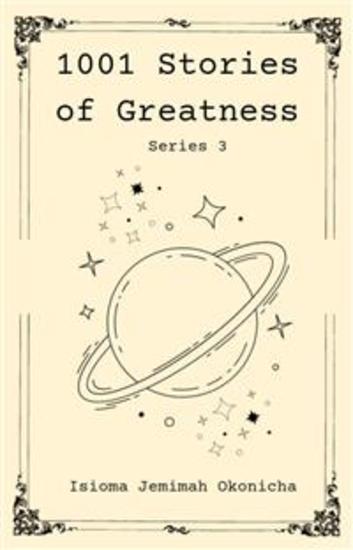
1001 Stories of Greatness Series 3 - Greatness from Within - cover

1001 Stories of Greatness Series 3 - Greatness from Within

Isioma Jemimah Okonicha

Maison d'édition: BookRix

  • 0
  • 0
  • 0

Synopsis

  Once upon a time, in a small town called Cox, there lived a kind and generous woman named Lily. Lily was known in the town for her compassionate nature and willingness to help anyone in need. One day, Lily noticed a young girl who was crying on the sidewalk. She approached the girl, whose name was Dorathy and asked if she needed any help. The girl explained that she had lost her way home and was feeling scared and alone. Lily immediately took the girl under her wing, comforting her and helping her find her way home. The girl was so grateful for Lily’s kindness that she told her parents about the woman who had helped her. The following week, Lily received a thank you note from the girl’s parents, expressing their gratitude for her kindness. The note also mentioned that they had been struggling financially and were finding it difficult to put food on the table for their family. Moved by the family’s situation, Lily decided to help them out. She started cooking extra food every day and would bring it to their doorstep. The family was amazed by her generosity and kindness. But Lily’s kindness didn’t stop there. She began to notice other families in the town who were struggling, and she started to offer her help to them too. She would hire babysitters for families who couldn’t afford a babysitter, and she would even give them money when they needed it. The kindness and generosity of Lily started to spread throughout the town, and soon others started to follow in her footsteps. People began to see the impact that one act of kindness could have, and they started to look for ways to help others too. As more and more people in the town started to practice kindness, it created a ripple effect. The town became a much more caring and compassionate place, and people started to feel a sense of community that they had never felt before. Years later, Lily grew old and left Cox to another town. And one day, as she was walking on the sidewalk, she accidentally stepped on
Disponible depuis: 21/12/2023.
Longueur d'impression: 22 pages.
D'autres livres qui pourraient vous intéresser

  • Alpine Divorce An - From their pens to your ears genius in every story - cover

    Alpine Divorce An - From their...

    Robert Barr

    • 0
    • 0
    • 0
    Robert Barr was born in Glasgow, Scotland on the 16th September 1849.  Five years later the family emigrated to a farm near Muirkirk in Upper Canada.  
    His early years were uneventful as the family settled into their new lives and Barr began his education. 
    A career path as a teacher opened up for him and, by 1874, he had been appointed as headmaster at the Central School at Windsor.  Concurrently he also wrote travel and humourous articles for magazines.  Within two years their success in the regional periodicals encouraged him to change careers to become a reporter and columnist. 
    In August 1876, at age 27, he married Eva Bennett and they began a family. 
    A half decade later he was the exchange editor of the ‘Free Press’ but decided to relocate to London to establish an English edition and to write fiction, which both met with much success. 
    Over the years he was a prolific writer and in 1892, along with Jerome K Jerome, he established ‘The Idler’ magazine and, just after the turn of the century, became its sole proprietor. 
    Although a number of his crime novels and short stories are parodies on Sherlock Holmes and other best-selling detectives of the time, he also wrote short stories across a whole range of subjects and genres usually with intriguing ideas and many laced with wit and humour. 
    Robert Barr died at his home in Woldingham, Surrey of heart disease on the 21st October 1912.  He was 63.
    Voir livre
  • Pen Pals - A Romantic Short Story - cover

    Pen Pals - A Romantic Short Story

    CK Timber

    • 0
    • 0
    • 0
    Jase is an average joe who lives in England, and Elizabeth, five-thousand miles away, lives in California. They met online and began writing to each other. It was an innocent exchanged. After a while, their pen pal relationship blossomed into a series of erotic rendezvous, both in pen and in each other's arms. Fulfilling their fantasies, they explore love from a distance and from the perspective of a thirty-year age gap.
    Voir livre
  • Her Lover - From their pens to your ears genius in every story - cover

    Her Lover - From their pens to...

    Maxim Gorky

    • 0
    • 0
    • 0
    Alexei Maximovich Peshkov was born on 28th March 1868, in Nizhny Novgorod, Russia. 
    Better known as Maxim Gorky he was orphaned at 11 and ran away from home at 12.  At 19 he had already attempted suicide and thereafter travelled, by foot, across the Russian Empire for 5 years. 
    His first book ‘Essays & Stories’ in 1898 was a sensation and so began a long career as an author of short stories, novels and plays.  Gorky saw writing as a moral and political act that would help to change the unjust world around him.  He was an ardent early advocate of the emerging Marxist movement and publicly opposed the Tsarist regime leading several times to his arrest.  
    In 1904 he began his own theatre but the censor banned every play and Gorky was forced to abandon the project. 
    But Gorky was a financially successful author, editor, and playwright and gave monies to political parties as well as for civil rights and social reform.  The brutal shooting of workers, which set in motion the Revolution of 1905, pushed Gorky more decisively toward radical solutions.  
    In 1906 he went to the United States to raise funds for the Bolsheviks. Those experiences including a scandal over travelling with his lover and not his wife deepened his contempt for the ‘bourgeois soul.’ 
    Gorky now moved to Capri in Italy, both for health reasons and to escape the increasingly repressive times in Russia.  
    An amnesty for the 300th anniversary of the Romanov dynasty saw him return to Russia in 1914. His politics remained close to the Bolshevik cause.  But soon, after the 1918 revolution, his essays referred to Lenin as a tyrant for his senseless arrests and repression.  He was soon appealing to the outside world for food aid after the catastrophic crop failure. 
    In October 1921 Gorky returned to Italy, now in Fascist hands, and settled in Sorrento until 1932.  His health worsened with the onset of tuberculosis. 
    He wrote several successful books there but now decided to find an understanding with the communist regime. Stalin invited him home and his return was hailed as a major propaganda victory.  He was decorated with the Order of Lenin, and a province, a park, and various streets re-named in his honour. 
    But he had his faults too.  In 1933, Gorky co-edited a book on the White Sea-Baltic Canal and denied even a single prisoner died during its construction, but thousands had. As well, knowing that some Nazis were homosexual, a phrase was attributed to him that said ‘exterminate all homosexuals and fascism will vanish’.  Although he was himself was quoting another he was decidedly homophobic. 
    With the increase of Stalinist repression in 1935 Gorky was placed under unannounced house arrest. 
    Maxim Gorky died on the 18th June 1936 from pneumonia.  He was 68. 
    Stalin and Molotov were among those who carried Gorky's urn of ashes at his funeral.
    Voir livre
  • The Hanging Stranger - cover

    The Hanging Stranger

    Philip K. Dick

    • 0
    • 0
    • 0
    Step into a chilling reality with The Hanging Stranger by Philip K. Dick—a gripping tale of paranoia, conformity, and the terrifying truths hidden in plain sight. When Ed Loyce notices something disturbingly out of place in his small town, he's plunged into a nightmare where no one else seems to care. Is he losing his mind, or has the world itself gone mad? This thought-provoking audiobook blends psychological horror with dystopian suspense, keeping you on edge until the very last word. Perfect for fans of dark science fiction and mind-bending thrillers. Listen now and uncover the stranger hanging in the shadows.
    Voir livre
  • Emissaries - and other short stories - cover

    Emissaries - and other short...

    Youssef Rakha

    • 0
    • 0
    • 0
    What might William Burroughs be doing in Tahrir Square at the height of the Egyptian revolution of 2011? Was there really a radical atheist insurgency in New Cairo? Where in extant science fiction do people go when they die? In these Cairo-focused stories written at the height of the Arab Spring, in its wake and its ruins, the reader is led by a colorful cast of characters through a hypnagogic urbanscape pulsating with the spectres of post-political Islam and failed revolution. Whether it is an alien abduction in “Lexi” or a Cairo-centered, futuristic retelling of an Old Testament narrative in the titular story “Emissaries” - the stories here play with notions of contemporary Egyptianness to evoke a human circus of possibility and despair that is undeniably universal at its core. 
    Emissaries, and other short stories is the first short story collection of Youssef Rakha's work. The short stories within this collection appeared first in the following journals: 
    The Boy Jihadi (Guernica) 
    Thus Spoke Che Nawwarah (Kenyon Review Online) 
    Emissaries (The Puritan) 
    Nawwah (Miranda Literary Magazine – defunct) 
    Qaf (Mashallah News) 
    The Secret History of Atheism (Minor Literatures) 
    A Father’s Counsel (BULL) 
    The End Night (Litro) 
    “Lexi” and “The Trees Are Houses” are published for the first time. “The Trees Are Houses” was written especially for this publication.  
    Voir livre
  • A Lickpenny Lover - From their pens to your ears genius in every story - cover

    A Lickpenny Lover - From their...

    O Henry

    • 0
    • 0
    • 0
    William Sydney Porter was born on 11th September 1862 in Greensboro, North Carolina. At age 3 his mother died from tuberculosis. From an early age it was clear Porter had a large appetite for reading as he absorbed the world around him. 
    He first attended at a school run by his aunt before enrolling at the Lindsey Street High School and then worked at his uncle’s drugstore and gained a pharmacists’ license in 1881.  
    A persistent cough took him to Texas in the hope that a change of climate would help his symptoms. He took on various types of work, initially from ranch hand and cook and then as varied as pharmacist, draftsman, bank teller and journalist. He also began to write, though for now, purely as a hobby. 
    He was a member of several singing and dramatic groups when he met 17 year old Athol Estes, daughter of a wealthy Austin family. Despite her mother’s objection owing to Athol’s tuberculosis, they began courting and in July 1887, they eloped and soon married. 
    Athol, impressed by his writing, encouraged him to get them published. A job as a draftsman at the Texas General Land Office paid a healthy $100 dollars per month and life was good. 
    But then life turned cruel. His son died a few hours after birth although a daughter, Margaret, came the following year.  His job had to be vacated but another was found at the First National Bank of Austin. The bank operated informally and Porter was careless in keeping the books. He lost that job but began writing for the humourous weekly The Rolling Stone and the Houston Post. Some time later the federal Bank auditors went through his former accounts and he was arrested on charges of embezzlement. 
    Porter fled the day before his trial to Honduras. Holed up for several months he began to write.  Athol had become too ill to travel to meet him and learning that her health was deteriorating he surrendered to the court in February 1897.  Bail was obtained so that he could stay with Athol during her final days.  
    Porter was sentenced to five years at the Ohio Penitentiary in Columbus. His pharmacy qualifications got him the job of night druggist.  His sentence also gave him time to write and publish fourteen short stories. In December 1899 in McClure’s Magazine he published a short story as O Henry.  
    He was released two years early in July 1901, and reunited with Margaret, now 11, in Pittsburgh.  He now began his most prolific period of writing; a short story per week for the New York World, while also publishing works in other magazines.  Eventually over 600 of his short stories were published. 
    Porter was a heavy drinker and in 1908 his health, which had deteriorated for several years, took a dramatic turn for the worse, as did his writing.  
    O Henry died of cirrhosis of the liver complicated by diabetes and an enlarged heart on 5th June 1910.
    Voir livre