Join us on a literary world trip!
Add this book to bookshelf
Grey
Write a new comment Default profile 50px
Grey
Subscribe to read the full book or read the first pages for free!
All characters reduced
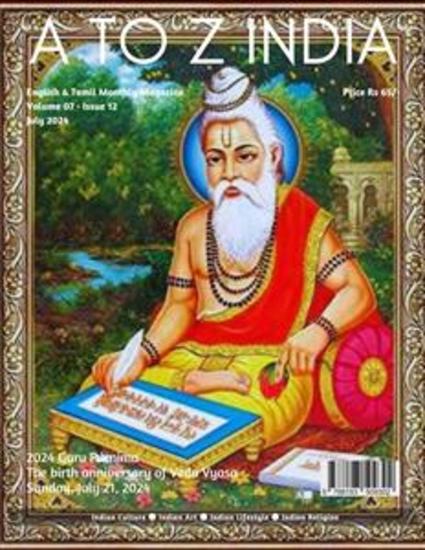
A to Z India - July 2024 - cover

A to Z India - July 2024

Indira Srivatsa

Publisher: A TO Z INDIA

  • 0
  • 0
  • 0

Summary

FROM THE EDITOR'S DESK: SPREAD OF ISLAM IN INDONESIA - One theory states that Islam arrived directly from Arabia as early as the 9th century, during the time of the Umayyad and Abbasid caliphates. Another theory credits Sufi travelers for bringing Islam in the 12th or 13th century, either from Gujarat in India or from Persia. Before the archipelago's conversion to Islam, the predominant religions in Indonesia were Hinduism (particularly its Shaivism tradition) and Buddhism; BHARATIYA JANATA PARTY AND NARENDRA MODI: CHALLENGES AND OPPORTUNITIES BEFORE MODI GOVERNMENT - BJP may have suffered a loss in terms of seats, but it emerged as the largest party for the third consecutive time.
Available since: 06/28/2024.

Other books that might interest you

  • Wars of Classical Greece The: The History of the Conflicts that Led to the Rise and Fall of the Greeks’ Dominance - cover

    Wars of Classical Greece The:...

    Charles River Editors

    • 0
    • 0
    • 0
    The ancient Greeks have long been considered the forefathers of modern Western Civilization, but the Golden Age of Athens and the spread of Greek influence across much of the known world only occurred due to one of the most crucial battles of antiquity: the Battle of Marathon. In 491 B.C., following a successful invasion of Thrace over the Hellespont, the Persian emperor Darius sent envoys to the main Greek city-states, including Sparta and Athens, demanding tokens of earth and water as symbols of submission, but Darius didn’t exactly get the reply he sought. 
    	The Peloponnesian War, as the great historian Thucydides wrote in the introduction to his eponymous book, which has become one of the greatest historical treatises of antiquity, was an event of such calamitous magnitude that Greece had never witnessed its like in all of recorded history. Not the Trojan War, not the Dorian Invasion, not even the recent Persian invasions – which had devastated mainland Greece and seen Athens herself evacuated and put to the flame, the buildings on her Acropolis razed into dust – could compare to the scale of the devastation that engulfed all of Greece for almost three decades, causing the deaths of tens, perhaps hundreds of thousands.  
    	Entire populations were displaced, whole cities destroyed, and mountainous sums of money spent, all in order for Greece’s two most famous city-states to establish who had dominion over Greece. Sparta, whose invincible armies had recently led the Greeks to victory against Xerxes’s hordes at Plataea was at the head of the Peloponnesian League. Their opponents were led by proud Athens, possessor of a fleet that virtually dominated the entire Mediterranean and decimated the Persian navy at Salamis and Mycale, at the head of the Delian League. Sparta was insular and old-fashioned, while Athens was dynamic and democratic, but both were bent on imperialistic expansion.
    Show book
  • Statistical Physics - The Physics of Particles and Systems - cover

    Statistical Physics - The...

    Mark Hedges

    • 0
    • 0
    • 0
    Statistical mechanics is the branch of physics that applies probability theory and statistics to describe the behavior of systems with a large number of particles. It provides a framework for understanding macroscopic phenomena in terms of the microscopic properties of individual particles. The central goal of statistical mechanics is to connect the microscopic world of atoms and molecules with the macroscopic world of thermodynamic variables like temperature, pressure, and volume. 
    Historically, statistical mechanics emerged in the 19th century as scientists sought to explain the observed laws of thermodynamics, which describe the behavior of systems in equilibrium. Classical thermodynamics, while incredibly successful, was primarily phenomenological and lacked a fundamental microscopic understanding. This gap was filled by the development of statistical mechanics, largely attributed to the works of Ludwig Boltzmann, James Clerk Maxwell, and Josiah Willard Gibbs. 
    At its core, statistical mechanics is based on the idea that the behavior of macroscopic systems can be understood by considering the collective behavior of their microscopic constituents. Instead of directly tracking every particle, which is practically impossible for large systems, statistical mechanics calculates the statistical properties of the system. These properties are derived from the laws of probability
    Show book
  • Restoring Reason - Using the Ancient Liberal Arts to Defend Against Modern Manipulation - cover

    Restoring Reason - Using the...

    Travis M. Corcoran

    • 0
    • 0
    • 0
    Frustration. Confusion. Anxiety. Despair. These are the symptoms of sensory overload, a state of mind in which we increasingly find ourselves. We’re drowning in data supplied by entities with no regard for our best interests. Your intellectual freedom is at stake, threatened by everything from academia and Big Tech to the media and government. Fortunately, you have a way to take back personal control, and it’s a solution founded upon ancient philosophy. In Restoring Reason, philosopher Dr. Travis Corcoran demonstrates how the liberal arts provide us with a skillset to evaluate knowledge and draw our own conclusions for clarity, confidence, and freedom. Dr. Corcoran explains the trivium—knowledge, understanding, and wisdom—and the foundation it lays for making high-quality decisions for a high-quality life. Restoring Reason is an intellectual self-defense manual to make sense of the world we live in. Including an analysis of the five biggest social engineers today, including corporate interests and legacy media, this reproducible, systematic framework will help you see truth, deny falsehoods, and lead a fulfilled, independent life.
    Show book
  • Phenomenology in Anthropology - A Sense of Perspective - cover

    Phenomenology in Anthropology -...

    Kalpana Ram, Christopher Houston

    • 0
    • 0
    • 0
    This volume explores what phenomenology adds to the enterprise of anthropology, drawing on and contributing to a burgeoning field of social science research inspired by the phenomenological tradition in philosophy. Essays by leading scholars ground their discussions of theory and method in richly detailed ethnographic case studies. The contributors broaden the application of phenomenology in anthropology beyond the areas in which it has been most influential—studies of sensory perception, emotion, bodiliness, and intersubjectivity—into new areas of inquiry such as martial arts, sports, dance, music, and political discourse.
    Show book
  • Washington's History Revised Edition - The People Land and Events of the Far Northwest - cover

    Washington's History Revised...

    Harry Ritter

    • 0
    • 0
    • 0
    Now with updated content, including three brand-new chapters plus a new preface and a postscript from the author. 
    An anything-but-dry history textbook, Washington's History is a fascinating walk through the sweeping story of a place and its people. 
     
    For centuries, the natural beauty and riches of the Northwest have excited the human imagination, from its first peoples to seafaring explorers, to westward-thinking pioneers, to technological thinkers and giants. 
     
    A Washington resident himself, author Harry Ritter offers fifty-five vignettes that comprise an entertaining and informative picture of life in the Far Northwest. 
     
    Learn about the Natives, explorers, traders, missionaries, loggers, farmers, inventors, and politicians. From Chief Seattle to Dr. John McLoughlin, William E. Boeing, Henry M. "Scoop" Jackson, Bill Gates, and Jeff Bezos, these are the people at the epicenter of events that shaped the Evergreen State.
    Show book
  • Louvre and the Hermitage The: The History and Contents of Europe’s Biggest Art Museums - cover

    Louvre and the Hermitage The:...

    Editors Charles River

    • 0
    • 0
    • 0
    The very name of the Louvre conjures up scenes of art and elegance, and of long halls filled with beauty and people strolling through them whispering quietly among themselves about the glories they are witnessing. Even those who have never been to the Louvre know some of its most prized possessions, from ancient statues to Leonardo Da Vinci’s “Mona Lisa”. As the world’s largest museum, the Louvre is unquestionably the cultural highpoint of Paris, a city that has long been considered the cultural center of Europe. 
    However, life is rarely as simple as one imagines, and the life of the Louvre is no different. While just about everyone is familiar with its history as an art museum, the Louvre’s history goes back over 800 years, and it used to have far different purposes, both as a medieval fortress and a palatial residence for French kings. The Louvre bore witness to mass murder during the French Revolution, and there have been countless accusations of theft and other questionable actions since its opening. 
    Catherine the Great came to power in the midst of the Enlightenment, which was flourishing in France and Britain, and she would rule as an Enlightened ruler. A known correspondent of Voltaire’s, Catherine sought to modernize Russia and turn it into a force in its own right, creating a rich and cultured court at the same time. Over the course of nearly 35 years in power, Catherine ushered in the Russian Enlightenment and presided over a period of time known as the Golden Age of the Russian Empire. 
    Moreover, Catherine had an unmatched passion for the arts, and she began a private art collection that would eventually evolve into galleries upon galleries of historical treasures shipped in from all over the world. This fabled museum was none other than the Hermitage, located in the heart of Saint Petersburg, a city founded by the imperial empire's very own Peter the Great.
    Show book