Rejoignez-nous pour un voyage dans le monde des livres!
Ajouter ce livre à l'électronique
Grey
Ecrivez un nouveau commentaire Default profile 50px
Grey
Abonnez-vous pour lire le livre complet ou lisez les premières pages gratuitement!
All characters reduced
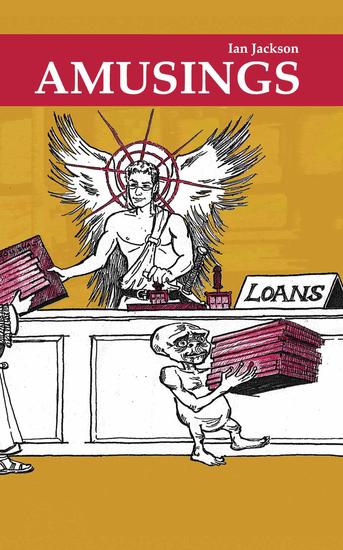
Amusings - cover

Amusings

Ian Jackson

Maison d'édition: Grosvenor House Publishing

  • 0
  • 0
  • 0

Synopsis

The micro Amusings of Australian author Ian Jackson suggests a definitive 'without fanfare' approach to humour and satire. His stories and ditties sweep across different genres and subjects with a thought-provoking approach to debate and discussion. A former London resident, his narratives are ensconced deep within the heart of Hampstead, the traditional London borough that is home to some of the richest inhabitants of our planet, yet also harbours the lower orders of the population, such as the jobless man at the end of his wits who finds himself thrust into the limelight when he suddenly inherits divine spiritual aptitude. Then there is the uber ambitious estate agent hatching a plot to use counter intelligence to inject dynamism into the housing market and the erstwhile leader of a secret mystical organisation burdened by the calling to make the most important announcement of his life to his followers. Jackson also tackles domesticity with the long suffering wife wondering how to spice up her staid marriage and politics comes under the radar when a Parliamentary Senate Committee is recalled to discuss the most far reaching scientific discovery of our age. Jackson's writing takes in spies, extra terrestrials, religion and intergalactic Superheroes in equal measure. Whether the reader is a political observer or a radical dreamer, has interest in religion or race, society or nature, conservation or the vagaries of one super power or t'other, Amusings tickles the edges of humour with its eclectic and succinct micro narratives. Subtle, laconic, surrealist and at times acerbic witticisms offer a translucent glance at generic satire, whimsically casting a glance at our post modern world.
Disponible depuis: 28/03/2024.
Longueur d'impression: 198 pages.
D'autres livres qui pourraient vous intéresser

  • A Ballet of Lepers - A Novel and Stories - cover

    A Ballet of Lepers - A Novel and...

    Leonard Cohen

    • 0
    • 0
    • 0
    A never-before-published early novel and stories by the legendary musician, songwriter, and poet Leonard Cohen 


    The pieces in this collection, written between 1956 and 1961 and including short fiction, a radio play, and a stunning early novel, offer startling insights into Cohen's imagination and creative process. Cohen explores themes that would permeate his later work, from shame and unworthiness to sexual desire in all its sacred and profane dimensions to longing, whether for love, family, freedom, or transcendence. The titular novel, A Ballet of Lepers—one he later remarked was "probably a better novel" than his celebrated book The Favourite Game—is a haunting examination of these elements in tandem, focusing on toxic relationships and the lengths to which one will go to maintain them, while the fifteen stories, as well as the playscript, probe the inner demons of his characters, many of whom could function as stand-ins for the author himself. Cohen's work is meditative and surprising, offering playful, provocative, and penetrating glimpses into the world-weary lives of his characters, and a window into the early art of a storytelling master. 


    A Ballet of Lepers, vivid in its detail, unsparing in its gaze, reveals the great artist and visceral genius as never seen before.
    Voir livre
  • The Cone - cover

    The Cone

    H. G. Wells

    • 0
    • 0
    • 0
    In H.G. Wells' gripping tale "The Cone," a visceral story of revenge unfolds within the industrial setting of an ironworks. The narrative follows Horrocks, the ironworks manager, as he guides his friend Raut through the smoky, infernal landscape of his domain. Unbeknownst to Raut, Horrocks is aware of an affair between Raut and his wife. The tour takes a dark turn as Horrocks, fueled by betrayal and rage, leads Raut to the mouth of a gigantic smelting furnace—the cone. Wells masterfully builds tension, culminating in a shocking, tragic climax that explores themes of passion, jealousy, and the destructive power of human emotions.
    Voir livre
  • Arch Rascal An - From their pens to your ears genius in every story - cover

    Arch Rascal An - From their pens...

    Knut Hamsun

    • 0
    • 0
    • 0
    Knud Pedersen was born in Lom in the Gudbrandsdal valley of Norway on the 4th of August, 1859 in what was then the United Kingdoms of Sweden and Norway.  He was the fourth son of seven children born to poor parents who, when he was three, were invited to an uncle’s farm to work his land. 
    When he was nine he moved away from his family to help another uncle who ran a post office.  Whilst with him he was beaten and starved which manifested in a series of chronic nervous difficulties.  The treatment endured for six years until he managed to escape back to Lom. 
    For some time he now took any job that was available to him, including store clerk, peddler, shoemaker's apprentice, sheriff's assistant, elementary-school teacher and ropemaker's apprentice.  At about the same time, with the wealth of these gained experiences, he began to explore his literary talents. 
    In 1877 he published his first book ‘The Enigmatic Man: A Love Story from Northern Norway’, others soon followed but real success only came in 1890 with ‘Hunger’, an influential work for later novelists with its internal monologue and bizarre logic.  His work is often associated with Pantheism; where nature and mankind are unified in a strong and often mystical bond.   
    His work was so influential that in 1920 he was awarded the Novel Prize for Literature. 
    Shortly after this point his works became fewer and his interests darker.  During World War II he became a fervent admirer of the Nazi’s, even meeting Hitler, even though German armies had overrun Norway.  With the war’s end he was detained on charges of treason.  His old age was apparently the primary reason given for Hamsun receiving only a fine.  Other reasons also sought to excuse his abhorrent behaviour but it was clear that whilst he was loved for his literature he was detested for his politics and morals. 
    His literary canon includes more than 20 novels, a poetry collection, short stories, plays, a travelogue, other works of non-fiction and essays. 
    Knut Hamsun died on the 19th February 1952 in Grimstad. He was 92.
    Voir livre
  • Blessed Are the Meek - From their pens to your ears genius in every story - cover

    Blessed Are the Meek - From...

    Mary Webb

    • 0
    • 0
    • 0
    Mary Gladys Meredith was born on 25th March 1881 at Leighton Lodge in the village of Leighton, near Shrewsbury in Shropshire.  
    Mary was home-schooled by her father before being sent to a finishing school in Southport in 1895. Her longs walks in the countryside helped her develop a heightened sense of observation and description, of both people and places, which later infused both her poetry and prose. 
    When she was 20 she developed symptoms of Graves' disease, a thyroid disorder that caused bulging protuberant eyes and throat goitre. This caused life-long ill health and was a possible contributor to her early death.  
    Mary was first published as a teenager when her brother sent to a local newspaper her poem on a recent rail accident.  Mary, who was in the habit of destroying her work was appalled though placated when she discovered that it had received some positive appreciation in readers letters. 
    1912 brought marriage to Henry Bertram Law Webb, a teacher. He supported her literary work which, in 1917, resulted in the publication of her novel ‘The Golden Arrow.’ 
    A few years later they acquired a property in London where, it was hoped, recognition of her literary talents would be more easily recognised.   
    Her 1924 novel, ‘Precious Bane’, won the Prix Femina Vie Heureuse, the prestigious French literary prize awarded by an all-female jury. 
    Most of her poetry and various other works were only published after her death. 
    By 1927 her health was deteriorating and her marriage failing.   
    Mary Webb died on 8th October 1927 at St Leonards-on-Sea, East Sussex.  She was 46.
    Voir livre
  • Mary Elizabeth Braddon - A Short Story Collection - A hugely popular Victorian author she has become underrated over time but here we try and correct that with an amazing compilation of stories - cover

    Mary Elizabeth Braddon - A Short...

    Mary Elizabeth Braddon

    • 0
    • 0
    • 0
    Mary Elizabeth Braddon – A Short Story Collection – An Introduction 
     
    Mary Elizabeth Braddon was born in London on the 4th October 1835. 
     
    At age 5 her parents separated but her ambition to succeed was not daunted.  After being privately educated she took to acting, and the minor roles she obtained where enough to support both her and her mother.  This potential career waned as soon as she began writing and secured an income from it. 
     
    In 1860, she met John Maxwell, a publisher of periodicals, and moved in with him the following year.  At the time Maxwell was already married with five children but his wife was confined to an Irish mental asylum.  On her death they married and she had six children by him. 
     
    Braddon was prolific and wrote over 80 novels, perhaps the most famous is ‘Lady Audley's Secret’ (1862), which won her both sales and a fortune as a bestseller.  She also wrote a number of historical fiction novels which again increased her reputation. 
     
    She was equally prolific as a short story writer, primarily supernatural and ghost stories, all of which continue to be anthologized to this day, such is the high regard they are kept in. 
     
    Braddon founded Belgravia magazine in 1866, its fare being serialised sensation novels, poems, travel narratives and biographies, along with essays on fashion, history and science, all lavishly illustrated.  She also edited Temple Bar magazine. 
     
    Mary Elizabeth Braddon died on 4th February 1915 and is buried in Richmond Cemetery. 
     
    1 - Mary Elizabeth Braddon - A Short Story Collection - An Introduction 
    2 - Colonel Benyon's Entanglement by Mary Elizabeth Braddon 
    3 - The Cold Embrace by Mary Elizabeth Braddon 
    4 - The Face in the Glass by Mary Elizabeth Braddon 
    5 - Eveline's Visitant by Mary Elizabeth Braddon 
    6 - The Higher Life by Mary Elizabeth Braddon
    Voir livre
  • A Daemon in Jade - A Short Horror Story - cover

    A Daemon in Jade - A Short...

    Michael van der Voort

    • 0
    • 0
    • 0
    What is evil? Is it simply a concept, a description applied to the actions of men or to incidents that impact them or is it something more? An external force eternal and ever present that can weave itself in slithering pathways into our thoughts and deeds? Is it possible for instance, for an object to be evil? For it to reek, on a level detectable beyond our normal senses of corruption, or wickedness and of rot? could it leave upon the skin and the mind like a residue a clinging film of something that is not only older than man but hateful of him? 
    These are the questions that circulate around the Daemon in Jade, the massive sculpture that the ancients chose to bury head down and disregard. Not simply forgetting, but deliberately, purposely shunning the hideous thing as wretched and unclean.
    Voir livre