¡Acompáñanos a viajar por el mundo de los libros!
Añadir este libro a la estantería
Grey
Escribe un nuevo comentario Default profile 50px
Grey
Suscríbete para leer el libro completo o lee las primeras páginas gratis.
All characters reduced
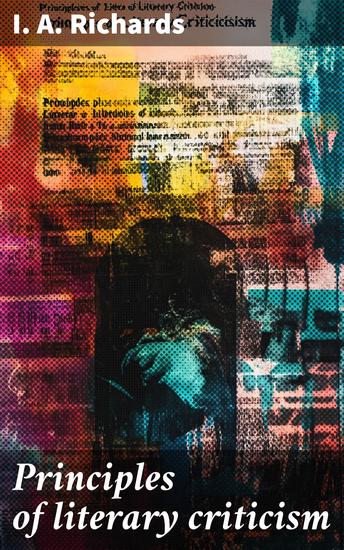
Principles of literary criticism - cover

Principles of literary criticism

I. A. Richards

Editorial: Good Press

  • 0
  • 0
  • 0

Sinopsis

I. A. Richards' "Principles of Literary Criticism" is a seminal work that delves into the intricate relationship between literature and the reader's experience. With its innovative approach, the book presents a systematic analysis of literary texts, emphasizing the significance of emotional response and the role of the reader's interpretation. Richards employs a clear and analytical literary style, reflecting the early 20th-century context of formalist criticism, while also engaging with the emerging trends in modernist thought. This text challenges traditional views of literary analysis by exploring how meaning is constructed through language and the complex interplay of ideas within a work. I. A. Richards, a prominent British literary critic, poet, and scholar, was influential in shaping modern criticism, particularly through his role at Cambridge University. His background in both classical literature and the emerging fields of linguistics and psychology informed his philosophies in literary criticism. The personal and educational experiences Richards accumulated contributed to his pioneering ideas, making him a pivotal figure in the development of contemporary literary analysis and theory. Richards' "Principles of Literary Criticism" is an essential read for students, scholars, and anyone interested in understanding literature's impact on the human psyche. Through its profound insights and practical applications, the book not only enhances one's appreciation of literary works but also cultivates a deeper understanding of the dynamics between literature and its audience.
Disponible desde: 02/03/2025.
Longitud de impresión: 110 páginas.

Otros libros que te pueden interesar

  • Jimmy Carter: A short biography - 5 Minutes: Short on time – long on info! - cover

    Jimmy Carter: A short biography...

    5 Minutes, 5 Minute Biographies,...

    • 0
    • 0
    • 0
    Jimmy Carter, American president and Nobel Peace prize laureate: Life and work in a short biography! Everything you need to know, brief and concise. Infotainment, education and entertainment at its best!
    Ver libro
  • The Weimar Republic - Inflation Degeneration and Historicity - cover

    The Weimar Republic - Inflation...

    Kelly Mass

    • 0
    • 0
    • 0
    To summarize everything about this topic, the Weimar Republic was a disaster. Perhaps the setup of the republic wasn’t as much as fault as just the world events that led to the Great Depression, the eventual surrender of Germany to France, Russia, and England in World War I before that, and other significant changes in the economy at the time. 
    The Weimar Republic was a federal constitutional republic that lasted in Germany from 1918 to 1933. The German Reich (Deutsches Reich) was the main name of the state, which was also referred to as the German Republic (Deutsche Republik). The first word associates with the city of Weimar, which hosted the republic's first constituent assembly. The nation was typically described as "Germany" in English; the title "Weimar Republic" didn't become well-known till the 1930s. 
    Do you want to buy a few eggs with thousands of marks? How about a loaf of bread for ten thousand dollars? The inflation in the Weimar Republic led to a severe economic downturn, one that had probably never been there ever before. This led to other problems, which also explained the rise of Nazi Germany somewhat later. 
    If you want to understand all these things, then go ahead and get started.
    Ver libro
  • Norse Mythology: The History of the Norse Pantheon and the Most Famous Myths - cover

    Norse Mythology: The History of...

    Editors Charles River, Andrew Scott

    • 0
    • 0
    • 0
    Much of what is known of the Norse myths comes from the 10th century onwards. Until this time and, indeed, for centuries afterwards, Norse culture (particularly that of Iceland, where the myths were eventually transcribed) was an oral culture. In fact, in all Scandinavian countries well into the 13th century laws were memorized by officials known as “Lawspeakers” who recited them at the “Thing.” The Thing was the legislative assembly in Scandinavia “held for judicial purposes.” 
    One of the most famous of these Lawspeakers was the Icelander Snorri Sturluson, a masterful writer who wrote the Prose Edda in the thirteenth century. There are other sources for the Norse myths, namely the later “Poetic Edda,” a collection of poems and prose work, and other sagas but the Snorri’s Prose Edda is the most complete work whose attribution is known to modern scholars. 
    The Prose Edda is a collection of Norse Myths split into three sections, the Gylfaginning (the Deluding of Gylfi), the Skáldskaparmál (the Language of Poetry) and the Háttatal (the Enumeration of Meters). The first has a frame story that entails a Swedish King, Gylfi, disguising himself as an old man, Gangleri, when he journeys to Asgard to meet the gods. When he arrives, he meets three men - “High One, Just-As-High, and Third” - who reveal to him stories of the world and the gods. The second section contains a warning for Christians not to believe in the Norse gods, specifically the two families, the Aesir and the Vanir, but also refutes the notion that they were demons, which was a common supposition among some Christians at the time. The Prose Edda begins in this line of thought with a euhemeristic prologue, which traces the history of the Norse Gods as human heroes of Troy, making Thor one of King Priam’s sons.
    Ver libro
  • Never Let Me Go by Kazuo Ishiguro (Book Analysis) - Detailed Summary Analysis and Reading Guide - cover

    Never Let Me Go by Kazuo...

    Bright Summaries

    • 0
    • 0
    • 0
    Unlock the more straightforward side of Never Let Me Go with this concise and insightful summary and analysis!This engaging summary presents an analysis of Never Let Me Go by Kazuo Ishiguro, a dystopian novel set in a fictionalised version of England where human clones are used for organ donation. The novel follows three of these clones, Kathy, Ruth and Tommy, as they grow up and come to realise that they have no way of escaping their fate, which will inevitably lead to their early deaths. In this way, the author reflects on mortality, the ethical limits of modern science and what it means to be human. Never Let Me Go is Kazuo Ishiguro's sixth novel and, along with The Remains of the Day (for which he won the Man Booker Prize in 1989) and The Buried Giant, is one of his most widely read works. Find out everything you need to know about Never Let Me Go in a fraction of the time!This in-depth and informative reading guide brings you:• A complete plot summary• Character studies• Key themes and symbols• Questions for further reflectionWhy choose BrightSummaries.com?Available in print and digital format, our publications are designed to accompany you on your reading journey. The clear and concise style makes for easy understanding, providing the perfect opportunity to improve your literary knowledge in no time.See the very best of literature in a whole new light with BrightSummaries.com!
    Ver libro
  • Global Poverty - Addressing the Deepening Divide in the World's Wealth - cover

    Global Poverty - Addressing the...

    Marcus Klein

    • 0
    • 0
    • 0
    Global poverty remains one of the most pressing challenges of our time, reflecting a deepening divide in the world’s wealth. Despite advances in technology, medicine, and economic systems, billions of people continue to live in conditions of extreme deprivation. This chapter introduces the complexities of global poverty, exploring its definition, scope, and implications for societies worldwide.  
      
    At its core, poverty is not merely a lack of income but a multifaceted issue encompassing inadequate access to basic needs such as food, clean water, healthcare, and education. The World Bank defines extreme poverty as living on less than $2.15 a day, a figure that starkly contrasts with the extravagant wealth enjoyed by the world’s richest individuals and nations. Beyond material deprivation, poverty often strips individuals of dignity, opportunity, and hope for a better future.  
      
    The scale of global poverty is staggering. According to the United Nations, over 700 million people live in extreme poverty, with the vast majority concentrated in sub-Saharan Africa and South Asia. However, poverty is not confined to developing nations; it exists in wealthy countries as well, manifesting as homelessness, food insecurity, and lack of affordable housing. This disparity between the wealthy and the impoverished underscores a global system that perpetuates inequality. 
    Ver libro
  • How to Take Smart Notes - One Simple Technique to Boost Writing Learning and Thinking 2nd Edition - cover

    How to Take Smart Notes - One...

    Sönke Ahrens

    • 0
    • 1
    • 0
    This is the second, revised and expanded edition. The first edition was published under the slightly longer title "How to Take Smart Notes. One Simple Technique to Boost Writing, Learning and Thinking - for Students, Academics and Nonfiction Book Writers". 
    The key to good and efficient writing lies in the intelligent organisation of ideas and notes. This book helps students, academics and other knowledge workers to get more done, write intelligent texts and learn for the long run. It teaches you how to take smart notes and ensure they bring you and your projects forward. 
    The Take Smart Notes principle is based on established psychological insight and draws from a tried and tested note-taking technique: the Zettelkasten. This is the first comprehensive guide and description of this system in English, and not only does it explain how it works, but also why. It suits students and academics in the social sciences and humanities, nonfiction writers and others who are in the business of reading, thinking and writing. 
    Instead of wasting your time searching for your notes, quotes or references, you can focus on what really counts: thinking, understanding and developing new ideas in writing. 
    Dr. Sönke Ahrens is a writer and researcher in the field of education and social science. He is the author of the award-winning book "Experiment and Exploration: Forms of World Disclosure" (Springer). 
    Since its first publication, How to Take Smart Notes has sold more than 100,000 copies and has been translated into seven languages.
    Ver libro