Begleiten Sie uns auf eine literarische Weltreise!
Buch zum Bücherregal hinzufügen
Grey
Einen neuen Kommentar schreiben Default profile 50px
Grey
Jetzt das ganze Buch im Abo oder die ersten Seiten gratis lesen!
All characters reduced
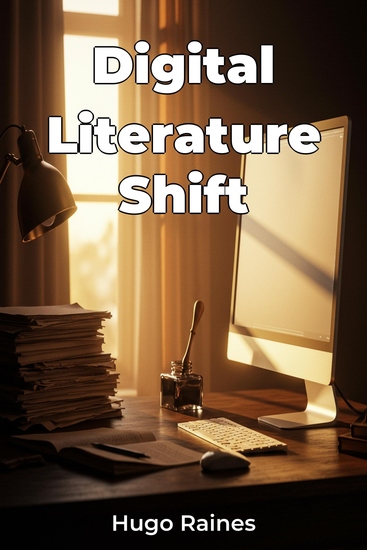
Digital Literature Shift - cover

Digital Literature Shift

Hugo Raines

Übersetzer A AI

Verlag: Publifye

  • 0
  • 0
  • 0

Beschreibung

Digital Literature Shift explores how the internet and digital publishing are reshaping reading and writing. It examines the evolution of reading habits, the transformation of writing practices, and the socioeconomic impacts of digital publishing. One intriguing insight is how digital reading encourages non-linear navigation, a stark contrast to the linear processing of print. Another is the democratization of publishing, allowing for decentralized content creation and altering the traditional publishing industry. The book traces the history of reading and writing from print to digital, considering social factors like increased access to information and growing digital literacy.

 
It's structured in three parts: foundational concepts, the influence of digital platforms on reading habits (such as online reading behavior), and the transformation of writing practices (like online content creation). This approach provides a comprehensive overview of the digital revolution's effects on language arts.

 
Ultimately, this book argues that understanding these shifts is crucial for educators, policymakers, and anyone interested in the future of literacy. It emphasizes the importance of digital literacy and offers practical applications for educators and writers alike.
Verfügbar seit: 06.05.2025.
Drucklänge: 84 Seiten.

Weitere Bücher, die Sie mögen werden

  • The Influence of Ancient Egypt on Modern Culture - cover

    The Influence of Ancient Egypt...

    Omar Khalil

    • 0
    • 0
    • 0
    The fascination with Ancient Egypt’s visual and structural aesthetics has significantly influenced Western art and architecture, especially during the 18th and 19th centuries. Known as the Egyptian Revival, this movement emerged as part of a broader romantic and neoclassical interest in ancient civilizations. Following Napoleon's campaign in Egypt and the publication of Description de l'Égypte, Europe became enamored with Egyptian motifs, leading to their incorporation into a wide range of architectural projects. 
    One of the most recognizable contributions of Egyptian Revival architecture is the use of obelisks and pyramid forms in public spaces and memorials. These iconic shapes, once central to Egyptian religious and ceremonial design, were reinterpreted in cemeteries, government buildings, and monuments across Europe and the United States. The Washington Monument in the U.S., for instance, is a clear example of how Egyptian form was adapted to convey power and permanence. 
    In interior design and decorative arts, Egyptian Revival made a mark through bold geometric patterns, lotus flower motifs, and symbolic elements like the sun disk and winged scarab. Furniture, wallpaper, jewelry, and textiles adopted these styles, evoking the mystery and majesty of the Nile. This decorative trend became especially popular after the discovery of King Tutankhamun’s tomb in 1922, which triggered a new wave of Egyptomania in the early 20th century.
    Zum Buch
  • The Dogma of Christ - And Other Essays on Religion Psychology and Culture - cover

    The Dogma of Christ - And Other...

    Erich Fromm

    • 0
    • 0
    • 0
    “Fromm’s developing thought merits the critical attention of all concerned with the human condition and its future.” —The Washington Post The essays in this fascinating volume examine present-day psychological and cultural problems with the keen insight and humanistic sympathies characteristic of Erich Fromm’s work.The Dogma of Christ provides some of the sharpest critical insights into how the contemporary world of human destructiveness and violence can no longer separate religion, psychology, and politics. The book brilliantly summarizes Fromm’s ideas on how culture and society shape our behavior. “It’s the new post-religious theme song. The Fromm exhortations are imaginative and he has a definite audience.” —Kirkus Reviews “Of all the psychological theorists who have tried to formulate a system better than Freud’s to approach problems of contemporary life, no one has been more creative or influential than Erich Fromm. He is the most articulate advocate on the role of social forces in molding our character and on our manner of relating to others. This volume is an expansion of his systematic doctrine.” —Louis L. Lunsky, MD, Archives of Internal Medicine
    Zum Buch
  • The Communist Manifesto - cover

    The Communist Manifesto

    Karl Marx, Friedrich Engels

    • 0
    • 0
    • 0
    The Communist Manifesto, originally the Manifesto of the Communist Party (German: Manifest der Kommunistischen Partei), is an 1848 political document by German philosophers Karl Marx and Friedrich Engels. Commissioned by the Communist League and originally published in London just as the Revolutions of 1848 began to erupt, the Manifesto was later recognised as one of the world's most influential political documents. It presents an analytical approach to the class struggle (historical and then-present) and the conflicts of capitalism and the capitalist mode of production, rather than a prediction of communism's potential future forms.The Communist Manifesto summarises Marx and Engels' theories concerning the nature of society and politics, namely that in their own words "the history of all hitherto existing society is the history of class struggles". It also briefly features their ideas for how the capitalist society of the time would eventually be replaced by socialism. In the last paragraph of the Manifesto, the authors call for a "forcible overthrow of all existing social conditions", which served as a call for communist revolutions around the world. In 2013, The Communist Manifesto was registered to UNESCO's Memory of the World Programme along with Marx's Capital, Volume I.
    Zum Buch
  • From Warlords to Statelords - Armed Groups and Power Trajectories in Libya and Yemen - cover

    From Warlords to Statelords -...

    Federica Saini Fasanotti,...

    • 0
    • 0
    • 0
    In Libya and Yemen armed groups play a central role. Pervading weak and contested institutions, they have gradually brought their webs of survival, profit and governance under the state umbrella: warlords have become the new lords of the state. Armed groups control most of the energy revenues, critical infrastructure, smuggling and illicit trafficking. Their leaders are multifaceted: they are simultaneously military commanders, tribal chiefs, politicians and businessmen.
    Combining comparative analysis and case studies, this Report sheds light on the "economic face" of the armed groups and their power trajectories. How do armed groups build networks of profit and loyalty in the territories they hold? How does clientelism mark a continuity trend with former authoritarian regimes?
    Zum Buch
  • Being Cosmopolitan - A Political Approach - cover

    Being Cosmopolitan - A Political...

    Luke Ulas

    • 0
    • 0
    • 0
    What does it mean to be cosmopolitan? Typically, cosmopolitanism is understood as a broad moral orientation, involving some kind of commitment to global moral equality. On this understanding, to be cosmopolitan is simply to evidence that moral orientation oneself. By contrast, Being Cosmopolitan takes up a thoroughly political approach. The focus is on what it might mean, and what it is like, to be political in a distinctly cosmopolitan form. What it means to be cosmopolitan in this thoroughly political sense cannot involve appeal to any particular moral orientation, because politics is about, inter alia, the contestation of such orientations and commitments. Instead, this book offers an account that is based upon the internalization of particular kind of global "social imaginary," involving the imagination of a global public to which certain issues—or global public affairs—are understood to pertain. 


    Within which kind of global order is it possible, or comfortable, for a cosmopolitical agent to live? In answer to this question, the book argues against the viability of both a world of self-determining peoples, and of "pluralist" global visions—both of which are popular with moral cosmopolitan theorists.
    Zum Buch
  • Exit Zero - Family and Class in Postindustrial Chicago - cover

    Exit Zero - Family and Class in...

    Christine J. Walley

    • 0
    • 0
    • 0
    In 1980, Christine J. Walley’s world was turned upside down when the steel mill in Southeast Chicago where her father worked abruptly closed. In the ensuing years, ninety thousand other area residents would also lose their jobs in the mills—just one example of the vast scale of deindustrialization occurring across the United States. The disruption of this event propelled Walley into a career as a cultural anthropologist, and now, in Exit Zero, she brings her anthropological perspective home, examining the fate of her family and that of blue-collar America at large. Interweaving personal narratives and family photos with a nuanced assessment of the social impacts of deindustrialization, Exit Zero is one part memoir and one part ethnography— providing a much-needed female and familial perspective on cultures of labor and their decline. Through vivid accounts of her family’s struggles and her own upward mobility, Walley reveals the social landscapes of America’s industrial fallout, navigating complex tensions among class, labor, economy, and environment. Unsatisfied with the notion that her family’s turmoil was inevitable in the ever-forward progress of the United States, she provides a fresh and important counternarrative that gives a new voice to the many Americans whose distress resulting from deindustrialization has too often been ignored.
    Zum Buch