¡Acompáñanos a viajar por el mundo de los libros!
Añadir este libro a la estantería
Grey
Escribe un nuevo comentario Default profile 50px
Grey
Suscríbete para leer el libro completo o lee las primeras páginas gratis.
All characters reduced
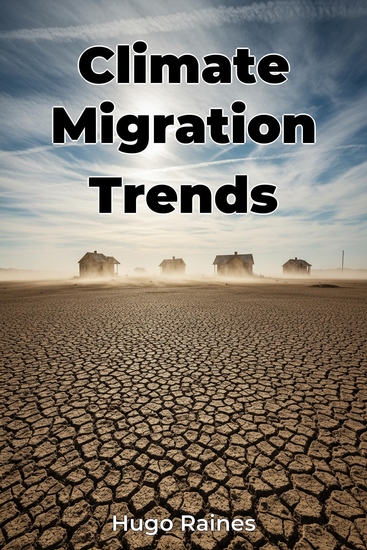
Climate Migration Trends - cover

Climate Migration Trends

Hugo Raines

Traductor A AI

Editorial: Publifye

  • 0
  • 0
  • 0

Sinopsis

Climate Migration Trends investigates the growing phenomenon of climate migration, where environmental change forces communities to leave their homes. It highlights how rising sea levels, desertification, and extreme weather events are driving human displacement and reshaping global population patterns, particularly towards urbanization. The book emphasizes that this is not just a future threat, but a present reality demanding immediate attention.

 
The book examines the experiences of those displaced, their adaptation challenges, and the effectiveness of current policy responses. It uses data from governmental reports and academic studies to provide a comprehensive overview of the issue.

 
Distinct regional variations in displacement patterns reveal factors that determine where people relocate and the difficulties they face in accessing housing, employment, and social services in new urban environments.

 
The book progresses from establishing the scientific basis for climate-induced displacement to examining case studies from various regions. It concludes with policy options, advocating for strategies that address the root causes of climate change, support adaptation in vulnerable regions, and facilitate the integration of climate refugees into urban areas, connecting to fields like human rights law, urban planning, and development economics.
Disponible desde: 01/05/2025.
Longitud de impresión: 74 páginas.

Otros libros que te pueden interesar

  • Litigating the Pandemic - Disaster Cascades in Court - cover

    Litigating the Pandemic -...

    Susan M. Sterett

    • 0
    • 0
    • 0
    As officials scrambled in 2020 to manage the spread of COVID, the reverberations of the crisis reached well beyond immediate public health concerns. The governance problems that emerged in the pandemic would be problems in other climate-related disasters, too. 


    Many of these governance problems wound up in court. Businesses filed insurance claims for lost commerce; when the claims were denied, some companies sued. As state governments ordered closures and otherwise tried to adapt, interest organizations that had long sought to limit government authority challenged them in court. Political officials railed against litigation they argued would stop businesses from reopening. The United States, like other countries, governs partly through litigation, and litigation is one way of seeing the multiple governance failures during the pandemic. 


    Drawing on databases of cases filed, news reports, and other sources, Susan M. Sterett argues that governing during the pandemic must include the human institutions intertwined with the effects of the virus. Those institutions reveal problems well beyond the reach of technical expertise. Failures in private insurance as a way of governing risk, conflicts about the primacy of religion, government authority, and health, are problems that predated the pandemic and will persist in future disasters.
    Ver libro
  • Ron DeSantis in Office: An Unauthorized Account of the Florida Republican's Efforts to Uphold the Constitution as a Congressman and Governor - cover

    Ron DeSantis in Office: An...

    Cason Longhurst

    • 0
    • 0
    • 0
    During the COVID-19 pandemic, Governor Ron DeSantis made Florida the freest state in the country. While other politicians advocated lockdowns and masking policies, DeSantis did everything he could to keep businesses open and protect civil liberties. 
    DeSantis began fighting for civil liberties years earlier, though. He launched his political career in the U.S. Congress in 2012. Drawing on his Harvard law school education and military experience, he argued for Constitutional principles. Then, with the endorsement of President Donald Trump, he successfully ran for Governor of Florida. 
    Cason Longhurst recounts Ron DeSantis's political career to date, revealing the principles that guide this conservative rising star.
    Ver libro
  • The Principal Speeches of Demosthenes - A Selection - cover

    The Principal Speeches of...

    Demosthenes

    • 0
    • 0
    • 0
    Demosthenes (384-322 BCE) is regarded as one of the greatest orators of Classical times. This view has persisted through the centuries even though his rousing speeches warning of the dangers of Macedonian expansion - firstly guided by Philip II and then Alexander the Great - failed to stem the course of continued military success. 
     
    A contemporary of Plato and Aristotle, it is said that Demosthenes undertook arduous measures to cure himself of a stammer by speaking with pebbles in his mouth and perfecting breath control. Starting as a speech writer, he made his mark at an unusually young age (for the time), delivering his first major public speech at the age of 30, advising Athens to build its naval fleet as a defence against the Persians. In fact, it was the ambition of Philip of Macedon that would prove the principal threat. This was recognised by Demosthenes, as shown by the main speeches included in this collection. 
     
    In the 'Three Olynthiac Orations', Demosthenes outlined the tactics of Philip’s aggression towards Olynthus, an ally of Athens. He urged support for the smaller state, but his words went unheeded until it was too late. Demosthenes’s increasingly unrestrained language - at one point he calls Philip ‘a barbarian’ - did not endear him to the Macedonian regime. 
     
    The 'Olynthiac Orations' are followed by the 'Three Philippics', which chart further military activity by the aforementioned Philip. In between the second and third 'Philippics' comes ‘On the Peace’: a speech given during a short diplomatic space engineered by Philip, but which Demosthenes clearly highlighted as an armistice rather than anything permanent. This ‘Philip’ section ends with ‘The Oration on the Letter'. Philip sent a letter to Athens, which implied that war, again, was imminent. Demosthenes responded with characteristic boldness. 
     
    The final speech on this recording is ‘On the Crown’, addressing a very different matter. The Athenian statesman Ctesiphon proposed that Demosthenes should be honoured with the ‘golden crown’ for his service to the city. This was opposed by Aeschines, a long-standing enemy of Demosthenes in Athenian politics. In the court case that followed (330 BCE), Demosthenes successfully defended Ctesiphon in a speech later described as ‘the greatest speech of the greatest orator in the world'. 
     
    Each of the orations in this collection is preceded with an introduction setting the scene, and outlining the context in which they were delivered. This also gives a concise picture of Athens at this difficult point in its history. Eight years later, when in danger of being captured and imprisoned by the young Alexander who was angered by decades of eloquent and unrestrained opposition, Demosthenes committed suicide. All the speeches are prefaced by the historical setting. Translations by Arthur Wallace Pickard and Charles Rann Kennedy.
    Ver libro
  • A Life in the Shadows - A Memoir - cover

    A Life in the Shadows - A Memoir

    A.S. Dulat

    • 0
    • 0
    • 0
    No Indian spymaster has, until now, written a memoir. A.S. Dulat is the first to do so, and in A Life in the Shadows he does it with considerable elan. 
    He is one of India's most successful spymasters, his name synonymous with the Kashmir issue. His methods of engagement and accommodation with all people and perspectives from India's most conflicted state are legendary. The author of two bestselling books, Kashmir: The Vajpayee Years (2014) and The Spy Chronicles: R&AW, ISI and the Illusion of Peace (2018), Dulat's views on India, Pakistan and Kashmir are well-known and sought after. 
    Yet very little is known about him, primarily because the former spymaster has been notoriously private about his personal life. In this unusual and unique memoir, Dulat breaks that silence for the first time. This is not a traditional, linear narrative as much as a selection of stories from across space and time. Still bound by the rules of secrecy of his trade, he tells a fascinating story of a life richly lived and insightfully observed. From a Partition-bloodied childhood in Lahore and New Delhi to his early years as a young intelligence officer; from meetings with international spymasters to travels around the world; from his observations on Kashmir-political and personal-post the abrogation of Article 370, to his encounters with world leaders, politicians and celebrities; moving from Bhopal to Nepal and from Kashmir to China, Dulat tells the story of his life with remarkable honesty, verve and wit.
    Ver libro
  • The Supreme Court - Power Politics and Law - cover

    The Supreme Court - Power...

    Newbury Publishing

    • 0
    • 0
    • 0
    As the highest court in what has become the world's most powerful nation, The Supreme Court of the United States sits at the faultline between the ideal and the real, between justice and power, between the serene majesty of The Law and the sometimes bombastic, sometimes grubby disputes that define our politics. 
    In the arguments before the court, principles clash with ambition and avarice, and it can be difficult to tell which is which. The decisions that the justices hand back are often wise and reasonable, but there have been moments of folly as well, and on more than one occasion it has taken decades for Americans to recognize the difference. 
    Learn more about the Supreme Court through this series.
    Ver libro
  • On Distant Service - The Life of the First US Foreign Service Officer to be Assassinated - cover

    On Distant Service - The Life of...

    Susan M. Stein

    • 0
    • 0
    • 0
    On July 18, 1924, a mob in Tehran killed U.S. foreign service officer Robert Whitney Imbrie. His violent death, the first political murder in the history of the service, outraged the American people. Though Imbrie’s loss briefly made him a cause célèbre, subsequent events quickly obscured his extraordinary life and career. 
    Susan M. Stein tells the story of a figure steeped in adventure and history. Imbrie rejected a legal career to volunteer as an ambulance driver during World War I and joined the State Department when the United States entered the war. Assigned to Russia, he witnessed the October Revolution, fled ahead of a Bolshevik arrest order, and continued to track communist activity in Turkey even as the country’s war of independence unfolded around him. His fateful assignment to Persia led to his death at age forty-one and set off political repercussions that cloud relations between the United States and Iran to this day. Drawing on a wealth of untapped materials, On Distant Service returns readers to an era when dash and diplomacy went hand-in-hand.
    Ver libro