Rejoignez-nous pour un voyage dans le monde des livres!
Ajouter ce livre à l'électronique
Grey
Ecrivez un nouveau commentaire Default profile 50px
Grey
Abonnez-vous pour lire le livre complet ou lisez les premières pages gratuitement!
All characters reduced
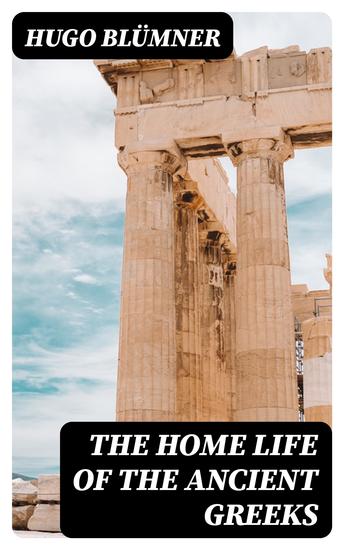
The Home Life of the Ancient Greeks - cover

The Home Life of the Ancient Greeks

Hugo Blümner

Traducteur Alice Zimmern

Maison d'édition: DigiCat

  • 0
  • 0
  • 0

Synopsis

In "The Home Life of the Ancient Greeks," Hugo Blümner meticulously explores the domestic sphere of ancient Greek society, providing readers with an insightful look into the everyday lives of its inhabitants. Blümner's literary style is both accessible and informative, employing descriptive precision and scholarly rigor that engages both general readers and those with a deeper interest in classical studies. He delves into aspects such as architecture, family dynamics, and social customs, placing them within the broader historical context of Greek civilization and illuminating the values that shaped their existence. Hugo Blümner, a distinguished philologist and archaeologist, dedicated his career to understanding the nuances of ancient cultures. His extensive travels and research in Greece and Romani territories provided him with a unique perspective on the practical realities of ancient life, undoubtedly influencing his desire to document and share this knowledge. Blümner's background in philology allowed him to draw from a wealth of primary sources, enriching his exploration of the Athenian home and its significance in the larger tapestry of Greek society. This book is an essential read for anyone interested in classical antiquity, as it offers a nuanced portrayal of an often-overlooked aspect of Greek heritage. Those seeking to understand the social fabric and daily practices of ancient Greeks will find Blümner's work invaluable, enhancing their appreciation of this foundational civilization.
Disponible depuis: 13/06/2022.
Longueur d'impression: 446 pages.

D'autres livres qui pourraient vous intéresser

  • Time to Thank - Caregiving for My Hero - cover

    Time to Thank - Caregiving for...

    Steve Guttenberg

    • 0
    • 0
    • 0
    Since moving to Hollywood at age seventeen, Steve Guttenberg has delighted and moved audiences with his film and television work. But when his father is diagnosed with kidney failure, Steve has to step into a new and wholly unexpected role: caretaker. In Time to Thank, Steve tracks his weekly road trips from Los Angeles to Arizona to care for his father and the ways in which his time on the road affords him the perspective to reflect on his life. 


    Through the prism of his relationship with his father, Steve recounts his early life in Queens and Long Island; his early career as a rising Hollywood star, trying to find his way with the encouragement of his parents; and the painful and moving work of helping care for an ailing family member at the end of their life. From glamorous Hollywood parties and film sets around the world to the daily process of dialysis in suburban Phoenix, Steve offers his wit, empathy, and signature charm. 


    This is a book for movie fans, road trip junkies, and anyone who finds themselves doing the hard work of caring for an aging loved one. Steve Guttenberg serves as a uniquely perceptive guide through all these phases of life, with a story that is certain to touch listeners and make sure they know that they're not alone.
    Voir livre
  • The Greek Famine of World War II - The Struggle for Survival - cover

    The Greek Famine of World War II...

    Sarah Willards

    • 0
    • 0
    • 0
    In the autumn of 1940, Greece found itself thrust into the chaos of World War II when Italian forces, under the command of Benito Mussolini, launched an invasion from Albania. Despite being outnumbered and under-equipped, Greek forces mounted a formidable defense, pushing the Italians back and even advancing into Albanian territory. This unexpected success humiliated Mussolini and prompted Adolf Hitler to intervene, leading to a swift German invasion in April 1941. Within weeks, Greece had fallen under Axis control, divided between Germany, Italy, and Bulgaria. 
    The occupation marked the beginning of a dark chapter in Greek history. The country was strategically important, but the Axis powers showed little interest in the welfare of the population. The division of the territory resulted in inconsistent governance and exploitation. The Germans controlled key cities and transportation networks, while the Italians managed the majority of the countryside. Bulgaria, seeking territorial expansion, aggressively imposed policies of assimilation in northern regions. Each occupying force pursued its own interests, often at the expense of the Greek people. 
    From the earliest days of occupation, the signs of impending crisis were clear. The agricultural economy, already fragile, was disrupted by war and commandeered by the Axis to support their military campaigns. Transportation networks were dismantled or redirected to serve occupying forces, cutting off essential supply chains. Coastal blockades, imposed by the British to weaken the Axis, unintentionally contributed to the strangulation of Greek imports, especially food. The result was a country teetering on the edge of economic and social collapse.
    Voir livre
  • Daily Life in Rome - A Social and Cultural History - cover

    Daily Life in Rome - A Social...

    Rogan Fish

    • 0
    • 0
    • 0
    The foundation of Roman society was built upon a complex hierarchy that influenced daily life, social interactions, and political structures. At its core, the Roman family served as the most fundamental unit, shaping personal identity, social standing, and economic stability. The paterfamilias, or male head of the household, wielded significant authority over his family, including his wife, children, and even enslaved individuals. Roman families emphasized duty, tradition, and respect for elders, with ancestral lineage playing a crucial role in societal reputation. Women, while largely confined to domestic roles, could exert influence within the household and, in some cases, in business affairs. Marriage alliances were also instrumental in forging political and social ties, reinforcing the interconnected nature of Roman society. 
    Beyond the family, Roman society was stratified into distinct classes, each with its own privileges and restrictions. At the top were the patricians, an elite group of aristocratic families who traditionally held political power. Their wealth and influence allowed them to dominate the Senate and other governing bodies. Below them were the plebeians, a broad class of commoners that included farmers, artisans, and merchants. Although they had fewer political rights in the early Republic, the plebeians gradually gained influence through social and political struggles, such as the Conflict of the Orders. The lowest tier of society consisted of enslaved individuals and freedmen. Slaves were often prisoners of war or those born into servitude, playing essential roles in both households and large-scale economic activities. Freedmen, formerly enslaved individuals who had gained their freedom, occupied an intermediate status, often working as skilled laborers or entrepreneurs while still facing social limitations.
    Voir livre
  • Ethics of Redistribution The: Book Summary & Analysis - cover

    Ethics of Redistribution The:...

    Briefly Summaries

    • 0
    • 0
    • 0
    This is a concise summary and analysis of The Ethics of Redistribution, by 
    Bertrand de Jouvenel.
     
    It is not the original book and is not affiliated with or endorsed by Bertrand de Jouvenel.
    Ideal those seeking a quick and insightful overview.
     
    In The Ethics of Redistribution, the author delves into the philosophical and economic implications of wealth redistribution, challenging commonly held assumptions about equality and social justice. The book explores the ethical boundaries of government intervention in economic systems, questioning whether redistributive policies truly benefit society or hinder individual freedoms and innovation. Through incisive arguments and historical examples, this work provides a thought-provoking critique of the role of the state in shaping economic fairness, making it an essential read for anyone interested in political philosophy, economics, or public policy.
    Voir livre
  • Summary of Confronting Evil - Assessing the Worst of the Worst - cover

    Summary of Confronting Evil -...

    Fortune Press

    • 0
    • 0
    • 0
    Book Summary: Confronting Evil by Bill O’Reilly and Josh Hammer 
     Assessing the Worst of the Worst 
    What drives human beings to commit acts of unspeakable cruelty—and what separates those who resist evil from those who enable it? In Confronting Evil, Bill O’Reilly and Josh Hammer examine history’s darkest figures to reveal the moral choices that define humanity’s ongoing battle between good and evil. 
    This summary explores the key ideas and insights behind O’Reilly and Hammer’s chilling yet thought-provoking analysis of tyrants, conquerors, and criminals—from Genghis Khan and Caligula to Hitler, Stalin, and modern-day despots. Through their stories, the book sheds light on the psychology of power, corruption, and the devastating cost of moral indifference. 
    With clarity and depth, this companion guide distills the authors’ central message: evil persists not only because of those who commit it, but because too many good people look away. 
    Disclaimer: This is an unofficial summary and analysis of Confronting Evil by Bill O’Reilly and Josh Hammer. It is intended to provide educational value and enhance understanding of the original work.
    Voir livre
  • A Question of Standing - The History of the CIA - cover

    A Question of Standing - The...

    Rhodri Jeffreys-Jones

    • 0
    • 0
    • 0
    The mission of the CIA has always been intelligence. Seventy-five years ago, in the year of its creation, the National Security Act gave the agency, uniquely in world history up to that point, a democratic mandate to pursue that mission of intelligence. It gave the CIA a special standing in the conduct of United States foreign relations. That standing diminished when successive American presidents ordered the CIA to exceed its original mission. When they tasked the agency secretly to overthrow democratic governments, the United States lost its international standing, and its command of a majority in the United Nations General Assembly. Such dubious operations, even the government's embrace of assassination and torture, did not diminish the standing of the CIA in United States public opinion. However, domestic interventions did. CIA spying on domestic protesters led to tighter congressional oversight from the 1970s on. 


    A Question of Standing offers a balanced narrative and perspective on recognizable episodes in the CIA's history. Famous incidents include the Bay of Pigs invasion, the War on Terror, 9/11, the weapons of mass destruction deception, the Iran estimate of 2007, the assassination of Osama bin Laden, and Fake News. The book also defends the CIA's exposure of foreign meddling in United States elections.
    Voir livre