Begleiten Sie uns auf eine literarische Weltreise!
Buch zum Bücherregal hinzufügen
Grey
Einen neuen Kommentar schreiben Default profile 50px
Grey
Jetzt das ganze Buch im Abo oder die ersten Seiten gratis lesen!
All characters reduced
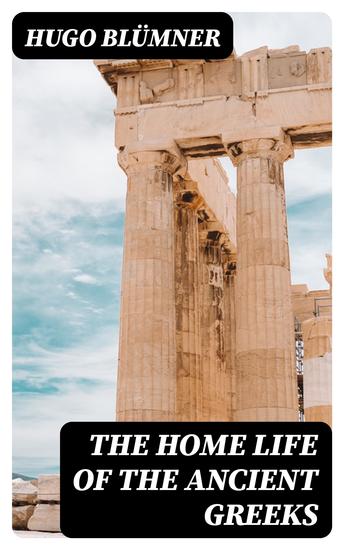
The Home Life of the Ancient Greeks - cover

The Home Life of the Ancient Greeks

Hugo Blümner

Übersetzer Alice Zimmern

Verlag: DigiCat

  • 0
  • 0
  • 0

Beschreibung

In "The Home Life of the Ancient Greeks," Hugo Blümner meticulously explores the domestic sphere of ancient Greek society, providing readers with an insightful look into the everyday lives of its inhabitants. Blümner's literary style is both accessible and informative, employing descriptive precision and scholarly rigor that engages both general readers and those with a deeper interest in classical studies. He delves into aspects such as architecture, family dynamics, and social customs, placing them within the broader historical context of Greek civilization and illuminating the values that shaped their existence. Hugo Blümner, a distinguished philologist and archaeologist, dedicated his career to understanding the nuances of ancient cultures. His extensive travels and research in Greece and Romani territories provided him with a unique perspective on the practical realities of ancient life, undoubtedly influencing his desire to document and share this knowledge. Blümner's background in philology allowed him to draw from a wealth of primary sources, enriching his exploration of the Athenian home and its significance in the larger tapestry of Greek society. This book is an essential read for anyone interested in classical antiquity, as it offers a nuanced portrayal of an often-overlooked aspect of Greek heritage. Those seeking to understand the social fabric and daily practices of ancient Greeks will find Blümner's work invaluable, enhancing their appreciation of this foundational civilization.
Verfügbar seit: 13.06.2022.
Drucklänge: 446 Seiten.

Weitere Bücher, die Sie mögen werden

  • Squanto - A Native Odyssey - cover

    Squanto - A Native Odyssey

    Andrew Lipman

    • 0
    • 0
    • 0
    Taken to Europe as a slave, he found his way home and changed the course of American history 


    American schoolchildren have long learned about Squanto, the welcoming Native who made the First Thanksgiving possible, but his story goes deeper than the holiday legend. Born in the Wampanoag-speaking town of Patuxet in the late 1500s, Squanto was kidnapped in 1614 by an English captain, who took him to Spain. From there, Englishmen brought him to London and Newfoundland before sending him home in 1619, when Squanto discovered that most of Patuxet had died in an epidemic. A year later, the Mayflower colonists arrived at his home and renamed it Plymouth. 


    Prize-winning historian Andrew Lipman explores the mysteries that still surround Squanto: How did he escape bondage and return home? Why did he help the English after an Englishman enslaved him? Why did he threaten Plymouth's fragile peace with its neighbors? Was it true that he converted to Christianity on his deathbed? Drawing from a wide range of evidence and newly uncovered sources, Lipman reconstructs Squanto's upbringing, his transatlantic odyssey, his career as an interpreter, his surprising downfall, and his enigmatic death. The result is a fresh look at an epic life that ended right when many Americans think their story begins.
    Zum Buch
  • The Role of the Nile River in Ancient Egyptian Civilization - cover

    The Role of the Nile River in...

    Omar Khalil

    • 0
    • 0
    • 0
    The Nile River was more than just a water source for the ancient Egyptians; it was the very foundation upon which their civilization thrived. Stretching over 4,000 miles, the river provided sustenance, enabled agriculture, and shaped daily life in profound ways. Without the Nile, the flourishing civilization that we now associate with ancient Egypt would have been impossible. 
    The river’s importance was most evident in its role as a source of life. Flowing from the heart of Africa to the Mediterranean Sea, the Nile brought fertile silt during its annual inundation. This natural event transformed the arid desert landscape into a lush and arable strip of land, ideal for farming. The nutrient-rich soil deposited by the flooding allowed ancient Egyptians to grow crops like wheat, barley, and flax, which were essential for food, trade, and textile production. This dependable agricultural cycle fostered stability, reducing the risks of famine and ensuring food security for the population. 
    The river also played a crucial role in sustaining both humans and animals. Its waters provided drinking sources not only for the people but also for livestock, which were integral to agricultural practices. Additionally, the Nile supported a wide variety of fish and attracted wildlife to its banks, allowing ancient Egyptians to develop fishing and hunting practices that supplemented their diet. Daily life revolved around the river, as it supplied the necessary resources for cooking, cleaning, and irrigation.
    Zum Buch
  • Imperial Rome - From Augustus to the Fall - cover

    Imperial Rome - From Augustus to...

    Rogan Fish

    • 0
    • 0
    • 0
    The fall of the Roman Republic in the late first century BCE paved the way for a new era, one defined by the leadership of a single man: Augustus. Born Gaius Octavius, he emerged as the heir of Julius Caesar and transformed Rome from a state of political turmoil into a stable empire. His rise to power was marked by strategic alliances, military victories, and significant political reforms that laid the foundation for imperial rule. 
    The aftermath of the Republic’s collapse saw Rome in chaos. The assassination of Julius Caesar in 44 BCE triggered a power struggle between his supporters and those who sought to restore the old Republic. Octavian, as he was then known, capitalized on his status as Caesar’s adopted son and formed the Second Triumvirate with Mark Antony and Marcus Lepidus. Together, they pursued and defeated Caesar’s assassins, Brutus and Cassius, at the Battle of Philippi in 42 BCE. However, tensions among the triumvirs soon escalated. Lepidus was forced into retirement, and Octavian turned against Antony, who had allied himself with Cleopatra of Egypt. Their rivalry culminated in the Battle of Actium in 31 BCE, where Octavian’s naval forces decisively defeated Antony and Cleopatra, leading to their eventual suicides. With no remaining challengers, Octavian stood as the unopposed ruler of Rome. 
    Rather than seizing power as a dictator, Octavian carefully crafted his authority to appear as a restoration of Republican values. In 27 BCE, he formally returned power to the Senate, a move that won him widespread support and the honorary title "Augustus." However, this gesture was largely symbolic, as he retained control over the military and key provinces. His governance established the principate, a system in which the emperor ruled under the guise of republican traditions while holding ultimate authority.
    Zum Buch
  • Democracy and Its Critics: Book Summary & Analysis - cover

    Democracy and Its Critics: Book...

    Briefly Summaries

    • 0
    • 0
    • 0
    This is a concise summary and analysis of Democracy and Its Critics, by Robert A. Dahl.
     
    It is not the original book and is not affiliated with or endorsed by Robert A. Dahl.
    Ideal those seeking a quick and insightful overview.
     
    This insightful book examines the strengths and challenges of democracy, offering a comprehensive analysis of democratic theory and practice. It explores the philosophical foundations of democracy, its historical development, and its practical implications in contemporary politics. The book critically evaluates competing views of democracy, addressing both its achievements and shortcomings, and provides a framework for understanding how democracy can be strengthened in the face of modern challenges such as inequality, populism, and globalization. A compelling read for anyone interested in political theory, governance, and the future of democratic institutions.
    Zum Buch
  • Women Intersectionality & Europe - Exploring lived realities and the path to gender equality - cover

    Women Intersectionality & Europe...

    Tamara Makoni

    • 0
    • 0
    • 0
    How does identity shape the lives of women in Europe today? And what steps can we take to empower all women and thus achieve true gender equality? 
    Women, Intersectionality & Europe offers a clear and insightful look at what it means to be a woman in 21st century Europe. It brings together academic research, personal stories and case studies from across the continent to explore how women live, the unique challenges that they face, and how we can use this understanding to create a more inclusive future. It will engage your curiosity, deepen your awareness and inspire you to imagine a fairer, more equal future. 
    About the author 
    Tamara Makoni is an inclusion and culture specialist who in 2024 was named one of Europe's leading voices on diversity, equity and inclusion. She works extensively on inclusive community building, intersectionality and gender equality, and her thought leadership has been featured by several leading publications.
    Zum Buch
  • Vietnam Combat - Firefights and Writing History - cover

    Vietnam Combat - Firefights and...

    Robin Bartlett

    • 0
    • 0
    • 0
    The year 1968 was arguably the most significant year of the war. It was the height of the American involvement, and because officer casualties had been so great after the Tet Offensive of January 1968, all prior officer assignments were canceled. 


    1st Lieutenant Robin Bartlett suddenly found himself at the "repo-depo" in Bien Hoa reassigned to the 1st Cavalry Division. The unit had more helicopter support than any other unit in Vietnam. Immediate support from artillery, helicopter gunships, and ARA was only minutes away to support a firefight. Wounded troops could be medevaced even in dense jungle using "jungle penetrators." It also meant that Bartlett's platoon could deploy through helicopter combat assaults into hot LZs (landing zones) at a moment's notice if an enemy force had been spotted. And they did. 


    It was with extreme anxiety that Bartlett made his way to join his battalion and company—it was the worst of times to be a platoon leader in Vietnam. Bartlett also had to cope with personal issues of commitment to a war that was rapidly losing support not only back home but among the soldiers he was leading. Fifty years later, Bartlett's vivid combat experiences are brought to light in a fast-moving, well-written, first-person narrative expressing the horror, fear, anguish, and sometimes illogical humor of that war.
    Zum Buch