¡Acompáñanos a viajar por el mundo de los libros!
Añadir este libro a la estantería
Grey
Escribe un nuevo comentario Default profile 50px
Grey
Suscríbete para leer el libro completo o lee las primeras páginas gratis.
All characters reduced
The Unknown Masterpiece - cover

The Unknown Masterpiece

Honoré de Balzac

Editorial: CLXBX

  • 0
  • 0
  • 0

Sinopsis

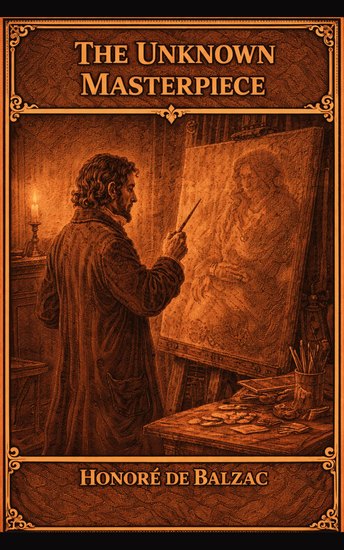
The Unknown Masterpiece by Honoré de Balzac is a profound and visionary novella that explores the consuming nature of artistic genius and the perilous pursuit of perfection. First published in 1831 and later incorporated into La Comédie Humaine, this remarkable work has fascinated readers, writers, and artists for generations with its penetrating insight into creativity, obsession, and the fragile boundary between brilliance and madness.

Set in 17th-century Paris, the story revolves around three painters whose lives intersect in a tense and revealing encounter. The young and ambitious Nicolas Poussin seeks recognition and guidance in the competitive world of art. He is introduced to the renowned yet enigmatic master Frenhofer, a reclusive genius who has spent years working in secret on what he believes will be the ultimate painting—a flawless representation of life itself.

Frenhofer speaks passionately about capturing not merely the outward appearance of his subject, but the very essence of reality. For him, true art transcends imitation; it must embody breath, spirit, and movement. Yet as he tirelessly refines his canvas, layering detail upon detail, his masterpiece remains unseen by the world.

When at last the hidden work is revealed, the outcome is both shocking and tragic. What Frenhofer perceives as perfection appears to others as incomprehensible chaos. The contrast between the artist's vision and external judgment exposes the isolation that often accompanies creative ambition. Balzac raises haunting questions: Is genius always understood? Can the pursuit of absolute perfection destroy the very beauty it seeks to create?

Through concise yet richly philosophical prose, Balzac examines the psychology of creation. He portrays the artist as both visionary and vulnerable, driven by an internal standard that may be unreachable. The novella also explores themes of rivalry, mentorship, and the tension between innovation and tradition in the artistic world.

The Unknown Masterpiece has resonated far beyond its era, influencing modernist and avant-garde thinkers who recognized in Frenhofer's struggle a reflection of their own artistic dilemmas. The story anticipates debates about abstraction, realism, and the limits of representation, making it strikingly ahead of its time.

Intense, reflective, and intellectually compelling, The Unknown Masterpiece stands as one of Balzac's most enduring explorations of the creative spirit. It is a timeless meditation on art, ambition, and the price of striving for the unattainable—a haunting reminder that genius, in its highest form, can be both sublime and solitary.
Disponible desde: 18/02/2026.
Longitud de impresión: 37 páginas.


Otros libros que te pueden interesar

  • My Ride with Nautilus MC Danmark - cover

    My Ride with Nautilus MC Danmark

    Max Ølsted

    • 0
    • 0
    • 0
    This isn’t a story about outlaws. Not the kind you’ve seen on screen, anyway. There are no shootouts, no staged rebellions, no romanticized lawlessness. If you’re looking for that, you won’t find it here. What you will find is a ledger. A record of early mornings, cold engines, quiet tests, and the slow, unglamorous work of earning a place in a room that doesn’t need you until you prove it does. 
    Nautilus MC Danmark was founded in 1981. Not as a statement. Not as a spectacle. As a response. Men who built things with their hands were watching those things disappear. Roads were getting faster. Rules were getting tighter. And a lot of us were left with empty weekends, quiet houses, and the realization that no one was going to hand us back our purpose. So we built our own. Not outside the law. Outside the committee. The 1% patch never meant chaos. It meant autonomy. It meant refusing to ride by someone else’s schedule, answer to someone else’s consensus, or pretend that convenience is loyalty. That’s all it ever meant. And it’s all it still means. 
    I walked into their space in 2010. Fifty-five years old. Newly divorced. Calendar full of weekends I didn’t know how to fill. I thought I was looking for riding partners. For cold beer. For men who’d laugh at my bad jokes and let me pretend I still belonged to something loud and alive. I was wrong about almost all of it. But I was wrong in the right way. 
    This book is about that process. Not the myth. The work. It’s about the difference between wanting to belong and being willing to pay for it. It’s about learning that brotherhood isn’t a social club. It’s a contract. Signed in sweat. Sealed with discipline. Paid in missed dinners, stiff joints, quiet sacrifices, and the hard understanding that the patch on your back isn’t armor. It’s accountability.
    Ver libro
  • Taken by Three Bodyguards - cover

    Taken by Three Bodyguards

    Jasmine Black

    • 0
    • 0
    • 0
    Twenty-one-year-old Stephanie Stephenson has been in a safehouse with her three sexy bodyguards for many months. She’s a lone witness to a murder and they’ve been protecting her from Santonio, the mob boss, who has vowed revenge if she dared to testify. It’s all been strictly professional and platonic with her hunky bodyguards. Now the trial is over and Stephanie is free to go. 
     But her three bodyguards have other plans for Stephanie…very naughty plans.
    Ver libro
  • Better Dead - From their pens to your ears genius in every story - cover

    Better Dead - From their pens to...

    J M Barrie

    • 0
    • 0
    • 0
    Sir James Matthew Barrie, 1st Baronet, OM, was born in Kirriemuir, Angus on 9th May, 1860.  
    Barrie knew from an early age that he wished to be an author. His family wished otherwise. The compromise was that he would attend university to study literature at the University of Edinburgh. He graduated with an M.A. in April, 1882. 
    His first job was as a staff journalist for the Nottingham Journal. The London editor of the St. James's Gazette "liked that Scotch thing" in Barrie’s work and he wrote several stories for them and later several novels based on his mother’s early life.  
    Barrie though was increasingly drawn to working in the theatre.  His first plays achieved little attention but in 1901 and 1902, Barrie had back-to-back theatre successes with Quality Street and The Admirable Crichton. 
    The character of ‘Peter Pan’ first appeared in The Little White Bird in 1902. This most famous and enduring of his works; Peter Pan, or The Boy Who Wouldn't Grow Up had its first stage performance on December 27th, 1904.  
    Peter Pan would overshadow all his other works.  But his short stories cannot be overlooked.  Indeed, from today’s vantage point they are excellent gems of social manners, of class and the way characters, sometimes in the most mundane of circumstances, react in the most surprising of ways.
    Ver libro
  • The Legend of Sleepy Hollow - The iconic gothic tale of the headless horseman that is still widely known today despite being written over 200 years ago - cover

    The Legend of Sleepy Hollow -...

    Ambrose Bierce

    • 0
    • 0
    • 0
    Washington Irving was born on 3rd April, 1783, the youngest of 11, in New York. 
      
    Irving found his real interests away from school in literature and the theatre.  An outbreak of yellow fever at 15 moved him away from Manhattan and into the surrounding countryside providing valuable settings for later works such as ‘The Legend of Sleepy Hollow’. 
     
    By 19 Irving was writing regularly to the New York Morning Chronicle, commenting on the theatrical and social scenes.  When his health began to fail, he was sent on the Grand Tour of Europe.  Bizarrely he ignored most of the great sights on offer to concentrate on developing his social and conversational powers.  His health, though, did improve.  
     
    In 1806, back in New York to study law, he scraped a pass at the bar and then founded with several others the literary magazine Salmagundi. Irving nicknamed the city ‘Gotham City’, a name still in use today.  Moderately successful, the magazine spread Irving’s reputation beyond New York. 
     
    In 1809 while mourning the death of his teenage fiancée Irving finished his first significant book, ‘A History of New-York from the Beginning of the World to the End of the Dutch Dynsasty, by Diedrich Knickerbocker’.  It satirised local history, local historians and politics.  It received great critical acclaim. 
     
    Unfortunately his family’s established trading company was now facing great upheavals and Irving was dispatched to England to try to sort it out.  After two years he could see no way out but bankruptcy.  This left him in England with no real employment prospects, and so he returned to writing.  
     
    He sent some short stories back to New York to be published as ‘The Sketch Book of Geoffrey Crayon, Gent’.  The first part included ‘Rip Van Winkle’ and was extremely successful.  The sixth part contained ‘The Legend of Sleepy Hollow’.  
     
    Beset by literary piracy, with no copyright law at the time, he set about publishing legitimate copies in England to outwit the bootleggers.  From now on Irving published concurrently in America and England in order to render piracy obsolete.  
     
    In August 1824, he published ‘Tales of a Traveller’, which included the famed ‘The Devil and Tom Walker’.  
     
    In 1826, the American Minister to Spain, invited him to Madrid where he could examine the many historical documents that he had access to.  Irving reveled in both the size of the libraries he was granted access to and their rich quality.  Historical works flowed from his pen further enhancing his reputation and fortune.   
     
    Following the completion of ‘Tales of the Alhambra’ in 1832, Irving returned to America after 17 years abroad. He was now a figurehead of American literature and dispensed advice to Edgar Allan Poe amongst others.  Irving also became an advocate for American copyright legislation.  
     
    A later appointment as Minister to Spain in 1842 left him disheartened at the antics of the various political factions he encountered.  It also afforded him no time to write as he had hoped.  
     
    On his return home he began an ‘Author’s Revised Edition’ of his works agreeing an unprecedented deal for 12 per cent of the retail profits.  
     
    Washington Irving died of a heart attack at his ‘Sunnyside’ home on the 28th November 1859 at the age of 76, a few months after completing his five volume George Washington biography, in whose honour he had been named.  
     
    ‘The Legend of Sleepy Hollow’ is a story almost everyone has encountered.  An enormous success at the time it is now an undeniable American Spooky classic.
    Ver libro
  • The Life & Adventures of Robinson Crusoe - cover

    The Life & Adventures of...

    Daniel Defoe

    • 0
    • 0
    • 0
    This audiobook is narrated by an AI Voice. "The Life & Adventures of Robinson Crusoe" is widely considered to be a literary classic, and is one of the earliest and most influential early works in English literature.  
     
    It is the tale of a castaway who spends nearly three decades on a remote tropical island near Trinidad.  This is a story of survival, solitude and self-reliance as Robinson Crusoe struggles to stay alive on an isolated island on which he's been shipwrecked as the sole survivor. 
     
    Robinson Crusoe launched the genre of realistic fiction and remains enduring to this day with its themes of adventure, faith and resilience of the human spirit when facing what seems to be insurmountable challenges.
    Ver libro
  • The Stolen Bachilus - From their pens to your ears genius in every story - cover

    The Stolen Bachilus - From their...

    H G Wells

    • 0
    • 0
    • 0
    Herbert George Wells was born on September 21st, 1866 at Atlas House, 46 High Street, Bromley, Kent. He was the youngest of four siblings and his family affectionately knew him as ‘Bertie’.  
    The first few years of his childhood were spent fairly quietly, and Wells didn’t display much literary interest until, in 1874, he accidentally broke his leg and was left to recover in bed, largely entertained by the library books his father regularly brought him. Through these Wells found he could escape the boredom and misery of his bed and convalescence by exploring the new worlds he encountered in these books.  
    From these humble beginnings began a career that was, after several delays, to be seen as one of the most brilliant of modern English writers.    
    Able to write comfortably in a number of genres he was especially applauded for his science fiction works such as The Time Machine and War of the Worlds but his forays into the social conditions of the times, with classics such as Kipps, were almost as commercially successful.  His short stories are miniature masterpieces many of which bring new and incredible ideas of science fiction to the edge of present day science fact.  Wells also received four nominations for the Nobel Prize in Literature 
    Despite a strong and lasting second marriage his affairs with other women also brought the complications of fathering other children.  His writings and work against fascism, as well as the promotion of socialism, brought him into increasing doubts with and opposition to religion.  His writings on what the world could be in works, such as A Modern Utopia, are thought provoking as well as being plausible, especially when viewed from the distressing times they were written in. 
    His diabetic condition pushed him to create what is now the largest Diabetes charity in the United Kingdom.  Wells even found the time to run twice for Parliament. 
    It was a long, distinguished and powerfully successful career by the time he died, aged 79, on August 13th, 1946.
    Ver libro