Unisciti a noi in un viaggio nel mondo dei libri!
Aggiungi questo libro allo scaffale
Grey
Scrivi un nuovo commento Default profile 50px
Grey
Iscriviti per leggere l'intero libro o leggi le prime pagine gratuitamente!
All characters reduced
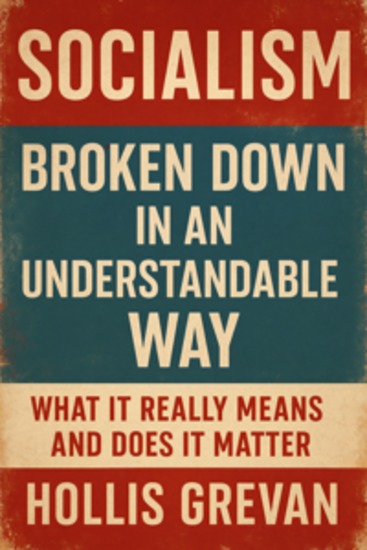
Socialism Broken Down In An Understandable Way - What It Really Means and Does It Matter - cover

Socialism Broken Down In An Understandable Way - What It Really Means and Does It Matter

Hollis Grevan

Casa editrice: SD

  • 0
  • 0
  • 0

Sinossi

In a world overflowing with arguments but starved for understanding, this book offers something rare—clarity. It takes one of the most debated and misunderstood ideas in modern history and breaks it down into plain, everyday language. Without slogans, extremes, or academic jargon, it explores how different societies have wrestled with questions of fairness, freedom, and the role of government.Through clear storytelling and thoughtful explanation, it traces how ideas about shared prosperity, equality, and power have evolved—from their early roots to today’s political and cultural battles. It looks at why these debates ignite such strong emotions, what history can teach us about success and failure, and how modern nations continue to blend competing philosophies in practical ways.Instead of trying to convince readers of one side, it invites them to think critically, ask questions, and see beyond political labels. It challenges the reader to move past the noise of partisanship and rediscover the role of common sense, curiosity, and empathy in civic life.This is not a book about taking sides—it’s about understanding them. For anyone tired of shouting matches and ready for honest, balanced conversation about how societies work, this is a guide to clearer thinking in confusing times.
Disponibile da: 09/01/2026.
Lunghezza di stampa: 190 pagine.

Altri libri che potrebbero interessarti

  • The Grammar of Self - Collected Poems 2000-2023 - cover

    The Grammar of Self - Collected...

    George Watt

    • 0
    • 0
    • 0
    In THE GRAMMAR OF SELF, George Watt presents a lifetime of memories, which seemingly move at random from decade to decade, from continent to continent, from cosmos to microcosm. It does have one central goal: to look at poetry as an attempt towards objectification of aspects of personal identity, as a means through which the self may be confronted, challenged and celebrated. But the volume of verse does more than that as it subscribes to a notion from Thomas Szasz about the self: it is “not something that one finds. It is something that one creates.” (T.S. Szasz, The Second Sin (New York: Anchor Press, 1973, p. 49.) This volume accepts that the poetic text, or multiples thereof, is one means through which a self finds articulation. This articulation is open-ended, chaotic, composed of innumerable experiential fragments that come from deed, time, place and person. The self in this volume is composed of psychic jigsaw pieces (single poems) each of which assert their right to placement, but which will never collate into a perfect picture. This volume of poetry is a collection of many of these pieces, which together present an incomplete movement towards Szaszian self-creation.
    Mostra libro
  • Fishes Insects Animals Reptiles and Birds - cover

    Fishes Insects Animals Reptiles...

    Manly Palmer Hall

    • 0
    • 0
    • 0
    The creatures inhabiting the water, air, and earth were held in veneration by all races of antiquity. Realizing that visible bodies are only symbols of invisible forces, the ancients worshiped the Divine Power through the lower kingdoms of Nature, because those less evolved and more simply constituted creatures responded most readily to the creative impulses of the gods. The sages of old studied living things to a point of realization that God is most perfectly understood through a knowledge of His supreme handiwork--animate and inanimate Nature. 
    Every existing creature manifests some aspect of the intelligence or power of the Eternal One, who can never be known save through a study and appreciation of His numbered but inconceivable parts. When a creature is chosen, therefore, to symbolize to the concrete human mind some concealed abstract principle it is because its characteristics demonstrate this invisible principle in visible action. Fishes, insects, animals, reptiles, and birds appear in the religious symbolism of nearly all nations, because the forms and habits of these creatures and the media in which they exist closely relate them to the various generative and germinative powers of Nature, which were considered as prima-facie evidence of divine omnipresence.
    Mostra libro
  • Beyond the Darkness - A Gentle Guide for Living with Grief and Thriving After Loss - cover

    Beyond the Darkness - A Gentle...

    Clarissa Moll

    • 0
    • 0
    • 0
    Sorrow is a dark and painful road. You don’t need to walk it alone.The Bible says that “God is near to the brokenhearted,” but what does that look like when you’re lost in the darkness of agonizing grief? How do you engage with your sorrow when the world tells you to shoulder through or move on?Award-winning writer and podcaster Clarissa Moll knows this landscape of loss all too well. Her life changed forever in 2019 when her husband, Rob, died unexpectedly while hiking―leaving her with four children to raise alone. In her debut book, Beyond the Darkness, Clarissa offers her powerful personal narrative as well as honest, practical wisdom that will gently guide you toward flourishing amidst your own loss.In the pages of Beyond the Darkness, you’ll learn how tomeet and engage with loss in your everyday life,uncover the lies the world has told you about your grief, andpoint your feet toward hope and find a way to navigate your new life with loss and God beside you.Whether you’ve lost someone dear to you or you’re supporting a loved one as they mourn, you can learn to walk with grief. And as you do, you might be surprised to discover the path is wide enough for another companion, the Good Shepherd of your soul. Grief may walk with us for the rest of our lives, but Jesus will too.
    Mostra libro
  • The Rivalry Peril - How Great-Power Competition Threatens Peace and Weakens Democracy - cover

    The Rivalry Peril - How...

    Van Jackson, Michael Brenes

    • 0
    • 0
    • 0
    How the US policy of competition with China is detrimental to democracy, peace, and prosperity—and how a saner approach is possible 


    For close to a decade, the US government has been preoccupied with the threat of China, fearing that the country will "eat our lunch," in the words of Joe Biden. The United States has crafted its foreign and domestic policy to help constrain China's military power and economic growth. Van Jackson and Michael Brenes argue that great-power competition with China is misguided and vastly underestimates the costs and risks that geopolitical rivalry poses to economic prosperity, the quality of democracy, and, ultimately, global stability. 


    This in-depth assessment of the trade-offs and pitfalls of protracted competition with China reveals how such a policy exacerbates inequality, leads to xenophobia, and increases the likelihood of violence around the world. In addition, it distracts from the priority of addressing such issues as climate change while at the same time undercutting democratic pluralism and sacrificing liberty in the name of prevailing against an enemy "other." Jackson and Brenes provide an informed and urgent critique of current US foreign policy and a road map toward a saner, more democratically accountable strategy of easing tension and achieving effective diplomacy.
    Mostra libro
  • How to English: Listening and Responding - A Practical Guide to Effective Communication and Thoughtful Interaction - cover

    How to English: Listening and...

    David Tobin

    • 0
    • 0
    • 0
    Master the art of communication through powerful listening. 
    Are you ready to build stronger relationships, boost your professional skills, and connect more deeply with others? How to English: Listening and Responding is your guide to becoming a more attentive, confident, and effective communicator. 
    In today’s fast-paced world, true listening is rare—but it’s also transformative. This audiobook offers clear, practical tools to help you: 
    Overcome common listening mistakes 
    Develop empathy and build trust 
    Navigate difficult conversations with confidence 
    Paraphrase and clarify for better understanding 
    Communicate effectively in both personal and professional settings 
    Practice real-world techniques to strengthen your daily conversations 
    With relatable examples, reflective exercises, and actionable advice, How to English: Listening and Responding empowers you to turn everyday conversations into meaningful connections.
    Mostra libro
  • Start of the Byzantine Empire The: The History of the Eastern Roman Empire’s Establishment as Rome Declined - cover

    Start of the Byzantine Empire...

    Editors Charles River

    • 0
    • 0
    • 0
    It would be hard if not outright impossible to overstate the impact Roman Emperor Constantine I had on the history of Christianity, ancient Rome, and Europe as a whole. Best known as Constantine the Great, the kind of moniker only earned by rulers who have distinguished themselves in battle and conquest, Constantine remains an influential and controversial figure to this day. He achieved enduring fame by being the first Roman emperor to personally convert to Christianity, and for his notorious Edict of Milan, the imperial decree which legalized the worship of Christ and promoted religious freedom throughout the Empire. More than 1500 years after Constantine’s death, Abdu'l-Bahá, the head of the Bahá'í Faith, wrote, “His blessed name shines out across the dawn of history like the morning star, and his rank and fame among the world's noblest and most highly civilized is still on the tongues of Christians of all denominations” 
    	However, it can be argued that despite his military successes – the most notable of which occurred fighting for supremacy against other Romans – Constantine may well have set the stage for the ultimate collapse of the Roman Empire as it had existed up until that point. It was Constantine who first decided that Rome, exposed and vulnerable near the gathering masses of barbarians moving into Germania and Gaul, was a strategically unsafe base for the Empire, and thus expanded the city of New Rome on the Dardanelles straits, creating what eventually became Constantinople. By moving the political, administrative and military capital of the Empire from Rome to the East, as well as the Imperial court with all its attendant followers, Constantine laid the groundwork for the eventual schism which saw the two parts of the Roman Empire become two entirely separate entities, go their own way, and eventually collapse piecemeal under repeated waves of invasion.
    Mostra libro