Rejoignez-nous pour un voyage dans le monde des livres!
Ajouter ce livre à l'électronique
Grey
Ecrivez un nouveau commentaire Default profile 50px
Grey
Abonnez-vous pour lire le livre complet ou lisez les premières pages gratuitement!
All characters reduced
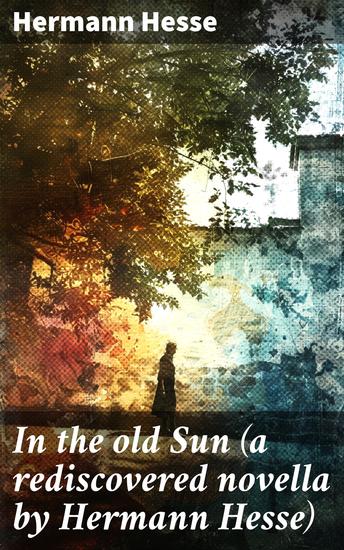
In the old Sun (a rediscovered novella by Hermann Hesse) - Journey of Self-Discovery and Spiritual Enlightenment - cover

In the old Sun (a rediscovered novella by Hermann Hesse) - Journey of Self-Discovery and Spiritual Enlightenment

Hermann Hesse

Maison d'édition: Good Press

  • 0
  • 0
  • 0

Synopsis

In his rediscovered novella, "In the Old Sun," Hermann Hesse artfully weaves a narrative that explores the intersection of nature, spirituality, and the human condition. Written in Hesse'Äôs signature poetic and lyrical prose, the novella delves into themes of existential longing and the quest for inner peace. Set against the backdrop of a pastoral landscape, the protagonist embarks on a journey of self-discovery that resonates deeply within the broader literary tradition of early 20th-century existentialism, reminiscent of Hesse'Äôs celebrated works such as "Siddhartha" and "Steppenwolf." Hermann Hesse, a Nobel laureate in literature, was profoundly influenced by his own experiences with spirituality and the conflict between societal expectations and personal fulfillment. His life was marked by a series of existential inquiries, shaped by his tumultuous upbringing and the climate of change in early modern Europe. These experiences inform the reflective nature of "In the Old Sun," a work that, despite its rediscovery, feels timely and relevant today. This novella is an essential read for those interested in exploring the complexities of the human psyche and the pursuit of enlightenment. Hesse'Äôs evocative language and profound insights make "In the Old Sun" a compelling addition to both his oeuvre and the broader literary canon.
Disponible depuis: 05/12/2023.
Longueur d'impression: 100 pages.
D'autres livres qui pourraient vous intéresser

  • The Time Machine The Lost Manuscript - Stories For Everyone - cover

    The Time Machine The Lost...

    H.G. Wells

    • 0
    • 0
    • 0
    Herbert George Wells was an English writer. Prolific in many genres, he wrote dozens of novels, short stories, and works of social commentary, history, satire, biography, and autobiography. His work also included two books on recreational war games. Wells is now best remembered for his science fiction novels and is often called the "father of science fiction", along with Jules Verne. 
     
    During his own lifetime, however, he was most prominent as a forward-looking, even prophetic social critic who devoted his literary talents to the development of a progressive vision on a global scale. A futurist, he wrote a number of utopian works and foresaw the advent of aircraft, tanks, space travel, nuclear weapons, satellite television, and something resembling the World Wide Web. His science fiction imagined time travel, alien invasion, invisibility, and biological engineering.  
     
    Wells's earliest specialized training was in biology, and his thinking on ethical matters took place in a specifically and fundamentally Darwinian context. He was also an outspoken Socialist from a young age, often (but not always, as at the beginning of the First World War) sympathizing with pacifist views. His later works became increasingly political and didactic, and he wrote little science fiction, while he sometimes indicated on official documents that his profession was that of a journalist. Novels such as Kipps and The History of Mr. Polly, which describe lower-middle-class life, led to the suggestion that he was a worthy successor to Charles Dickens, but Wells described a range of social strata and even attempted a diagnosis of English society as a whole.
    Voir livre
  • A Tale of the Ragged Mountains - cover

    A Tale of the Ragged Mountains

    Edgar Allan Poe

    • 0
    • 0
    • 0
    "A Tale of the Ragged Mountains," published in 1844, is a short story written by Edgar Allan Poe partially based on his experiences while a student at the University of Virginia. Set near Charlottesville, it is the only one of Poe's stories to take place in Virginia. It was first published in 1844. "A Tale of the Ragged Mountains" highlights scientific theories of Poe's day, engages with British imperial history and forecasts contemporary interest in psychoactive drugs, the transmigration of the soul and the dynamics of the doctor-patient relationship.
    Voir livre
  • Country Landlords - cover

    Country Landlords

    L.M. Spooner

    • 0
    • 0
    • 0
    The young lovers Gertrude Fitzhammons and Anarawd Gwynne are caught between their fathers' mutual antagonism. Eventually, Gertrudes' adoptive father, the retired sea captain Ricardo Lewis, is forced to flee Britain due to the machinations of old squire Gwynne and Lewis's mortal enemy, Lord Morlif. At the same time, Anarawd is sent abroad in the hope that he forgets his sweetheart.
    
    
    After several years apart, their separate fates lead them to meet again in Naples during the spring revolutions of 1848. After Lewis's betrayal to his death on the republican barricades, a broken-hearted Gertrude returns to her Welsh home. Will Anarawd follow her or seek his fortune abroad in the British Army?
    
    
    Loosely inspired by social and agricultural advancements in the district around the author's home in Porthmadog, Country Landlords (1860) looks at the relationship between the landed gentry and ordinary country population in the early nineteenth-century.
    
    
    The first republication of this novel since 1860, following on from the successful Honno republication of Spooner's first novel, Gladys of Harlech in 2017.
    
    
    • An informative introduction contextualizes Louisa Matilda Spooner's life and writings.
    
    
    • An example of mid-century novels by female authors from Wales dealing with contemporary issues, such as land improvement, nationalism, and empire.
    
    
    • A social novel in the style of a romance inspired by the villages and landed estates of rural west Wales and their links with the wider world.
    Voir livre
  • After Twenty years - From their pens to your ears genius in every story - cover

    After Twenty years - From their...

    O Henry

    • 0
    • 0
    • 0
    William Sydney Porter was born on 11th September 1862 in Greensboro, North Carolina. At age 3 his mother died from tuberculosis. From an early age it was clear Porter had a large appetite for reading as he absorbed the world around him. 
    He first attended at a school run by his aunt before enrolling at the Lindsey Street High School and then worked at his uncle’s drugstore and gained a pharmacists’ license in 1881.  
    A persistent cough took him to Texas in the hope that a change of climate would help his symptoms. He took on various types of work, initially from ranch hand and cook and then as varied as pharmacist, draftsman, bank teller and journalist. He also began to write, though for now, purely as a hobby. 
    He was a member of several singing and dramatic groups when he met 17 year old Athol Estes, daughter of a wealthy Austin family. Despite her mother’s objection owing to Athol’s tuberculosis, they began courting and in July 1887, they eloped and soon married. 
    Athol, impressed by his writing, encouraged him to get them published. A job as a draftsman at the Texas General Land Office paid a healthy $100 dollars per month and life was good. 
    But then life turned cruel. His son died a few hours after birth although a daughter, Margaret, came the following year.  His job had to be vacated but another was found at the First National Bank of Austin. The bank operated informally and Porter was careless in keeping the books. He lost that job but began writing for the humourous weekly The Rolling Stone and the Houston Post. Some time later the federal Bank auditors went through his former accounts and he was arrested on charges of embezzlement. 
    Porter fled the day before his trial to Honduras. Holed up for several months he began to write.  Athol had become too ill to travel to meet him and learning that her health was deteriorating he surrendered to the court in February 1897.  Bail was obtained so that he could stay with Athol during her final days.  
    Porter was sentenced to five years at the Ohio Penitentiary in Columbus. His pharmacy qualifications got him the job of night druggist.  His sentence also gave him time to write and publish fourteen short stories. In December 1899 in McClure’s Magazine he published a short story as O Henry.  
    He was released two years early in July 1901, and reunited with Margaret, now 11, in Pittsburgh.  He now began his most prolific period of writing; a short story per week for the New York World, while also publishing works in other magazines.  Eventually over 600 of his short stories were published. 
    Porter was a heavy drinker and in 1908 his health, which had deteriorated for several years, took a dramatic turn for the worse, as did his writing. 
    O Henry died of cirrhosis of the liver complicated by diabetes and an enlarged heart on 5th June 1910.<
    Voir livre
  • Waverley Volume 1 - cover

    Waverley Volume 1

    Walter Scott

    • 0
    • 0
    • 0
    "Waverley" by Walter Scott is an enthralling historical novel set during the Jacobite Rebellion in 1745. The protagonist, Edward Waverley, becomes embroiled in the conflict, torn between loyalty to his English roots and his growing affinity for the Highland clans. Scott masterfully captures the political and social turbulence of the time, blending romance, adventure, and historical realism. The novel paints a vivid picture of Scotland's landscapes, traditions, and the clash between two worlds. "Waverley" is a timeless exploration of identity, allegiance, and the impact of historical events on individual lives.
    Voir livre
  • The Horse-Stealers - cover

    The Horse-Stealers

    Anton Chekhov

    • 0
    • 0
    • 0
    The Horse-Stealers - a story by Anton Pavlovich Chekhov. Written in 1890, first published in the magazine "New Time" No. 5061, April 1, 1890, signed Anton Chekhov.
    Voir livre