Join us on a literary world trip!
Add this book to bookshelf
Grey
Write a new comment Default profile 50px
Grey
Subscribe to read the full book or read the first pages for free!
All characters reduced
Moby Dick Or The Whale - cover

Moby Dick Or The Whale

Herman Melville

Publisher: Librorium Editions

  • 0
  • 0
  • 0

Summary

Call me Ishmael. Some years ago—never mind how long precisely—having little or no money in my purse, and nothing particular to interest me on shore, I thought I would sail about a little and see the watery part of the world. It is a way I have of driving off the spleen and regulating the circulation. Whenever I find myself growing grim about the mouth; whenever it is a damp, drizzly November in my soul; whenever I find myself involuntarily pausing before coffin warehouses, and bringing up the rear of every funeral I meet; and especially whenever my hypos get such an upper hand of me, that it requires a strong moral principle to prevent me from deliberately stepping into the street, and methodically knocking people’s hats off—then, I account it high time to get to sea as soon as I can. This is my substitute for pistol and ball. With a philosophical flourish Cato throws himself upon his sword; I quietly take to the ship. There is nothing surprising in this. If they but knew it, almost all men in their degree, some time or other, cherish very nearly the same feelings towards the ocean with me.
Available since: 01/03/2026.

Other books that might interest you

  • The Captain of the Pole Star - cover

    The Captain of the Pole Star

    Arthur Conan Doyle

    • 0
    • 0
    • 0
    Word goes among the crew of the Pole Star that the captain is haunted by demons. And after the days turn into weeks in the frigid Arctic Ocean, stories begin to circulate of ghosts and midnight hauntings.
    Show book
  • When Trying to Return Home - Stories - cover

    When Trying to Return Home -...

    Jennifer Maritza McCauley

    • 0
    • 0
    • 0
    Profoundly moving and powerful, the stories in this collection dig deeply into the question of belonging. A young woman is torn between overwhelming love for her mother and the need to break free from her damaging influence during a desperate and disastrous attempt to rescue her brother from foster care. A man, his wife, and his mistress each confront the borders separating love and hate, obligation and longing, on the eve of a flight to San Juan. A college student grapples with the space between chivalry and machismo in a tense encounter involving a nun. And in 1930s Louisiana, a woman attempting to find a place to call her own chances upon an old friend at a bar and must reckon with her troubled past. Forming a web of desires and consequences that span generations, Jennifer Maritza McCauley’s Black American and Afro–Puerto Rican characters remind us that these voices have always been here, occupying the very center of American life—even if we haven’t always been willing to listen.
    Show book
  • The Hammer of God - A Father Brown Mystery - cover

    The Hammer of God - A Father...

    G.K. Chesterton

    • 0
    • 0
    • 0
    Will Father Brown discover who killed the well-to-do ne’er-do-well? It appears as though he was stricken with the hammer of God. Is that a thing?  
    G.K. Chesterton is most notable for his creation of Father Brown. This unlooked for, and often unwelcome, detective is actually not a detective. But rather, an individual self-trained to think as criminals think, for he has heard so many of their confessions. He knows how their minds work, and can piece together many things that others cannot.  
    This story is from the first collection of Father Brown Stories, The Innocence of Father Brown. 
    Show book
  • Mrs Pierrepoint - From their pens to your ears genius in every story - cover

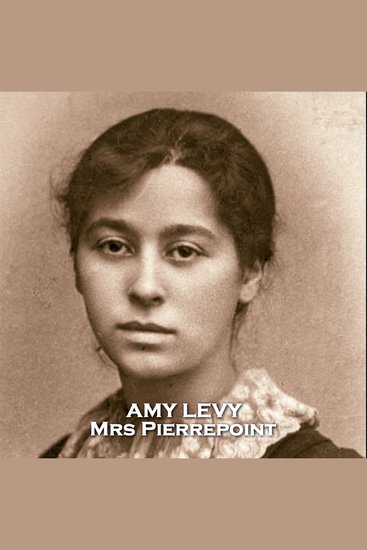
    Mrs Pierrepoint - From their...

    Amy Levy

    • 0
    • 0
    • 0
    Amy Levy was born in London, England in 1861, the second of seven in a fairly wealthy Anglo-Jewish family. The children read and participated in secular literary activities and became firmly integrated into Victorian life. 
    Her education was at Brighton High School, Brighton, before studies at Newnham College, Cambridge; she was the first Jewish student when she arrived in 1879, but left after four terms. 
    Amy’s writing career began early; her poem ‘Ida Grey’ appeared when she was only fourteen. Her acclaimed short stories ‘Cohen of Trinity’ and ‘Wise in Their Generation,’ were published by Oscar Wilde in his magazine ‘Women's World’. 
    Her poetic writings reveal feminist concerns; ‘Xantippe and Other Verses’, from 1881 includes a poem in the voice of Socrates's wife. ‘A Minor Poet and Other Verse’ from 1884 comprises of dramatic monologues and lyric poems. 
    In 1886, Amy began a series of essays on Jewish culture and literature for the Jewish Chronicle, including ‘The Ghetto at Florence’, ‘The Jew in Fiction’, ‘Jewish Humour’ and ‘Jewish Children’. 
    That same year while travelling in Florence she met the writer Vernon Lee. It is generally assumed they fell in love and this inspired the poem ‘To Vernon Lee’. 
    Her first novel ‘Romance of a Shop’, written in 1888 is based on four sisters who experience the pleasures and hardships of running a London business during the 1880s. This was followed by Reuben Sachs (also 1888) and concerned with Jewish identity and mores in the England of her time and was somewhat controversial. 
    Her final book of poems, ‘A London Plane-Tree’ from 1889, shows the beginnings of the influence of French symbolism. 
    Despite many friendships and an active life, Amy suffered for many years with serious depressions and this, together with her growing deafness, led her to commit suicide by inhaling carbon monoxide on September 10th, 1889. She was 27.
    Show book
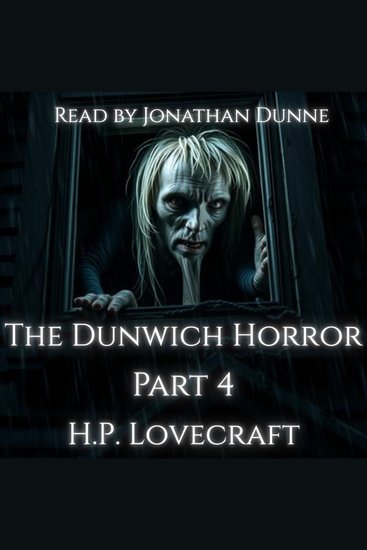
  • The Dunwich Horror — Part 4 of 10 - Timeless Terrors - cover

    The Dunwich Horror — Part 4 of...

    H. P. Lovecraft

    • 0
    • 0
    • 0
    Title: The Dunwich Horror — Part 4 of 10 
    Author: H. P. Lovecraft 
    Narrator: Jonathan Dunne 
    Original Publication: 1929 
    Public Domain: Yes 
    Series Placement: Timeless Terrors No. 62 — Part 4 of 10 
    Description: 
    Welcome to Timeless Terrors No. 62, continuing H. P. Lovecraft’s chilling masterpiece of cosmic dread: The Dunwich Horror. 
    The strange occurrences at the Whateley farmhouse intensify. Wilbur Whateley’s unnatural growth and mysterious abilities are only the beginning, as the unseen presence in the attic grows ever more powerful. Shadows move where they should not, the hills tremble with otherworldly force, and the village whispers of terror spread farther than ever. 
    Locked away with his grandfather, Wilbur nurtures a secret that is too vast, too alien, and too hungry to remain hidden. Every sound, every shadow, hints at the approaching horror, and the villagers’ fear grows alongside the incomprehensible forces at work. 
    Narrated by Amazon-bestselling horror author Jonathan Dunne, this performance brings Lovecraft’s cosmic horror vividly to life, exploring the thin boundary between human reality and ancient, unknowable forces. 
    This is Part 4 of a 10-part complete audiobook. Stay tuned — the nightmare continues.
    Show book
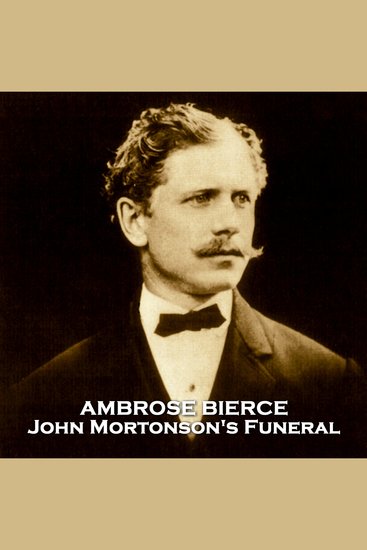
  • John Mortonson's Funeral by Ambrose Bierce - From their pens to your ears genius in every story - cover

    John Mortonson's Funeral by...

    Ambrose Bierce

    • 0
    • 0
    • 0
    Ambrose Gwinnett Bierce was born on 24th June 1842 at Horse Cave Creek in Meigs County, Ohio. His parents were poor but they introduced him to literature at an early age, instilling in him a deep appreciation of books, the written word and the elegance of language.  
    Growing up in Koscuisko County, Indiana poverty and religion were defining features of his childhood, and he would later describe his parents as “unwashed savages” and fanatically religious, showing him little affection but always quick to punish. He came to resent religion, and his introduction to literature appears to be their only positive effect. 
    At age 15 Bierce left home to become a printer’s devil, mixing ink and fetching type at The Northern Indian, a small Ohio paper. Falsely accused of theft he returned to his farm and spent time sending out work in the hopes of being published. 
    His Uncle Lucius advised he be sent to the Kentucky Military Institute. A year later he was commissioned as an Officer.  As the Civil War started Bierce enlisted in the 9th Indiana Infantry Regiment.  
    In April 1862 Bierce fought at the Battle of Shiloh, an experience which, though terrifying, became the source of several short stories. Two years later he sustained a serious head wound and was off duty for several months. He was discharged in early 1865.  
    A later expedition to inspect military outposts across the Great Plains took him all the way to San Francisco. He remained there to become involved with publishing and editing and to marry, Mary Ellen on Christmas Day 1871.  They had a child, Day, the following year.  
    In 1872 the family moved to England for 3 years where he wrote for Fun magazine. His son, Leigh, was born, and first book, ‘The Fiend’s Delight’, was published.  
    They returned to San Francisco and to work for a number of papers where he gained admiration for his crime reporting. In 1887 he began a column at the William Randolph Hearst’s San Francisco Examiner.  
    Bierce’s marriage fell apart when he discovered compromising letters to his wife from a secret admirer. The following year, 1889 his son Day committed suicide, depressed by romantic rejection. 
    In 1891 Bierce wrote and published the collection of 26 short stories which included ‘An Occurrence at Owl Creek Bridge’.  Success and further works including poetry followed.  
    Bierce with Hearst’s resources helped uncover a financial plot by a railroad to turn 130 million dollars of loans into a handout. Confronted by the railroad and asked to name his price Bierce answered “my price is $130 million dollars. If, when you are ready to pay, I happen to be out of town, you may hand it over to my friend, the Treasurer of the United States”.  
    He now began his first foray as a fabulist, publishing ‘Fantastic Fables’ in 1899.  But tragedy again struck two years later when his second son Leigh died of pneumonia relating to his alcoholism.  
    He continued to write short stories and poetry and also published ‘The Devil’s Dictionary’.  
    At the age of 71, in 1913 Bierce departed from Washington, D.C., for a tour of the battlefields where he had fought during the civil war. At the city of Chihuahua he wrote his last known communication, a letter to a friend. It’s closing words were “as to me, I leave here tomorrow for an unknown destination,” Ambrose Bierce then vanished without trace.
    Show book