Rejoignez-nous pour un voyage dans le monde des livres!
Ajouter ce livre à l'électronique
Grey
Ecrivez un nouveau commentaire Default profile 50px
Grey
Abonnez-vous pour lire le livre complet ou lisez les premières pages gratuitement!
All characters reduced
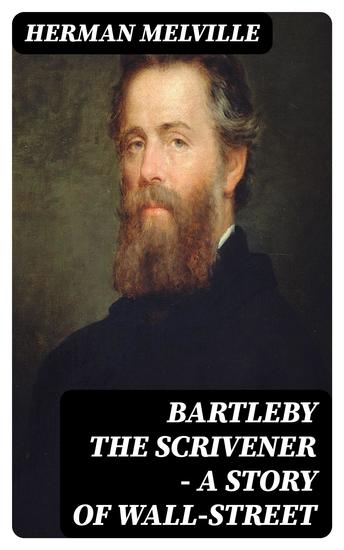
Bartleby the Scrivener — A Story of Wall-Street - cover

Bartleby the Scrivener — A Story of Wall-Street

Herman Melville

Maison d'édition: DigiCat

  • 0
  • 0
  • 0

Synopsis

In "Bartleby the Scrivener: A Story of Wall-Street," Herman Melville crafts a profound narrative that explores themes of isolation, passive resistance, and the dehumanizing effects of modern capitalism. Through the character of Bartleby, a scrivener whose refrain of "I would prefer not to" encapsulates his profound disengagement from societal expectations, Melville employs a minimalist yet poignant style that reflects both the starkness of Wall Street and the complexity of human nature. The story's setting against the backdrop of 19th-century New York serves as a critical commentary on the economic ambitions and moral dissonance of the time, echoing the existential concerns that arise in a rapidly industrializing world. Herman Melville, an author underscored by the struggles with his own identity and societal roles, draws from his experiences and observations in an era marked by economic upheaval. Despite initial obscurity, Melville's later recognition as a key figure in American literature was bolstered by his exploration of complex themes in works like "Moby-Dick" and "Billy Budd." His engagement with the contradictions of human ambition and individualism is evident in Bartleby's enigmatic presence, reflecting Melville's own ambivalence toward capitalism and modernity. "Bartleby the Scrivener" is highly recommended for readers interested in existential literature, economic critique, and the profound implications of passive resistance. This text remains a seminal work in understanding the human condition, raising questions about free will, societal expectations, and the individual's struggle within the mechanisms of commerce. Melville's rich prose and intricate character exploration invite readers to reflect deeply on their own existence and the nature of work in a modern society.
Disponible depuis: 29/05/2022.
Longueur d'impression: 36 pages.

D'autres livres qui pourraient vous intéresser

  • The Adventure of the Second Stain - cover

    The Adventure of the Second Stain

    Arthur Conan Doyle

    • 0
    • 0
    • 0
    The Adventure of the Second Stain, one of the 56 Sherlock Holmes short stories written by Sir Arthur Conan Doyle, is one of 13 stories in the cycle collected as The Return of Sherlock Holmes and the only unrecorded case mentioned passively by Watson to be written. Doyle ranked "The Adventure of the Second Stain" eighth in his list of his twelve favourite Holmes stories.Lord Bellinger, the Prime Minister, and the Right Honourable Trelawney Hope, the Secretary of State for European Affairs, come to Holmes in the matter of a document stolen from Hope's dispatch box, which he kept at home in Whitehall Terrace when not at work. If divulged, this document could bring about very dire consequences for all Europe, even war. They are loath to tell Holmes at first the exact nature of the document's contents, but when Holmes declines to take on their case, they tell him that it was a rather injudicious letter from a foreign potentate. It disappeared from the dispatch box one evening when Hope's wife was out at the theatre for four hours. No-one in the house knew about the document, not even the Secretary's wife. None of the servants could have guessed what was in the box...Famous works of the author Arthur Conan Doyle: A Study in Scarlet, The Sign of the Four, The Adventures of Sherlock Holmes, The Memoirs of Sherlock Holmes, The Hound of the Baskervilles, The Return of Sherlock Holmes, The Valley of Fear, His Last Bow, The Case-Book of Sherlock Holmes, Stories of Sherlock Holmes, The Lost World.
    Voir livre
  • The Adventure of the Norwood Builder - cover

    The Adventure of the Norwood...

    Arthur Conan Doyle

    • 0
    • 0
    • 0
    The Adventure of the Norwood Builder, one of the 56 short Sherlock Holmes stories written by Sir Arthur Conan Doyle, is the second tale from The Return of Sherlock Holmes. The story was first published in The Strand Magazine in 1903 with original illustrations by Sidney Paget.Sherlock Holmes and Dr. Watson are visited by "the unhappy John Hector McFarlane", a young lawyer from Blackheath who has been accused of murdering one of his clients, a builder called Jonas Oldacre. McFarlane explains to Holmes that Oldacre had come to his office only a day earlier and asked him to draw up his will in legal language. McFarlane saw, to his surprise, that Oldacre was making him the sole beneficiary and even heir to a considerable bequest, and McFarlane cannot imagine why Oldacre would do so. That business took McFarlane to Oldacre's house in Lower Norwood, where some documents had to be examined for legal purposes. They had been kept in the safe, where the murder allegedly took place. McFarlane left quite late and stayed at a local inn. He claims to have read about the murder in the newspaper the next morning on the train. The paper said quite clearly that the police were looking for him.The evidence against the young McFarlane is quite damning. His stick has been found in Oldacre's room, and a fire was extinguished just outside in which a pile of dry timber burnt to ashes, complete with the smell of burnt flesh...Famous works of the author Arthur Conan Doyle: A Study in Scarlet, The Sign of the Four, The Adventures of Sherlock Holmes, The Memoirs of Sherlock Holmes, The Hound of the Baskervilles, The Return of Sherlock Holmes, The Valley of Fear, His Last Bow, The Case-Book of Sherlock Holmes, Stories of Sherlock Holmes, The Lost World.
    Voir livre
  • Vision of Hell The - The Divine Comedy 1 (Unabridged) - cover

    Vision of Hell The - The Divine...

    Dante Alighieri

    • 0
    • 0
    • 0
    Dante's Inferno by Dante Alighieri. The first part of Dante's Divine Comedy , the "Inferno" (or "Hell") begins on the night before Good Friday in the year 1300, "halfway along our life's path". Dante is thirty-five years old, half of the biblical life expectancy of 70, lost in a dark wood, assailed by beasts he cannot evade, and unable to find the straight way to salvation. Conscious that he is ruining himself and that he is falling into a deep place where the sun is silent, Dante is at last rescued by Virgil, and the two of them begin their journey to the underworld. Each sin's punishment in Inferno is a contrapasso, a symbolic instance of poetic justice.
    Voir livre
  • Thing in the Moonlight The (Unabridged) - cover

    Thing in the Moonlight The...

    H. P. Lovecraft

    • 0
    • 0
    • 0
    "The Thing in the Moonlight" is a short story by J. Chapman Miske. The story is based on a letter dated November 24, 1927 from H. P. Lovecraft to Donald Wandrei describing one of Lovecraft's dreams. The story was prepared for publication by Miske, who filled in the story surrounding the description of the dream. In places, the letter and published story are identical to Lovecraft's style. It was first published in Bizarre magazine on January 1941.
    Voir livre
  • Morphine - This story is perhaps the greatest depiction and description in literature of the human psyche going through addiction - cover

    Morphine - This story is perhaps...

    Mikhail Bulgakov

    • 0
    • 0
    • 0
    Mikhail Bulgakov was born on 15th May 1891 in Kiev, in the Kiev Governorate of the Russian Empire, into a Russian family.  He was one of seven children. 
     
    In 1901, Bulgakov attended the First Kiev Gymnasium, and developed a keen interest in Russian and European literature, theatre and opera.  After the death of his father in 1907, his mother assumed responsibility for his education.  After graduating Bulgakov entered the Medical Faculty of Kiev University and then took up a post as physician at the Kiev Military Hospital. 
     
    At the outbreak of the First World War, he volunteered as a doctor and was sent directly to the front, where he was badly injured at least twice.  To suppress chronic pain, especially in the abdomen, he injected morphine.  It took years to wean himself off. 
     
    He now took up medical posts in various towns and in 1919, he was mobilised by the Ukrainian People's Army and assigned to the Northern Caucasus.  There, he became seriously ill with typhus and barely survived.  
     
    After this illness, Bulgakov abandoned his medicine to pursue writing.  He moved to Vladikavkaz and had two plays staged there with great success.  He wrote too for various newspapers and other outlets, but his critics were many.  And growing. 
     
    When a Moscow's theatre director severely criticised Bulgakov, Stalin personally protected him, saying that a writer of Bulgakov's quality was above ‘party words’ like ‘left’ and ‘right’.   Indeed, it is said that Stalin watched ‘The Days of the Turbins’ at least 15 times. 
     
    It was not to last and by March 1929, Bulgakov's career was ruined when Government censorship stopped publication of any of his work and plays. 
     
    In despair, Bulgakov wrote a personal letter to Stalin.  He requested permission to emigrate.  He received a phone call from the Soviet leader, who asked the writer whether he really desired to leave. He replied that a Russian writer cannot live outside of his homeland.  Stalin thus gave him permission to continue working. In May 1930, he re-joined the theater, as stage director's assistant.  
     
    During the last stressful decade of his life, and in poor health, Bulgakov continued to work on ‘The Master and Margarita’, wrote plays, critical works, stories, and continued translations and dramatisations of novels.  Many of them were not published, others were derided by critics.  
     
    On 10th March 1940, Mikhail Afanasyevich Bulgakov died from nephrosclerosis.  He was 48. 
     
    ‘The Master and Margarita’ was not published in any form until the mid-1960’s 
     
    In this story Bulgakov relates the terrifying and hellish descent into addiction that seems so avoidable and yet so chillingly not.
    Voir livre
  • Some Lessons of the Hour (Unabridged) - cover

    Some Lessons of the Hour...

    Booker T. Washington

    • 0
    • 0
    • 0
    Booker Taliaferro Washington (April 5, 1856 - November 14, 1915) was an American educator, author, orator, and adviser to several presidents of the United States. Between 1890 and 1915, Washington was the dominant leader in the African American community and of the contemporary black elite. Washington was from the last generation of black American leaders born into slavery and became the leading voice of the former slaves and their descendants. They were newly oppressed in the South by disenfranchisement and the Jim Crow discriminatory laws enacted in the post-Reconstruction Southern states in the late 19th and early 20th centuries.
    SOME LESSONS OF THE HOUR: This evening I am going to remind you of a few things which you should get out of the school year, but it will be of very little use for me to do this unless you make up your minds to do two things.
    Voir livre