Begleiten Sie uns auf eine literarische Weltreise!
Buch zum Bücherregal hinzufügen
Grey
Einen neuen Kommentar schreiben Default profile 50px
Grey
Jetzt das ganze Buch im Abo oder die ersten Seiten gratis lesen!
All characters reduced
A Beginner's History of Philosophy (Vol 1&2) - cover

A Beginner's History of Philosophy (Vol 1&2)

Herbert Ernest Cushman

Verlag: DigiCat

  • 0
  • 0
  • 0

Beschreibung

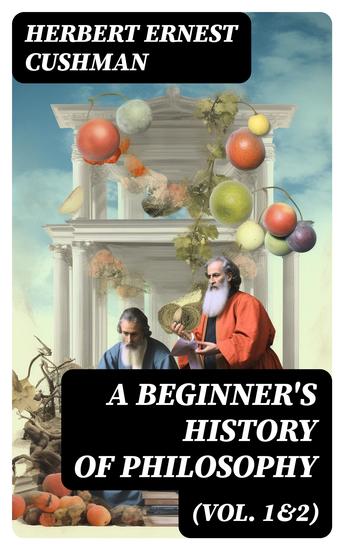
Herbert Ernest Cushman's "A Beginner's History of Philosophy (Vol. 1&2)" offers a comprehensive and accessible exploration of philosophical thought from antiquity to modern times. Cushman's pedagogical style is characterized by clarity and conciseness, making complex ideas digestible for novices. The work is organized chronologically, allowing readers to engage with the evolution of philosophical concepts whilst situating them within their historical contexts. This dual volume serves not only as a primer for those new to philosophy but also as a reference for seasoned scholars seeking to revisit foundational ideas presented in a straightforward manner. Cushman, an esteemed educator and philosopher, dedicated much of his career to the dissemination of philosophical knowledge. His teaching experience and passion for philosophy informed his approach in writing these volumes, aiming to inspire a love for philosophical inquiry among students and lay readers alike. His background reflects an era that sought to make philosophy more democratized and accessible, countering prevailing notions that such discourse was reserved solely for the elite. This book is highly recommended for anyone seeking to understand the trajectory of philosophical thought, regardless of prior knowledge. Cushman's engaging narrative not only fosters intellectual curiosity but also encourages readers to reflect critically on the ideas that have shaped human understanding throughout history.
Verfügbar seit: 23.11.2023.
Drucklänge: 546 Seiten.

Weitere Bücher, die Sie mögen werden

  • Taking Up the Runes - A Complete Guide to Using Runes in Spells Rituals Divination and Magic - cover

    Taking Up the Runes - A Complete...

    Diana L. Paxson

    • 0
    • 0
    • 0
    An accessible, in-depth exploration of the runes as a living spiritual tradition. Diana Paxson has distilled her many years of experience working with the runes into this essential source book. Readers will learn the historical meaning of each individual rune and its use and meaning now, in contemporary culture. But, Paxson reveals, the real power of the runes comes from internalizing them and using their symbols as sources of wisdom and power. At the end of each chapter are rituals and spells for all levels of ability that aim to help internalize the attributions, meanings, symbolism, and use of the runes. Everything regarding runes is covered in this definitive workbook, from the history of runes and how to make your own rune sets, to how to work with them on a psychic, spiritual, and magical level.
    Zum Buch
  • The Collapse of the Soviet Union - How the Superpower Disintegrated and the New World Order Emerged - cover

    The Collapse of the Soviet Union...

    Fredrich Hazelton

    • 0
    • 0
    • 0
    The Soviet Union, once the most powerful socialist state on the planet, dominated global politics and economics for much of the 20th century. From its establishment in 1922 until its disintegration in 1991, the USSR stood as a superpower, rivaling the United States in military strength, technological innovation, and ideological influence. The Soviet Union was not just a political entity; it was the manifestation of a grand vision of socialist governance that sought to reshape the world. Its rise to power was marked by revolution, war, and the forging of a unique socio-economic structure that stood in stark contrast to the capitalist world. 
      
    However, by the late 1980s, the Soviet Union faced insurmountable challenges. The centralized economy, which had initially driven industrial growth, was beginning to falter under the weight of inefficiency and stagnation. The military and political dominance the USSR had long enjoyed began to erode, and the ideological tenets that had once inspired its citizens no longer resonated with the younger generation. The political leadership, while still powerful, was marked by infighting, and the population grew disillusioned with the government’s inability to reform. Amid this turmoil, Mikhail Gorbachev ascended to the position of General Secretary of the Communist Party of the Soviet Union in 1985. Gorbachev’s policies of perestroika (restructuring) and glasnost (openness) sought to address the growing dissatisfaction and revive the Soviet state, but they inadvertently exposed the deep-rooted problems that had been festering for decades. 
      
    The decision to allow greater political freedom and economic flexibility unintentionally sparked a wave of unrest throughout the Soviet republics. Nationalist movements, long suppressed, began to rise, and demands for greater autonomy became louder...
    Zum Buch
  • The New Leviathans - Thoughts After Liberalism - cover

    The New Leviathans - Thoughts...

    John Gray

    • 0
    • 0
    • 0
    Ever since its publication in 1651, Thomas Hobbes's Leviathan has unsettled and challenged how we understand the world. Condemned and vilified by each new generation, his cold political vision continues to see through any number of human political and ethical vanities. 


    In his wonderfully stimulating book The New Leviathans, John Gray allows us to understand the world of the 2020s with all its contradictions, moral horrors, and disappointments. The collapse of the USSR ushered in an era of near apoplectic triumphalism in the West: a genuine belief that a rational, liberal, well-managed future now awaited humankind and that tyranny, nationalism, and unreason lay in the past. Since then, so many terrible events have occurred and so many poisonous ideas have flourished, and yet our liberal certainties treat them as aberrations that will somehow dissolve. Hobbes would not be so confident. 


    Filled with fascinating and challenging observations, The New Leviathans is a powerful meditation on historical and current folly. As a species we always seem to be struggling to face the reality of base and delusive human instincts. Might a more self-aware, realistic, and disabused ethics help us?
    Zum Buch
  • Transdisciplinary Impulses towards Socio-Ecological Transformation - Engaged Reflections – Reflected Engagements - cover

    Transdisciplinary Impulses...

    Helge Kminek, Anna Geyer, Markus...

    • 0
    • 0
    • 0
    Bildung für nachhaltige Entwicklung soll die Menschen zu zukunftsfähigem Denken und Handeln befähigen – angesichts von Herausforderungen wie Klimawandel, Umweltzerstörung, Verlust der biologischen Vielfalt, Armut und Ungleichheit. Wie können unterschiedliche Disziplinen diese Aufgabe wahrnehmen? In diesem Band werden wissenschaftlich interdisziplinäre Beiträge aus der Philosophie, den Sozial- und Erziehungswissenschaften um transdisziplinäre Beiträge aus Praxisfeldern (z. B Museumspädagogik, Journalismus) ergänzt. Die aktuellen Beiträge geben Reflexionsanstöße und eröffnen Denkräume, um der Komplexität der Aufgabe der sozial-ökologischen Transformation gerecht zu werden.
    Zum Buch
  • LSAT Tactics: Boost Your Score with Winning Strategies! - "Master the LSAT! Access captivating audio lessons designed to skyrocket your score with winning strategies!" - cover

    LSAT Tactics: Boost Your Score...

    Jasper Langford

    • 0
    • 0
    • 0
    LSAT Tactics: Boost Your Score with Winning Strategies! 
    ⭐⭐ Simplified Audio Guide with Explanations ⭐⭐ 
    Are you eager to advance your career and solidify your knowledge by conquering the LSAT?  
    Looking for a thorough guide that encompasses everything you need to excel on the LSAT? 
    Your search ends here! 
    This audiobook is your ultimate resource for enhancing your understanding, honing your skills, and participating in practical exercises. With this guidance, you're on the path to success. 
    Now updated for the LSAT Format! 
    Key features of this enhanced guide include: 
    - In-depth insights into the LSAT certification process 
    - Comprehensive explanations of LSAT fundamentals 
    - Effective strategies for test preparation and question tackling 
    Our guide stands out through its thorough coverage, which is crucial for your exam triumph. Topics aren’t merely glanced over; they are explored with detail and precision. 
    Please note that this guide operates independently and is not affiliated with any official LSAT organization. 
    Crafted with a systematic approach and accessible language, our LSAT Exam Guide ensures seamless transitions between topics. Say farewell to complex jargon and embrace clear, concise, and technically sound content. 
    So, why delay? Click the BUY NOW button, secure your guide, and embark on your journey to LSAT success!
    Zum Buch
  • Ludwig Wittgenstein - Language Logic and the Limits of Philosophy - cover

    Ludwig Wittgenstein - Language...

    Hector Davidson

    • 0
    • 0
    • 0
    Ludwig Wittgenstein, one of the most influential philosophers of the 20th century, profoundly shaped modern thought, particularly in the realms of language, logic, and the philosophy of mind. His philosophy spans two distinct periods, marked by an evolution in his views on the relationship between language, meaning, and reality. Wittgenstein’s work challenges the way we think about and use language, positing that philosophical problems often arise from misunderstandings of language and its limitations. 
    Wittgenstein’s early philosophy, as presented in his landmark work Tractatus Logico-Philosophicus, was grounded in the belief that language could mirror the structure of reality. According to his "picture theory of meaning," words and sentences are pictures that represent facts in the world. He argued that the limits of language are also the limits of the world, and anything that could not be meaningfully expressed through language was simply beyond the scope of philosophy. This view led him to conclude that many traditional philosophical problems were nonsensical, arising from a misuse of language. 
    However, Wittgenstein underwent a significant philosophical transformation after his work on the Tractatus, largely due to his dissatisfaction with the results of his early approach. By the time of his later work, particularly in Philosophical Investigations, Wittgenstein had rejected the picture theory of meaning and developed the concept of "language games." He argued that meaning is not inherent in words themselves but is derived from their use in various social contexts. Language, for Wittgenstein, is a tool embedded in human practices and activities. He claimed that understanding language requires understanding the ways it functions in specific contexts, challenging the idea of a fixed, underlying structure of meaning.
    Zum Buch